Los Angeles is set to go on an affordable housing spending spree.
On Tuesday, the City Council unanimously approved $466.6 million in funding that will be doled out to developers, nonprofits, land trusts and other organizations to build and renovate affordable housing.
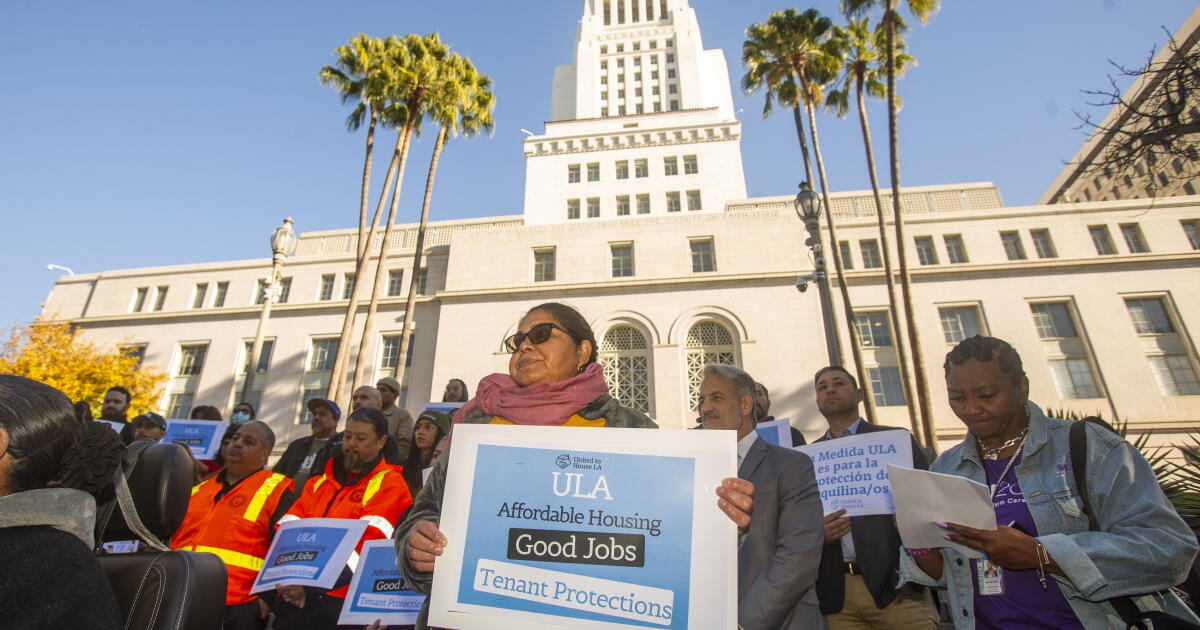
The pool of money is the largest in the city housing department’s history, topping last year’s $387 million. Roughly 70% of the record budget will come from Measure ULA, the so-called mansion tax, which levies a 4% or 5.5% tax on L.A. property sales above $5.4 million.
Accountability was top of mind during Tuesday’s City Council meeting. The spending plan, which now awaits Mayor Karen Bass’ approval, includes an amendment requiring the housing department to provide quarterly updates on where the money is going, as well as project timelines and any significant delays or challenges.
“We need to follow these dollars and make sure they’re producing the affordable housing Angelenos deserve,” Councilmember Imelda Padilla said at the meeting.
The funding should be a boon for L.A. developers, many of whom have stopped building multi-family projects because it’s hard to turn a profit — and many of whom blame Measure ULA for disincentivizing construction and decreasing the average sale price of multi-family units, which has dropped roughly 30% in L.A. County over the last five years.
Applications for the funds open Oct. 13 and close Dec. 4. The housing department will announce the recipients in February.
Last year, the city awarded $360.9 million to 80 projects that promise the construction of 1,288 new affordable units and the preservation of 3,713 units, mostly clustered around downtown L.A., South L.A. and Koreatown, with several others in San Pedro and the San Fernando Valley.
Not all the money from last year was allocated; roughly $30 million is being rolled over into the new funding round.
Of this year’s pool, $123 million will go toward multi-family affordable housing with 40 or more units, and $115 million will go toward projects seeking low-income housing tax credits.
There’s also $104 million for alternative models of new construction, $38 million for stabilizing existing affordable housing, $32 million for acquiring and rehabbing affordable units, $27 million for preserving existing units and $25 million for preserving units facing financial challenges.
“LAHD is very excited about the opportunities …t o produce more affordable housing and stabilize the city’s housing stock,” said Tiena Johnson Hall, the housing department’s general manager. “This is a unique opportunity and will create real and sustainable change in the affordable housing landscape.”
Councilmember Ysabel Jurado, who is chair of the newly created Homelessness and Health Committee, said the money will help working families, senior citizens and people with disabilities stay in the neighborhoods they call home. She credited Measure ULA for “turning the will of Los Angeles voters into concrete solutions that build and preserve affordable housing.”
Measure ULA has raised more than $1.3 billion since it took effect in 2023 and has been the primary driver of the last two funding rounds, which before the tax had typically ranged between $50 million and $75 million.
Until recently, city leaders were hesitant to commit Measure ULA funds over concerns that the tax could be overturned in court.
But as legal challenges faded, the city announced ULA spending plans of $425 million last year and $544 million this year. Whereas the plan approved by the council Tuesday grants funding to third parties, the $425-million and $544-million plans are for the city government to spend on affordable housing and homelessness initiatives.