Unlock the Editor’s Digest for free
Roula Khalaf, Editor of the FT, selects her favourite stories in this weekly newsletter.
Xi Jinping and Donald Trump have much to beef about when they meet in Washington this week. One topic on which the leaders of the world’s biggest superpowers should be somewhat relaxed is the growth of Chinese biotech.
Drugmakers from around the world are picking through China’s biotech sector to find treatments and technologies they can bring to overseas markets. So far this year, companies have signed licensing deals worth $110bn, if all milestones are met, according to biopharma data gatherer Sleuth. That is roughly a $20bn increase on last year.
These deals grant licensees various rights, such as to manufacture and sell a given drug or technology in specified regions. Leading the pack, AstraZeneca has clinched $45bn worth of deals since 2021, in licensing as well as research and development, and has earmarked another $15bn to invest in the country through 2030.
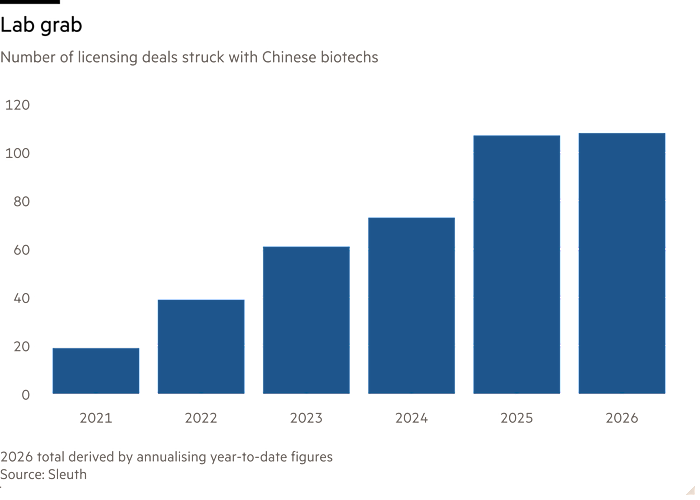
There’s an obvious commercial logic to this. Medicines may be hatched in Chinese labs but the illnesses they treat, including cancer and autoimmune diseases, are global. Advances into growth areas are warp speed. Look at immunology and inflammation, which went from virtually nowhere in 2023 to a fifth of deals two years later, according to BioCentury, another biopharma intelligence and data provider.
Trump tends to take a hawkish view of capital flowing away from the US. He signed the Biosecurity Act into law at the end of last year, aiming to curb dealmaking with China’s biotech sector. Three similar pieces of legislation are wending their way through the system. WuXi AppTec was blacklisted for alleged military ties — a decision subsequently blocked by a US federal judge.
But trying to squash Chinese biotech is both impractical and unwise. For one, the industry is fairly self-sufficient; unlike tech, say, Washington cannot opt to withhold component parts such as chips. China has the entire chain sewn up, from brainpower and raw materials to speedy clinical trials — trial recruitment is up to five times quicker than in the West, says McKinsey — and manufacturing.
Capital, too, is in ample supply. Chinese companies can tap local and, via Hong Kong, international markets. There is likely to be state support too. Beijing, which last week released its five-year plan for the pharma industry, wants China to develop at least a quarter of the world’s first-in-class drugs.
One reason even trade-sceptical Americans should welcome the biotech trend is that they don’t have easy options if the flow of drugs is impeded. Cars, smartphones and Labubu dolls — or reasonable substitute products — can all be sourced at home. It is an altogether different proposition to withhold access to world-class treatments.
AI remains an area of enormous tension between superpowers because in the race to superintelligence, it may be that there can only be one winner. In drugmaking, though, there can be many. If Chinese labs are coming up with innovative treatments and technologies, the rest of the world should cheer them on — and leave their protectionist tendencies for other sectors.