The Trump administration’s attacks on Canada have sparked a backlash among former US national security officials and Republicans, including claims Washington is “embarrassing” the US and demeaning a long-term ally.
Donald Trump and lieutenants have repeatedly aimed barbs at Canada’s military and sovereignty in recent months — but the broadsides escalated after trade talks between the countries collapsed on Friday, exposing cracks in the president’s own movement just months ahead of the midterm elections.
Trump on Tuesday said that he wanted to rename Lake Ontario “Lake America”, because “we don’t expect to [be] doing much business with Ontario any longer”. The comment came a day after Ontario’s premier Doug Ford called Trump “a loser”.
US vice-president JD Vance piled on the insults during a speech on Monday in Maine, which borders Canada — described as a “state” by Vance in an attempted joke — and has a blockbuster toss-up race for a US Senate seat.
“Canada is a country that has underinvested in its military that quite literally would get invaded by a foreign country were it not for the umbrella of protection provided by” the US, Vance told the crowd.
Vance’s claims about Canada’s defence echoed comments by US transportation secretary Sean Duffy, who told Fox News that Canada was “a country that doesn’t have a military”.
Former US military leaders reacted badly. Canadian troops have fought alongside the US in several American military conflicts.
“Mr secretary, please stop embarrassing us,” said Ben Hodges, the former commanding general of the US Army in Europe, referring to Duffy. “I served in Kandahar, Afghanistan in 2009-2010 alongside Canadian soldiers. They were skilled, courageous and effective. We were lucky to be on the same side with them.”
Nato-member Canada is among the US’s closest military partners, with the two sharing the North American Aerospace Defense Command (Norad), a mutual defence organisation. Canada deployed about 40,000 troops to Afghanistan over 12 years, suffering 158 deaths.
Karen Gibson, the former intelligence director at US Central Command, praised Canadian forces for their work alongside Americans in Afghanistan, Iraq and Kuwait. “We were stronger for their presence,” she told the FT, adding that the Norad partnership was “vital”.
One retired admiral, who served alongside Canadian special forces, told the FT that Canada’s “professional, competent forces” had added “much-needed capacity” to US war efforts including in Afghanistan.
“Fact: Canada has a brave and professional military. It has deployed into combat with us many times, including D-Day. Canadian troops, under my Nato command, faced intense fire in Afghanistan where many were killed in action. I honor their memory and salute them,” wrote James Stavridis, a retired US admiral.
Washington slapped new tariffs on $20bn worth of Canadian goods on Saturday hours after negotiations collapsed in acrimony. On Monday, Trump said he would increase levies on Canadian cars and automotive parts to 50 per cent. Canada was set to announce its retaliatory measures later on Tuesday.
The war of words has intensified as the US has escalated its trade conflict.
Vance rekindled the White House’s position that Canada should become the US’s 51st state during his speech in Maine.
“We have to remember Canada is a state. Sorry, Freudian slip,” Vance said. “That was actually an accident,” he contended.
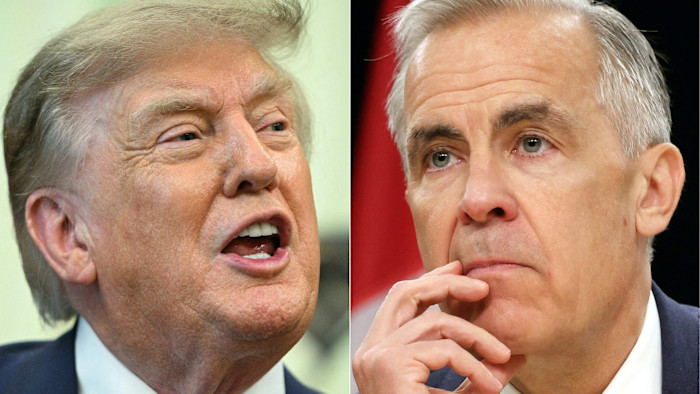
On Monday Trump called Canadian Prime Minister Mark Carney “Governor” in a social media post — an insult he also used to denigrate Carney’s predecessor Justin Trudeau.
Doug Ford, the pugnacious premier of Ontario — home to Canada’s auto-manufacturing hub, which has for decades been closely integrated with American supply chains — told Trump to “kiss my ass”.
Republicans fighting for re-election in battleground states that could suffer from Trump’s imposition of new border taxes on consumer goods have also balked at the president’s latest trade war.
Susan Collins, a Republican US senator trying to hold her seat in Maine, warned that Trump’s new levies would bring economic pain to Americans.
“I still think imposing new tariffs on Canada is a mistake” because they will increase costs for Mainers, Collins told reporters on Monday.
“We produce a lot in Maine — our blueberries, our potatoes, our lobster, our lumber — that is processed across the border. If it comes back with a huge tariff on it . . . that increases the cost of eating, building homes, and our best known products”, she added.
Collins did not attend Vance’s speech.
Scott Brown, a Republican vying for a US Senate seat in New Hampshire, which also borders Canada, told Semafor on Monday that “there’s gotta be a better way to negotiate or negotiate an agreement with our neighbor”.