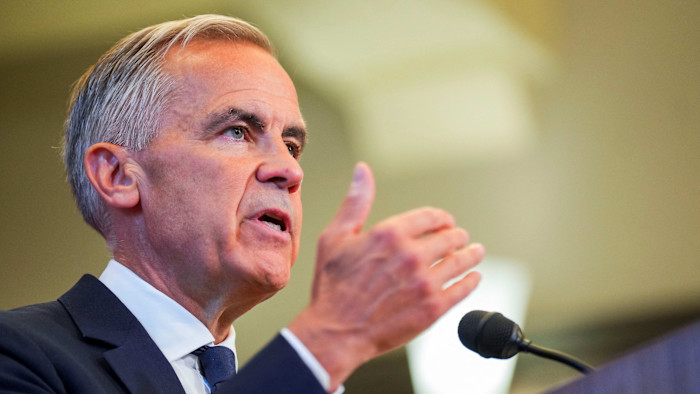
Canada was “at war” over trade with the US after President Donald Trump “miscalculated” by escalating his tariff attack, Prime Minister Mark Carney said.
Carney delivered a defiant address to the nation on Saturday after suspending trade talks with the US overnight, saying the Trump administration had demanded a “bad deal”.
The collapse of talks ushers in a new wave of tariffs on $20bn-worth of Canadian exports on top of existing levies on steel, aluminium, lumber and vehicles.
“You’re at war when you’re attacked, and we got attacked,” Carney told reporters in Ottawa.
Trump underestimated Canada’s resolve to stomach economic hardship in a “miscalculation” that escalated the trade war, he said.
“We cannot accept what they’ve offered and we will not give what they’ve asked,” he added.
Carney said last-minute changes proposed by the US were unacceptable. Ottawa had made no new demands and was “continually disappointed” by US answers to the issues Canadian officials raised as a midnight deadline loomed, he added.
Trump posted on his social network, Truth Social, overnight: “Canada wants the benefits of being a State, without being one!!! They have also charged our great farmers, for many years, massive amounts of Tariffs. No more!!!”
US trade representative Jamieson Greer said Washington would respond to Ottawa’s retaliation.
Carney said Ottawa was willing to lift retaliatory tariffs on strategic sectors, particularly steel and aluminium, if the US “substantially lowered” theirs on Canadian companies. “In exchange for a fair deal, we would encourage our provinces to return US alcohol to the shelves,” he said.
But despite “progress made towards a possible agreement” this week, the US suddenly changed its position, he said. “They asked too much and they offered too little,” he said. “It’s a power play.”
Carney listed numerous concessions Canada made to satisfy the evolving list of US complaints, from issues concerning the fentanyl drug trade to anti-tariff advertisements that had attracted the US president’s ire.
Canada had acted “in good faith to try to find compromise and secure a comprehensive deal in the best interests of both Canadians and Americans”, he said.
Carney said there was “no rationale” for new US demands on the auto industry, adding that they “would make production more uneconomic over time”.
At the eleventh hour, the US also introduced measures to restrict Canada’s ability to seal trade deals with other nations, he said. The US was seeking “exclusive access” to Canada’s critical minerals, which was a new red line, Carney said.
The US had also raised new concerns over perceived trade barriers due to language provisions in French-speaking Quebec, he said.
Carney suggested that tensions among US negotiators fuelled the talks’ breakdown. While Greer led Washington’s side of negotiations, car, aluminium and steel levies also brought the talks under commerce secretary Howard Lutnick’s purview.
Canadian and US media reported that Lutnick was unhappy with the terms of the proposed deal and that it was his last-minute intervention that prompted Carney to withdraw his negotiators.
The Canadian prime minister said his trade team was united in its message and objectives but “you could not say that about the US”.
When asked by reporters if Lutnick was responsible for talks collapsing, Carney said: “It’s a question for the US administration.”
A US official denied there was any tension between Greer and Lutnick.
“This is deflection from [their] repeated eleventh-hour demands” related to cars, aluminium and steel tariffs, the official said. There is “no daylight between Lutnick and Greer” and that “it’s not like Lutnick had infinite discretion to throw this off or not”.
US officials disputed claims from Canada that late demands from Washington had included restrictions on Canada’s ability to make other trade deals. They said it was Canada that had issued last-minute demands before walking away, without specifying these new claims.
“No idea what he’s talking about,” the US official said of Carney. “It was Canada that repeatedly made last-minute demands beyond the scope of what had been agreed upon.” The official did not specify what demands Ottawa had made.
“There were no ‘eleventh hour’ measures that the US introduced,” said a second US official.
“It was a bad deal,” said Ontario premier Doug Ford on Saturday. “Donald Trump is trying to inflict pain on every Canadian. We will inflict pain right back.”
Canada has sought relief on 50 per cent tariffs on its steel and aluminium sector and 25 per cent on vehicles as well as tariffs and anti-dumping levies on lumber, which over the past 18 months have forced factory closures and job losses.
Carney said Canada would match the fresh US tariffs “dollar for dollar”.
Dan Kelly, president of the Canadian Federation of Independent Business, said: “A full 40 per cent of small Canadian exporters will be directly hit by these tariffs and nearly one-third expect their revenues will drop by 50 per cent or more as a result.”
Subrata Bhattacharjee, a regulatory and public policy lawyer at Borden Ladner Gervais in Toronto, said it was “disappointing”. There will be “acute pain” — especially in Ontario and Quebec, he said.
“Ottawa was no doubt also measuring strong public sentiment against a deal at all costs and the PM’s messaging clearly reflects this,” he said.