Unlock the Editor’s Digest for free
Roula Khalaf, Editor of the FT, selects her favourite stories in this weekly newsletter.
Good morning. Kevin Warsh has come in for a fair amount of stick recently over his policy for Fed communication, which is to not communicate. Warsh is not just against talking about what the Fed might do next — so-called forward guidance. Money managers complain that his current guidance is mighty sparse, too — a concern that is appearing in markets as weakness in long-term Treasuries. A fascinating piece by the FT’s Claire Jones and Kate Duguid reports that people close to Warsh said he was committed to his quiet approach. But at the same time, the story notes that
Warsh would be prepared to raise interest rates at September’s meeting if inflation readings released in coming weeks are hot, and markets ratchet up their expectations for increases in borrowing costs, the people familiar with his thinking said.
The immediate response from the media, social and otherwise, was that this sounds an awful lot like, er, forward guidance. Two-year Treasury yields ticked up a few basis points after the story was published. Let us know what you think: [email protected].
Gathering momentum
Excess, exuberance and super-dense concentration all played a part in the pockets of stress that erupted in stocks last month. But the other big (and related) force was an implosion in leverage across the big asset classes. With that out of the way, momentum could well reassert itself.
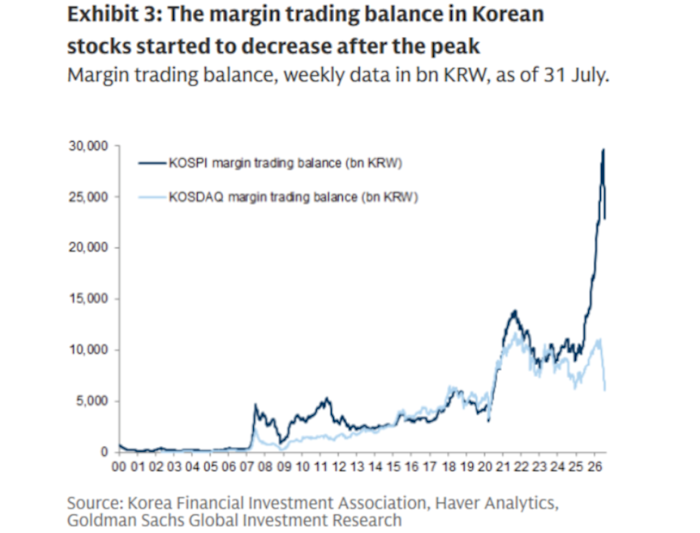
The most elaborate expression of excessive borrowed money underpinning stock market gains was, of course, in South Korea, where extreme market volatility has now morphed into a political issue, as this excellent piece from our colleagues in Seoul explains. Korean margin trading has clearly hit an air pocket, as this chart from Goldman Sachs illustrates:

But as Rob wrote back in June, this is not just a K-Leverage thing. In Japan, margin-financed stock purchases had hit the highest point since 1990, and assets parked in a whole bunch of leveraged tech ETFs globally have also surged, and then plunged. Goldman again:

It is also not just the retail crowd that had been punting around with borrowed money. As the Situational Awareness farrago demonstrated, hedge funds have also been loading up. Our friends at Absolute Strategy Research pointed out in a note this week that large hedge fund leverage was running at eye-watering levels heading into the summer, “making a chaotic unwind of non-bank leverage the critical market risk”.

That means we should not imagine that Situational Awareness was alone. (An opportunity, perhaps, for Big Ken Griffin, who, it must be said, has played this situation exquisitely well.)
As ASR points out, the hyperscalers and hedgie leverage are pretty much one and the same trade:

This all feels pretty intuitive, but ASR also argues the same phenomenon is playing a role in the rough patch for US Treasuries. The bulk of the blame here lies with sticky inflation and confusion over Warsh’s “say less” strategy. But it adds that on the margins, a pullback in the Treasuries basis trade — using borrowed money to exploit tiny gaps between Treasuries and futures — may also be at play:
The UST Basis Trade has been a key funding tool for Hedge Funds to increase their leverage, and has helped boost liquidity in markets. But since early January these Basis Trades have been cut by almost $300bn. As yields have risen, Asset Managers have reduced their exposure to bonds.
Two possible paths present themselves here. One is that we are soon going to be treated to a thousand Leopold Aschenbrenners. His beautifully misnamed Situational Awareness may be a biggie, but perhaps it’s just the start of a broader deleveraging. Or maybe it all means the market is now cleaner and momentum (momo to its friends) is ready to reaccelerate. That’s the gist of what Manish Kabra and colleagues at SocGen are saying:
Global equities remain in an uptrend, and we see further upside in the S&P 500. Korean equities, following the deleveraging and Momentum washout, are pricing in the deepest EPS stress globally.
So, momo → oh no → FOMO?
It’s early days, but new record highs in the S&P 500 and at least a stabilisation in Korean stocks do suggest the winds are blowing that way. Maybe they will end the rather tedious slumber in the big US stock indices that has quietly been in play for months.
One good read
FT Unhedged podcast

Can’t get enough of Unhedged? Keep following Rob Armstrong and Katie Martin’s incisive and unfiltered analysis on the Unhedged podcast, a twice-weekly, 15-minute lively dive into the latest markets news and financial headlines. New episodes every Tuesday and Thursday.