This article is an on-site version of our FirstFT newsletter. Subscribers can sign up to our Asia, Europe/Africa or Americas edition to get the newsletter delivered every weekday morning. Explore all of our newsletters here
Good morning and welcome to FirstFT. In today’s newsletter:
-
The Kremlin-backed A7 moved $6.9bn through the global banking system
-
Why the $2tn yen carry trade is at risk of unwinding
-
Shortages loom of the wildly popular ube yam
-
Should you spend $500 on a toothbrush?
Standard Chartered, Citigroup and other international banks have handled billions of dollars from a Kremlin-backed fintech company that tricked its way into the global financial system with a vast forgery operation.
Hundreds of thousands of files obtained by the FT from inside A7, a group set up as an alternative to the western payments system, reveal how it used old-fashioned money laundering to funnel more than $6.9bn through the international banking system despite sanctions on Russia.
Some payments in the leak related to extremely sensitive war-related goods, including military equipment and purchases by Russia’s security services.
Accounts held at Standard Chartered in Hong Kong alone received $1.1bn from A7-linked entities between late 2024, when A7 was established, and August 2025. Over the same period, DBS in Hong Kong was sent $273mn and Citi clients received $74mn.
A7 was originally set up in Russia and Kyrgyzstan by Ilan Shor, a Moldovan oligarch, with support from Promsvyazbank (PSB), a state-owned bank with close links to the defence industry. The Kremlin has touted A7 as the country’s flagship provider of cross-border payments for imports since Russian banks were cut off from the Swift system after the full-scale invasion of Ukraine in 2022.
Russian President Vladimir Putin and Narendra Modi, India’s prime minister, this month discussed a “Russian-Indian payment system” with the chair of PSB.
The FT found evidence of 100 A7 front companies making payments during the period covered by the leak. The documents mention at least a further 100 such groups, including at least 61 in the United Arab Emirates, 87 in Hong Kong, 16 in Kyrgyzstan and 14 in Indonesia.
The FT’s Anne-Sylvaine Chassany, Chris Cook and Anastasia Stognei reveal how the forgery scheme worked.
Here’s what else we’re keeping tabs on today:
-
UN General Assembly: US President Donald Trump will be among the world leaders speaking in New York where AI will be one of the topics discussed alongside the wars in Ukraine and the Middle East.
-
Economic data: Figures from Mexico’s national statistics agency are expected to show retail sales rose in July following a decline in June.
Could you be the FT’s next stockpicking champion? The new Stock Picking Game is a fast, fun way to test your trading instincts, sharpen your market expertise and compete for the chance to win £1,000. Terms and conditions apply. Find out more and register to play.
Five more top stories
1. Surging interest in Meta’s new AI tool is fuelling gains in global tech shares today, following yesterday’s sharp rally on Wall Street. But the moves in Europe and Asia were more measured than in the US, where the Nasdaq 100 jumped 2.8 per cent on Monday to end the day close to its record high. The S&P 500 rose 1.5 per cent for its biggest one-day gain since early August. One analyst described yesterday’s market moves in New York as an “everybody back into the pool moment”.
-
More market news: China has spent a record sum importing more than 1,000 tonnes of gold this year as the central bank and local investors pour cash into bullion amid rising geopolitical tensions abroad and poor returns on local assets.
2. Staff at world-leading AI companies and institutions are increasingly suffering from the mental strain of working on systems they fear could cause serious harm to society. A DeepMind employee said that work on making AI safer came with burnout risks as it felt like “an impossible task”. The escalating mental toll on those at the frontier of AI research comes as concerns about the reckless development of AI reach a fever pitch.
3. North Korea said it tested a new hypersonic weapon designed to evade missile defences, as Donald Trump and his South Korean counterpart Lee Jae Myung struggle to revive diplomacy with Kim Jong Un. North Korean state media said the “new weapon” was tested on Sunday.
4. Prediction markets platform Polymarket is launching a lobbying blitz to persuade European and UK regulators that it should be treated as a financial services group instead of a gambling company, opening the door to international growth.
4. Trump briefly returned to the familiar world of New York real estate yesterday, discussing a major new affordable housing development with the city’s mayor Zohran Mamdani. The president described Sunnyside Yard, an ambitious plan for thousands of affordable new homes in Trump’s former home borough of Queens, as “a big job” that will need “a lot of federal approvals”.
Betting on the yen

The $2tn yen carry trade — one of the foundations of global risk-taking for almost three decades — may be approaching a dangerous turning point. Rising Japanese interest rates could prompt investors to unwind huge yen-funded positions in assets ranging from US Treasuries to tech stocks, say analysts, reviving memories of 2024’s market meltdown.
We’re also reading . . .
-
Central bank rates: Monetary policy is not the best response tool for today’s economic and financial challenges, writes Mohamed El-Erian.
-
Donald Trump and Xi Jinping: The world needs far-sighted leadership but the US and Chinese leaders are unlikely to provide it, writes Gideon Rachman. And here’s more on what Xi wants from his summit with Trump.
-
Lloyd’s of London: Blackstone’s latest plans to compete with the insurance syndicate have sparked a firestorm.
-
Shunning effort: The number of students across OECD countries who say they give up easily is increasing, writes Sarah O’Connor. What does it mean to avoid doing what is difficult?
Chart of the day
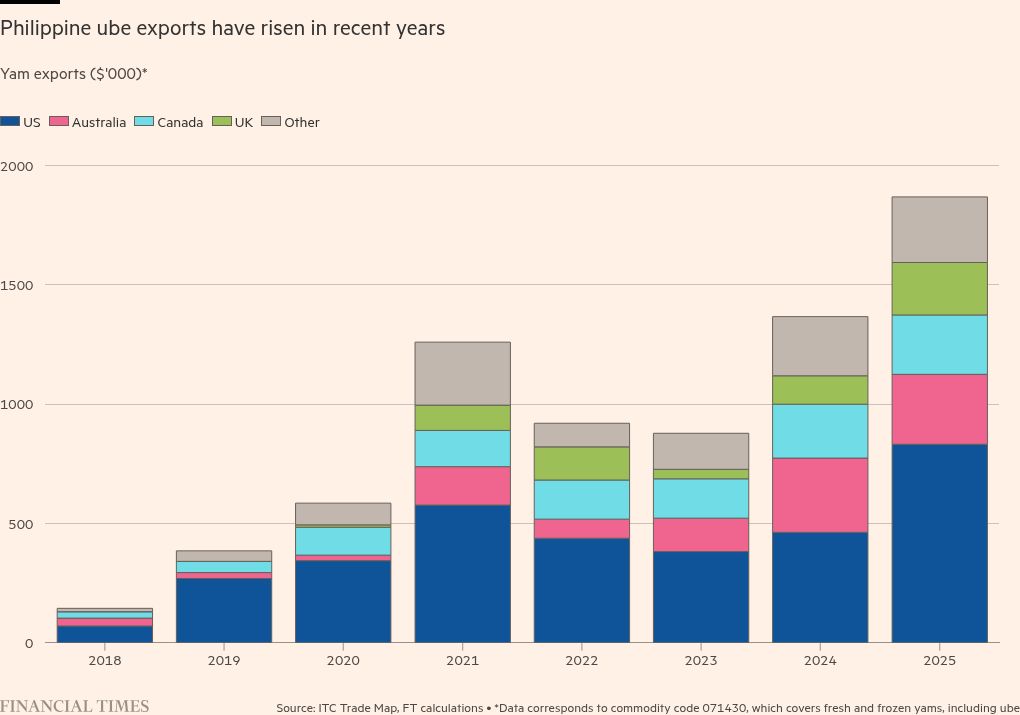
Ube, the vibrant purple-hued yam that has become a staple in global coffee chains and a viral sensation on Instagram and TikTok, might soon be in scarce supply. The Philippines, the world’s largest producer of the root vegetable, has banned exports of fresh ube as it tries to cement control of supplies of the wildly popular tuber.
Take a break from the news . . .
Should you spend more than $500 on a toothbrush? Dentists share their views.

Thank you for reading and remember you can add FirstFT to myFT. You can also elect to receive a FirstFT push notification every morning on the app. Send your recommendations and feedback to [email protected]
Recommended newsletters for you
The State of AI — A series of conversations between the FT and MIT Technology Review on the geopolitics of tech. Sign up here