This is an on-site version of the White House Watch newsletter. You can read the previous edition here. Sign up for free here to get it on Tuesdays and Thursdays. Email us at [email protected]
Welcome to White House Watch. President Donald Trump will shortly deliver an address to the UN General Assembly as world leaders meet in New York against a backdrop of wars in the Middle East and Ukraine. You can follow the latest with the FT’s live blog.
Here’s what else we’re looking at today:
-
Soaring diesel prices spur calls for an export ban
-
Washington and Beijing agree to set up “AI dialogue” mechanism
-
Houthi conflict piles new strain on US-Saudi relations
Diesel prices are at record levels. And with exactly six weeks to go until November’s midterm elections, that is causing ructions in Washington.
A growing number of Republican legislators are demanding that Trump ban diesel exports as farmers and truckers are squeezed by the shortage of fuel that powers the country’s agricultural and industrial heartlands.
Members of Congress from agri-reliant districts have lashed out in recent days as the Russia-Ukraine conflict and the US war with Iran combine to curb global supplies and send prices to unprecedented levels.
According to the AAA, US diesel prices hit $6.53 on Tuesday, up more than 70 per cent since the US and Israel first struck Iran in February.
Iowa senator Chuck Grassley has led the calls for the administration to intervene, saying on social media that high diesel prices were “KILLING FARMERS INCOME”.
“Why doesn’t Pres Trump put an embargo on diesel exports like presidents in the 70s put embargoes on ag products [because] food prices were inflated,” he wrote on X over the weekend.
Iowa congresswoman Ashley Hinson echoed Grassley’s call, urging the use of “every option at our disposal to provide some relief from high prices”, including “pausing diesel exports . . . and creating a diesel relief programme to help our farmers and truckers being crushed by the high costs”.
Other Iowa representatives have also demanded similar measures. Mariannette Miller-Meeks called on the administration to pause exports to “stop the bleeding”. Congressman Zach Nunn said the US should “sell American energy to Americans first”.
An export ban would send shockwaves through European countries, which rely heavily on imports of American petroleum products and are already facing protests on the back of sky-high prices ripping across the continent.
But a White House official insisted an export ban was not on the table “at this time”.
Instead, Trump pressed his Ukrainian counterpart Volodymyr Zelenskyy on Sunday to halt strikes on Russian refineries, which he has blamed for the high costs.
The latest headlines
-
US-Saudi relations are under fresh strain over Trump’s reluctance to back the Riyadh military against Houthi rebels in Yemen.
-
CNN, MS Now and Politico are suing the Trump administration after the president banned the news outlets from the White House.
-
Jon Ossoff’s re-election campaign in Georgia has stirred speculation he could run for president in 2028.
-
Six Nobel Prize-winning economists have thrown their support behind California’s controversial billionaire tax.
-
The Federal Reserve will need to be more “aggressive” if inflation is being fuelled by more enduring factors than the oil price shock, the head of the Chicago Fed has warned.
What we’re hearing
The US and China have agreed to set up an “AI dialogue” ahead of a high-stakes Washington summit on Thursday between Trump and Xi Jinping.
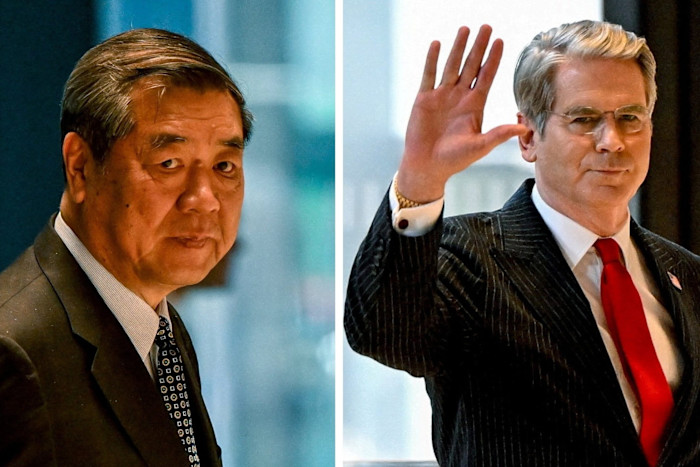
Treasury secretary Scott Bessent told my colleague Demetri Sevastopulo that the creation of the new mechanism marked an important step to reduce risks from the rapidly developing technology.
“The most important thing is just to start talking and so we have set up the AI Dialogue,” Bessent said following talks with Chinese vice-premier He Lifeng in New York on Sunday.

The discussion comes as dramatic safety fears over the development of so-called frontier AI models have been thrust into the spotlight this month, spurring calls for greater co-operation between Washington and Beijing.
Trump initially shrugged off calls for an AI slowdown from leading American tech groups, insisting he did not want to give up ground to Beijing. He has since said the US would create an “AI force” and appoint a new AI tsar.
Bessent told the FT that, despite “obstacles” to the US-China relationship, it was clear that “both sides want to maintain the stability of the past year”.
Could you be the FT’s next stock picking champion? The FT’s new Stock Picking Game is a fast, fun way to test your trading instincts, sharpen your market expertise and compete for the chance to win £1,000. Terms and conditions apply. Register for season two now.