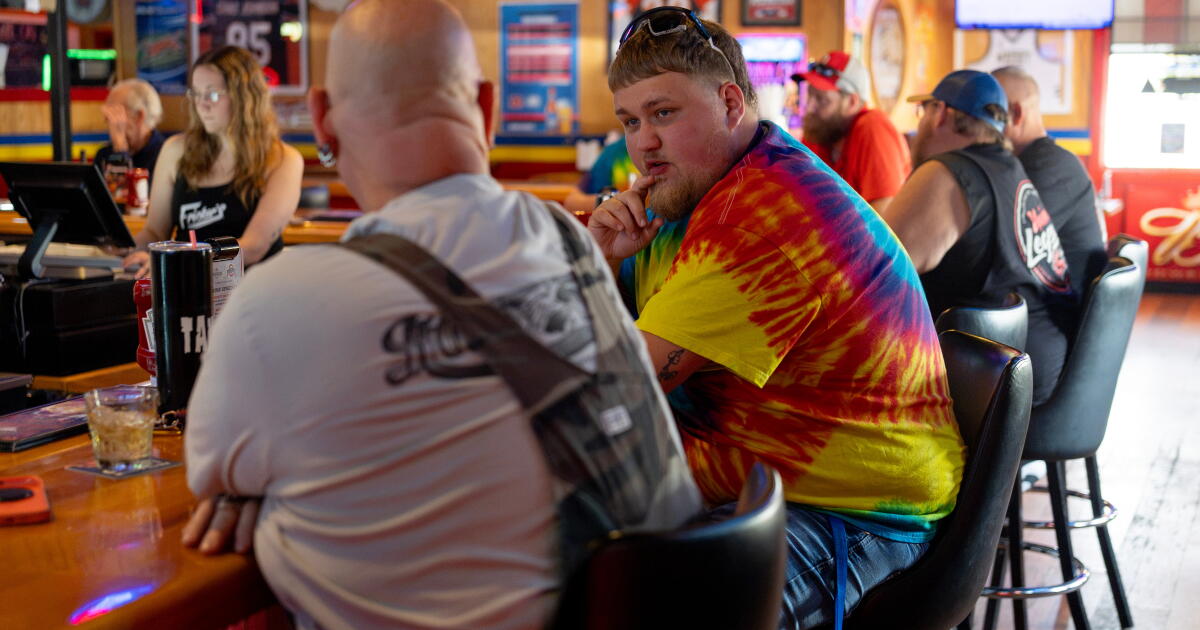
WASHINGTON — Sipping tea from beer mugs with his co-workers, Kyle Bos listed the ways his life is changing.
Bos has two daughters, with a third due in January. At the grocery store, five items cost as much as a full cart once did. And on Wednesday, Bos and nearly 1,400 other people were laid off from their jobs as the Navistar truck factory in southwestern Ohio shut down.
The layoffs — occurring three days before President Trump’s rally Saturday at a nearby high school — were large enough to essentially erase an entire year of job growth in the greater Dayton area. And they are one reason why Bos, 30, plans to spend the final weeks before the November election canvassing votes for Democrats.
Asked how many times he voted for Trump, Bos held up three tattooed fingers. But he said he’s done with the president.
“Something has to change politically in this country,” said Bos, a member of the United Auto Workers who identifies as a centrist.
A Trump campaign stop
This election is a test for the working-class coalition that lifted Trump into the White House again and gave majorities to Republicans in the House and Senate. The outcome will be decided in places like Dayton, which once sprouted factories but shed about half of its 90,000 factory jobs since 1990 after the North American Free Trade Agreement and trade with China made it cheaper to buy auto parts from abroad.
Trump’s blunt talk and status as a celebrity businessman initially helped him in and around Dayton, where some said politics as usual had failed them. But voters this year are disgruntled about inflation and the war in Iran.
An Ohio race could help determine control of the Senate. Republican Sen. Jon Husted is facing a challenge from Democratic former Sen. Sherrod Brown, who is trying to harness that disenchantment as he attempts a comeback two years after losing his seat.
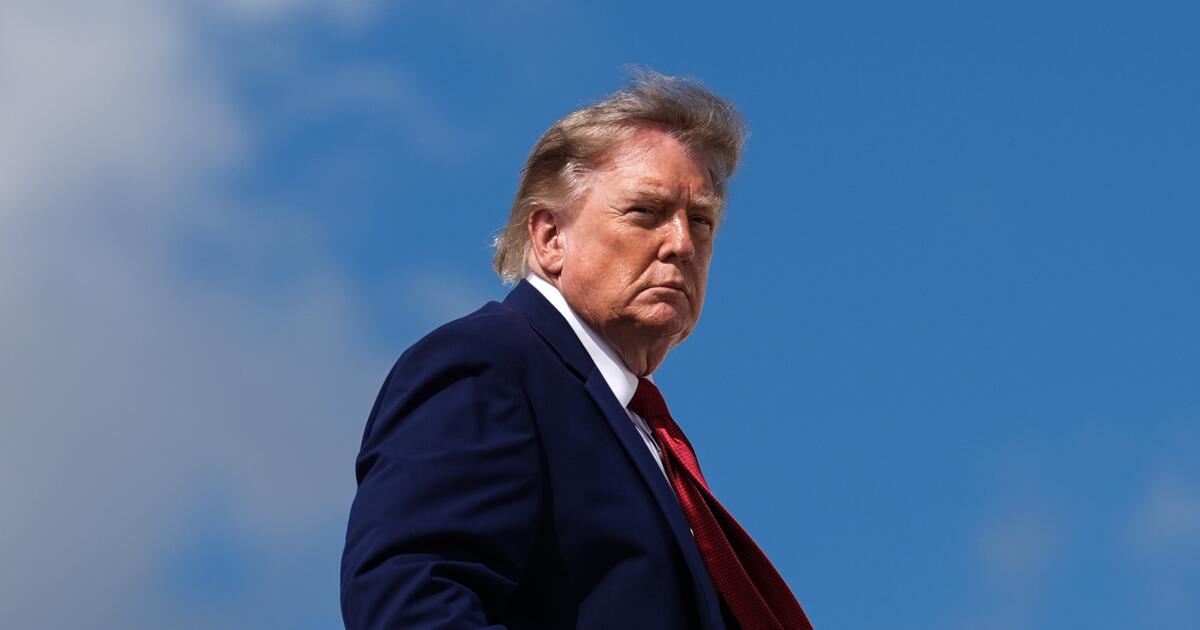
Americans increasingly blame Trump for the high cost of living, with just 17% approving of his handling of the issue, according to a new AP-NORC poll. Trump didn’t talk about grocery prices or gas prices or layoffs at his Saturday night rally in Vandalia, part of what he says will be a 32-day marathon of rallies to try to convince the public that the economy is better than they think.
“The fake news media, they refuse to talk about our record-setting numbers. So tonight, if you don’t mind, I’m going to do it myself,” he said at the rally.
Trump largely has scoffed at concerns about affordability, but is promising to give people $5,000 checks if Republicans win the House and Senate next month— something Bos said he found offensive.
“It feels like a bribe, a slap in the face, and, like, that we’re all ignorant,” Bos said.
Factory work moved abroad
As steady paychecks vanished in the 1990s, drug addiction and crime increased. Things seemed to hit bottom after the 2008 financial crisis, prompting Phil Plummer, who was then Montgomery County sheriff, to enter politics.
“My jail was 40% drug addicts, 50% mental health patients, 10% criminals,” said Plummer, the Montgomery County GOP chairman who has been a Republican state representative since 2019. “We got it upside down — that’s what drove me to the statehouse.”
Plummer is now on the ballot for the Ohio state Senate and thinks Trump is what keeps the GOP’s coalition of businesses and working-class families together.
In recent years, the local economy has improved as the Wright-Patterson Air Force Base steadily added government workers. The base has drawn new aerospace companies to the area such as Joby Aviation, Electra and the Sierra Nevada Corp.
“In economic development, it takes time, and you have got to give it a little bit of time to bake, and then once it does, then you’re going to have something special,” said Jeff Hoagland, chief of the Dayton Development Coalition.
Demand at plant fell
Trump pointed to the $850-million investment by aircraft maker Electra — along with a new project in Ohio from Stellantis and a Friday announcement from Bayer for a $2.2-billion drug plant near Columbus — as evidence that his policies were creating jobs.
But at the Navistar plant, Trump’s broad tariffs never boosted demand, and the plant’s former owner, International Motors, chose to offload the facility.
Trump’s major legislative achievement, the One Big Beautiful Bill Act, contributed little to people’s take-home pay, even as it temporarily stripped taxes from tips and overtime.
“We weren’t getting a lot of overtime because of the economy,” said Marianne Donnelly, who drove a forklift at the factory. “There just wasn’t any to be had, very little to be had.”
Laid-off workers like Donnelly say they expect to be rehired in six to 12 months by Roshel, a Canadian manufacturer of armored vehicles, which is buying the plant. Roshel said in a statement that it’s “working with everyone involved not only to protect the current workforce, but to more than double it over the coming years through a phased process.”
Laid-off workers looking for hope
On the Monday before the layoffs, Morgan Hughes and JoJo Burkhard were knocking on doors in Kettering, a Dayton suburb. They were trying to convince union members and retirees to vote for Democrats.
The Navistar job had helped Hughes, 35, buy a house at age 21 and work alongside her father. Burkhard said inflation had made it easier to swing voters to their side.
“It isn’t a hard pitch at all,” she said. “And even if they don’t want to stay Democratic long term, they’ll at least give the candidates a chance this election, which could be a turning point for us.”
After a morning of talking to voters, the pair settled down at a Chinese restaurant for some pot stickers, and the weight of the week hit them.
Burkhard cracked open a fortune cookie and tears began to well up. The layoffs meant no work for her, her boyfriend and her mother — and the words in small print almost seemed prophetic.
Her fortune read: “You’ll find your inner strength to overcome challenges.”
Boak writes for the Associated Press. AP writer Seung Min Kim in Vandalia contributed to this report.