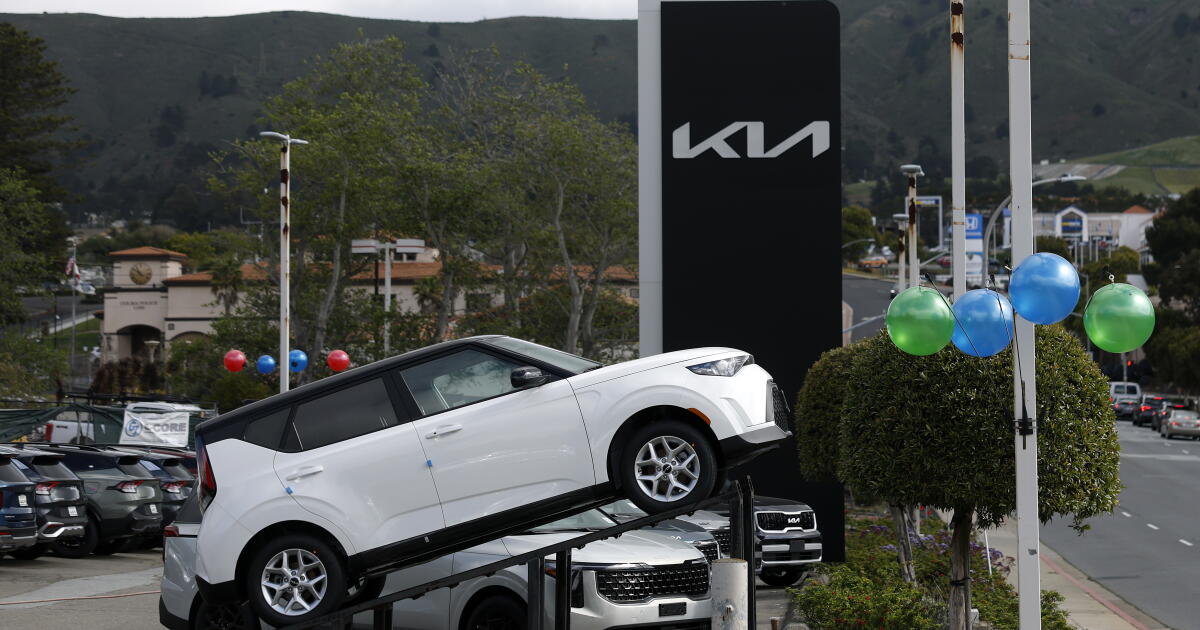
American insurers can sue Korean car makers for payouts on thousands of stolen Kias and Hyundais, the 9th Circuit Court of Appeals ruled Monday, directing a federal judge in Santa Ana to reopen a case seeking reimbursement for more than $1 billion in claims.
The ruling is the latest legal blow to the automakers, which have already settled a $145-million class-action suit with car buyers and a $9-million case brought by state attorneys general related to claims that manufacturers dropped a key ignition safeguard on U.S.-bound models, flooding the market with easy-to-boost vehicles made famous by the so-called “Kia Boys” challenge that went viral on TikTok in 2022.
The decision comes on the heels of a new UCLA study showing thefts of the automakers’ most vulnerable models will likely plague Los Angeles for years to come.
“We’re likely to be seeing elevated thefts of these cars through 2042,” said the study’s lead author, Jeffrey Brantingham, a UCLA anthropology professor.
The theft-prone models lack a critical safeguard called an engine immobilizer pioneered in the mid-1980s, when more than 60,000 cars a year were stolen in Los Angeles alone. By the turn of the century, such devices were ubiquitous, joining airbags and antilock breaks as standard safety features.
“If there’s one thing that auto manufacturers have done to really reduce auto theft, it’s been the introduction of immobilizers,” Brantingham said.
The technology was so universal that thieves didn’t notice at first when Kia dropped immobilizers from many of its American models in 2011, or when Hyundai did same five years later.
“If all cars have immobilizers, and you’re the one car that doesn’t, you can mostly slip under the radar,” Brantingham said. “[Thieves] didn’t know these Hyundai and Kia cars were easy to steal until about 2020.”
That’s when car theft began to surge across the country — particularly in Los Angeles, where thefts roughly doubled from the summer of 2019 to the summer of 2020.
L.A. County is home to almost 8 million registered vehicles, tens of thousands of which were left idle on the street through the pandemic’s early months. At the same time, thousands of potential thieves were laid off from work and sent home from school.
Data cited by the UCLA researchers suggest local boosters were among the first to realize Hyundais and Kias lacked immobilizers, leading to a spike in targeted thefts that largely predates the national trend.
“It was an independent discovery,” Brantingham said.
Thefts in L.A. were already surging when Milwaukee-based boosters launched their “Kia Boys” videos in the summer of 2021, and had begun to level off by time the meme hit national news a year later.
“There were some cities in the U.S. that had no idea about this vulnerability until the summer of 2022,” Brantingham said. “If you look at Atlanta, you can see as soon as the story broke in June of ’22 — boom! Kia and Hyundai thefts just exploded.”
Although California car thefts have plunged in recent years, the “Kia Boys” models remain stubbornly popular among criminals — a trend that is likely to trickle down from middle-class neighborhoods to poorer ones as the cars move through the secondary market, Brantingham said.
That’s because most modern car thieves are joyriders or commuters, meaning the overwhelming majority of stolen cars are recovered and returned in usable condition, ready to be boosted again.
“How many times is that Hyundai Sonata going to be stolen while it’s on the road?” the researcher mused.
Insurers say they’ve already paid more than $1 billion in claims and costs related to theft and attempted theft of vulnerable vehicles — money they now want the carmakers to reimburse.
Some 200 car insurance companies sued the Korean manufacturers, saying they deliberately nixed the safety feature for American-bound cars, while retaining it as standard for the rest of the world. The suits were consolidated into a group of related actions against the carmakers in California federal court.
U.S. District Judge James V. Selna dismissed that complaint, ruling his Santa Ana court lacked jurisdiction over the foreign automakers.
This week, the 9th Circuit reversed him, finding the Korean companies intentionally reserved immobilizers as an “upsell” for American buyers, making millions of base-models easy to hot-wire with little more than a screwdriver.
Because more than 70% of all Hyundai’s and Kia’s shipments to the U.S. passed through Golden State ports, the vast majority of vehicles built without working immobilizers were “targeted” to the state, the appellate panel found.
“Even though the Korean entities did not themselves sell the allegedly defective vehicles in California, they expressly aimed their intentional and allegedly tortious actions at California by sending thousands of shipments of vehicles to and through California’s ports,” Judge Eric D. Miller wrote for the panel. “In addition, the Korean entities’ U.S.-specific design supported the conclusion that they purposefully directed the defective vehicles to California.”
The case will return to Selna’s court in Orange County.