A guy who owns a beach resort on the coast of Florida, where hundreds of miles of overdeveloped shores are threatened by increasingly severe storms driven by global warming, is trying to tell Californians how best to manage our coast.
Guess who.
It’s not that we needed the help. If there’s any thought to adding an eighth wonder of the world to the current lineup of seven, I’d nominate the 1,100-mile treasure that kisses Oregon on one end and Mexico on the other. And it’s not by accident that coastal habitats are aggressively protected and most of the shoreline is free of mega resorts and architectural clutter.
A half century ago, Californians rose up against the threat of over-development. By the will of the people, the coast was enshrined in state law as a precious public asset accessible to the many, not a private playground fenced off for the few.
This year marks the 50th anniversary of the Coastal Act, and just as we begin the party, President Trump and his minions are scheming to pump some crude oil into the punch bowl.
And here’s how:
Going back to the 1970s, under the Coastal Zone Management Act, California has gotten high marks from the feds for the way in which its coastal regulatory agencies work with D.C. to manage federal projects. But now the state is under attack, which could mean that millions in federal dollars will be clawed back and the state’s voice muted.
So what horrible sins have we committed?
Sit down and take a deep breath.
We’re being accused of “environmental extremism.”
It’s just been far too many years of paying attention to water quality and vehicle and industrial emissions and all the rest. Imagine how that comes across to a president who wouldn’t admit to climate change if his putter melted in his hands or Mar-a-Lago became a swim-up hotel.
As penance for our crimes, U.S. Commerce Secretary Howard Lutnick (the one who labeled us environmental extremists) ordered the National Oceanic and Atmospheric Administration, or NOAA, to conduct “a full, formal review” of the state’s coastal management program.
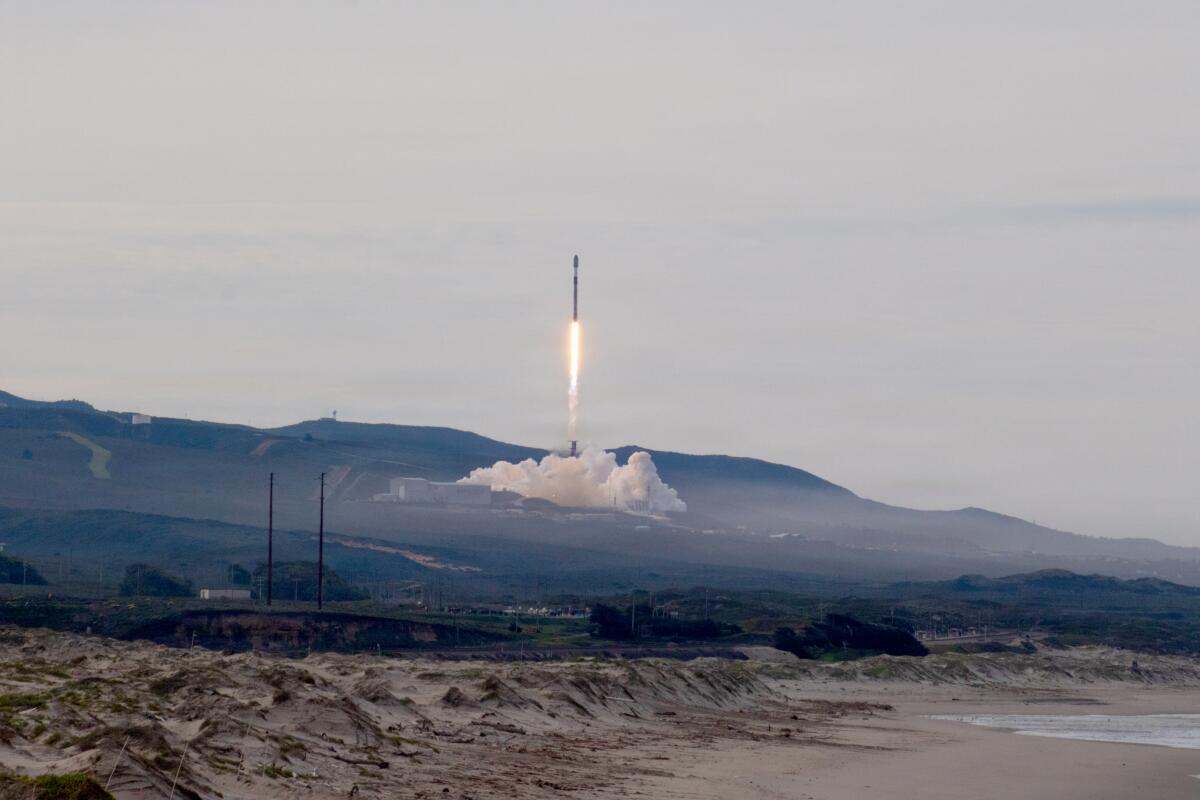
“California has repeatedly and unfoundedly obstructed spaceport development,” Lutnick declared, referencing a dispute over how many rockets Elon Musk’s Space X can launch from the U.S. military’s Vandenberg base. (Per the California Coastal Commission, many of the launches are for private interests rather than military purposes, and even the federal government has noted that the thunderous sonic booms take a toll on sea life and humans.)
We’re also allegedly blind to basic economics and the preferences of the Trump administration when it comes to “offshore oil production, maintenance of pipelines and desalination.” And we need to fall into line in “removing regulatory barriers that hinder U.S. technological and economic leadership while responsibly stewarding coastal resources.”
Where to begin?
I thought California had the world’s fourth-largest economy, with technology as a primary driver. In fact, it’s just been reported that we drew 10 times more venture capital than any other state this year, with AI leading the way. If one or two other states matched our output, imagine the boasting Trump could do, legitimately, about the economy.
And while the administration seems intent on tapping more offshore oil, it’s toppling the nation’s offshore wind projects while the planet suffers through blistering, deadly heat waves directly related to greenhouse gas emissions from the burning of fossil fuels.
If the president’s blowtorch buddies want to call us “environmental extremists” for not burying our heads in the sand, it’s a badge of honor.
And another thing.
If Trump is so intent on keeping the world’s oil supply flowing, maybe he shouldn’t have bungled his way into a senseless war that has handed Iran the keys to the global gas pump, spiking prices for everyone.
By the way, it’s not as if the primary coastal regulatory agency in the state — the California Coastal Commission — has said nothing but “no” over the years to oil projects and desalination plants.
“When you look at the Coastal Act, it doesn’t prohibit offshore oil and gas production and we approved a lot of it,” said Susan Hansch, who retired from a top administrative position in 2021 after 47 years at the Coastal Commission. “It just has to be done correctly.”
The commission has also approved multiple desalination plants, but four years ago rejected one proposed for Huntington Beach, despite support for it from Gov. Gavin Newsom. I thought the rejection was the right call, because the proposal struck me as a private boondoggle, with no designated customer for the water and a slurry of environmental hazards.

A Falcon 9 rocket is launched from Vandenberg Space Force Base on Jan. 25.
(2nd Lt. Andrew Taller / U.S. Space Force)
Not that the Coastal Commission has been infallible over the years. It has worked many a critic into a lather, with complaints that the agency has stood in the way of housing development during the state’s mounting shortage, and that its permitting process is the equivalent of a years-long root canal.
Former Gov. Jerry Brown, who signed the Coastal Act into law in 1976, once called the commissioners “bureaucratic thugs.”
And Trump has feuded with the agency over, among other things, a 70-foot-tall flagpole erected on his Rancho Palos Verdes golf course without a permit. Last year, Trump envoy Ric Grenell said the Coastal Commission was a “disaster” and must “absolutely be defunded,” calling commissioners unelected and “crazy woke left.”
Getting rid of the commission, he said, “is going to make California better.”
I don’t think so.
Ten years ago, I had the privilege of traveling the length of the state and meeting some of the heroes of the coast going back to the 1960s.
They were there when the devastating Santa Barbara oil spill blackened beaches, turned the shoreline into a wildlife graveyard, and galvanized grassroots defense of the coast.
When plans by PG&E to build a nuclear power plant at heavenly Bodega Head triggered an uprising.
When a massive Sonoma Coast residential development pitch sparked fears that beach access would be lost.
In 1972, ordinary Californians circulated petitions, knocked on doors, and rode bicycles down the coast, rallying support for Proposition 20, which aimed to regulate coastal development. It passed despite a massive opposition campaign from corporate, industrial and real estate interests.
That victory led, four years later, to the Coastal Act and creation of the Coastal Commission, whose job was to balance sensible development, habitat protection and conservation, and equitable public access.
Richard Charter, an Ocean Foundation senior fellow, told me in Bodega a decade ago that the California coast is “a public miracle” that was protected by ordinary people who saw it as “a global treasure.”
The Coastal Act has led to the creation of 2,500 public beach access points in the state, and its greatest achievements include wetlands not plowed, habitats not destroyed, and the preservation of countless mesmerizing vistas where land meets sea and California leaves you in speechless, grateful awe.
At Tuesday’s Coastal Commission meeting, Jennifer Savage of the Surfrider Foundation stepped to the microphone and said to commissioners:
“Surfrider sees this federal review as a politically motivated attempt to strip California of the coastal protections that our communities and our marine ecosystems depend on, and Surfrider stands with you, and we will fight this every step of the way.”
If you’d like to join that fight, you can speak in person or remotely when NOAA hosts public hearings Aug. 10-12 in Santa Monica. You can find more details on the Surfrider Foundation website.
One of the early leaders of the Coastal Commission, the late Peter Douglas, anticipated these trials and uttered a phrase I’ve repeated many times over the years. In the year of the 50th anniversary of the Coastal Act, it’s worth repeating once more, and you should think of it as a a clarion call:
“The coast is never saved,” Douglas said. “It’s always being saved.”