Unlock the White House Watch newsletter for free
Your guide to what Trump’s second term means for Washington, business and the world
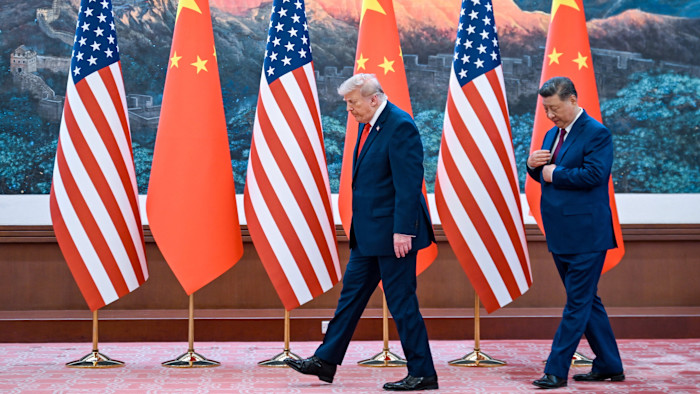
Officials are strapping on oxygen tanks and starting the final ascent. It’s a little over a week until the scheduled Xi Jinping-Donald Trump summit in Washington. Even if the climbing party manages to traverse the crevasse of tensions over Taiwan, which this weekend caused Xi to threaten to call off the meeting, there won’t be much to see at the peak. The summit’s main virtue is to show that relations are functional enough to meet at all. Both sides’ untrustworthiness and unilateral pursuit of strategic leverage will sharply confine its substance.
It’s common to describe the Xi-Trump relationship as transactional rather than based on principles. In reality, it isn’t even that. Anything they agree is subject to fudging and reneging. Their only real compact is a balance of terror, refraining from escalating trade or other actions for fear of mutual destruction. The best we can currently say is that this situation is at least holding. Trump’s rhetoric on China and particularly Xi himself has shifted from aggression to admiration.
The two last met in Beijing in May, but the key encounter was in South Korea last October. Trump backed down from imposing more tariffs on China in return for Xi easing off on export controls on rare earth minerals, a near-monopoly which Beijing has spent decades painstakingly constructing.
Supposedly, Xi agreed a moratorium on export controls until this November. In practice, Beijing seems to have been tugging on the leash ever since. Rare earth exports have been falling in recent months, with reported concerns among Chinese producers of angering Beijing by selling to the US. In June, China added two US rare earth companies to its export control list, limiting Washington’s attempt to build its own supply chains.
Xi is acutely aware of his power to renege on agreements as a sign of strength. Back in Trump’s first term, when the US president was signing something close to actual agreements, the two leaders signed a “phase 1” deal which involved China pledging to liberalise some key sectors and buy US exports, particularly soyabeans. A promise to buy $200bn in extra products over a past baseline level was never kept, and if China had done the promised deregulation, the US wouldn’t be moaning about a non-market economy now. Trump and Xi agreed a new soyabean purchase deal in 2025, which China is so far on track to keep, but compliance is always optional.
For his part, Trump’s caprice is famous. As Canada can tell you, no agreement will survive his angry and destructive whims, nor the dysfunction of his administration. Trump doesn’t lay off raising tariffs on China because he cares about principles and the rule of law: it’s because he knows the retaliatory consequences if he does not.
The US-China geoeconomic rivalry is not really being contested in an air war between leaders but in hand-to-hand combat on the ground, each side labouring to build supply chains and develop technologies that will protect it from coercion by the other. China firing warning shots with the rare earths weapon reminds Washington that the US is a very long way from developing its own capability. Meanwhile, Beijing is pushing Chinese industry hard to catch up with the US lead in semiconductors, but is still some way behind America and its allies.
This explains why a deal on the governance of AI, one of the subjects of the summit, isn’t likely to go much further than establishing a bilateral dialogue. Trump has shown he isn’t interested in constraining the potentially destructive technology: he’s interested in the US dominating it.
Summits are only worthwhile when interlocutors act in good faith towards a mutually beneficial outcome. The classic examples of successful summits with a US president involved more trustworthy participants: Richard Nixon’s 1972 trip to China, a rapprochement with the Communist state after a quarter-century of hostility; the Reykjavik summit between Ronald Reagan and Mikhail Gorbachev in 1986, which laid the ground for US-Soviet nuclear de-escalation; and, though the gains proved transitory, a succession of meetings on economic aid and security during the 1990s between Bill Clinton and Russian president Boris Yeltsin. Not for the first time, Trump has proved he is a worse president than Nixon.
It is good for Trump and Xi to meet, because at least if they are talking there is less likelihood of the relationship suddenly blowing up into a full-on trade war — or worse. But the summit will not end with them descending from the mountaintop bearing tablets of wisdom to guide the governance of an uncertain and fearful world.