Industrial America is contending with a fresh wave of supply chain inflation as Donald Trump’s Iran war pushes up energy costs, tariffs raise import prices and the AI boom strains supplies of crucial electronics.
Manufacturers are paying sharply more for raw materials, energy and freight, with some input costs rising by double-digit rates, according to executives and industry data, forcing some to raise prices and threatening further pressure on consumer inflation.
“We just need to spend more and more money for the same stuff,” said Julie Robbins, chief executive of EarthQuaker Devices, an Ohio-based manufacturer of guitar pedals.
“It feels like we have to try twice as hard to get the same results,” added Robbins, whose company has had to raise prices twice this year.
The mounting price pressures in the American factory sector are the latest sign of the inflation that is sweeping the US, driven by sharply higher fuel prices, levies on imports and the rush to procure electronics used in AI data centres.
The bout of inflation has become a growing political liability for Trump ahead of the midterm elections, contrasting with his claim at the Republican National Convention meeting in Dallas last week that he was “bringing the prices way down, way, way down”.
The price growth has contributed to a rout in the bond market that on Tuesday pushed the US 10-year yield to its highest level since 2007. Elevated inflation has also prompted bets on Wall Street that the Federal Reserve will lift interest rates on Wednesday.
More than a dozen industries within the factory sector reported rising raw material prices in the Institute for Supply Management’s closely watched August survey of executives, with none reporting declines.
ISM’s overall index of prices has also jumped since the start of 2026 and has shown costs rising for 23 consecutive months. Production managers have reported increases in prices of petroleum-based products and steel and aluminium costs.
“Supply chains are paying more for less inventory,” said Zac Rogers, professor of supply chain management at Colorado State University. “The bang for the buck in the supply chain keeps getting worse and worse.”
Inflation data also points to mounting pressure further up supply chains.
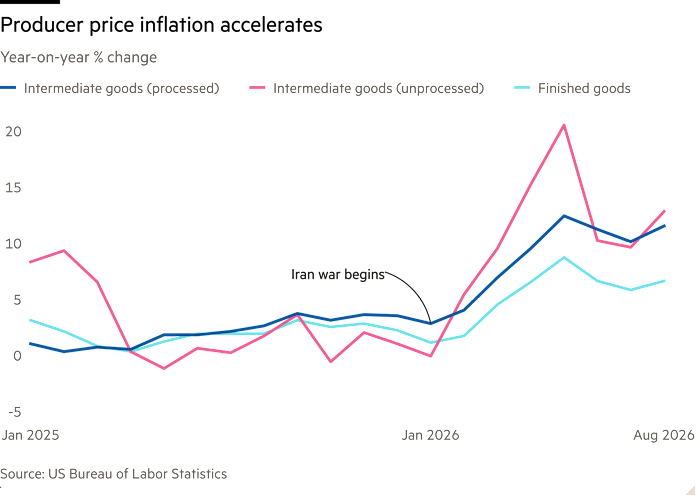
While prices charged by producers for finished goods rose 6.6 per cent year on year in August, the cost of goods used in production increased at a much quicker pace.
The price index for intermediate processed goods jumped 11.5 per cent year on year in August, driven by a surge in diesel costs, while the measure for unprocessed goods, such as scrap metal, rose 12.8 per cent, Bureau of Labor Statistics data shows.
Fuel costs have continued rising sharply since the end of August, with pump prices for diesel reaching a record $6.27 a gallon on Tuesday, according to AAA, the motoring group. Wholesale prices for US diesel also rose sharply on Tuesday, suggesting costs for drivers will soon rise further, analysts said.
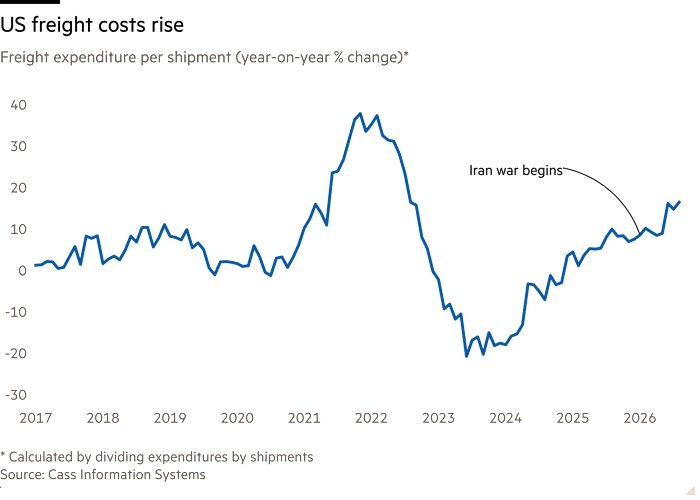
The cost of transporting goods has also increased markedly, with the average cost per freight shipment rising 16 per cent in August from a year earlier, according to FT calculations based on Cass Information Systems data.
Some manufacturers say it is also getting harder to find the inputs they need.
Traci Tapani, co-president of Wyoming Machine, a metal fabrication company outside Minneapolis, said the group had experienced “disruption” in its ability to secure raw materials. Steel in particular was posing “noticeable supply issues”.
Most executives distinguished the current supply chain squeeze from the disruptions caused by the Covid-19 pandemic, when goods could not be sourced. For the majority of sectors, they remain available but at notably higher prices.
“We’ve gone from scarcity to cost as the primary concern around supply chains,” said Kip Eideberg, senior vice-president for government and industry relations at the Association of Equipment Manufacturers, whose members make machines from tractors to trucks.
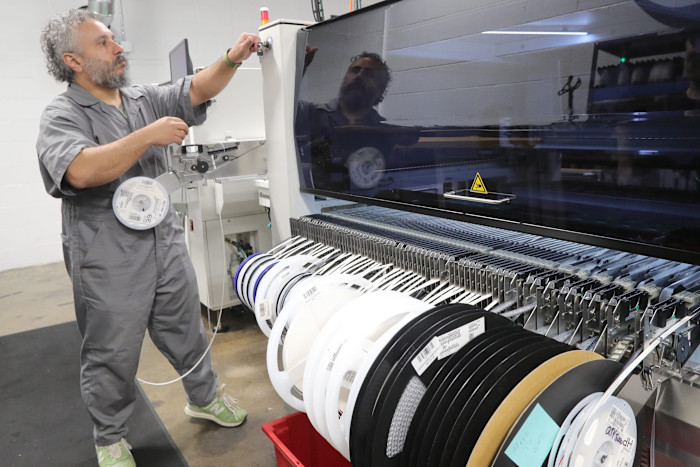
But for the electronics industry, the AI boom has made simply securing goods increasingly challenging. The rapid build-out of data centres has driven a frenzy of demand for specialised parts from memory chips to processors that suppliers are struggling to keep pace with.
The electronics sector’s supply chain was “going through another crisis even bigger and more complicated than during and post-Covid-19”, said an industry respondent to the ISM survey in August.
“The demand is kind of everywhere all at once,” said Shawn DuBravac at the Global Electronics Association. “It is, without doubt, driven by a colossal AI infrastructure investment.”
“Depending on the component you’re looking at, you’ve got multiyear lead times,” he added. “The only way that this strain gets resolved is production increases everywhere across the supply chain, or demand, primarily AI infrastructure demand, slows.”
The shortage is being felt globally. In a GEA survey last month, nearly two-thirds of electronics manufacturers worldwide reported limited component availability or extended lead times.
Despite the price rises, in many industries there is little appetite for making splashy investments in additional capacity, as companies contend with uncertainty over everything from the Iran war to tariffs.
“No company is going to put down a big capital expenditure without some certainty that the market will be the same a year from now,” said Rogers.
Robbins at EarthQuaker said the “constant changes make it so you can’t really develop a long-term plan”.
“As a business owner, you really rely on having stability and clarity on what’s going on, and that is not happening right now,” she said.