For six years, Californians have been able to shake up a craft cocktail at home using alcohol delivered to their doorstep. Now, it’s last call for the distillery deliveries, unless lawmakers intervene by the end of this month.
That’s unlikely, thanks to opposition from California’s wine industry, Teamsters union truck drivers and corporate alcohol wholesalers and distributors.
The influential, well-funded groups lobbied the Legislature behind closed doors this year to block legislation that would have made permanent pandemic-era rules that allowed craft distillers to ship spirits directly to their customers.
During the pandemic lockdowns, Gov. Gavin Newsom issued an executive order that allowed craft distillers to ship spirits to their customers’ homes. In the years since, lawmakers passed temporary laws allowing craft distillers — defined as those that produce up to 150,000 gallons a year — to keep shipping their spirits.
The latest extension expires Dec. 31.
“I don’t have a lot of hope that we’re going to be able to salvage this,” said Folsom Republican Assemblymember Josh Hoover. He tried unsuccessfully this year to amend one of his bills to let small distillers continue shipping directly to their customers.
The groups blocking Hoover’s proposal have spent more than $1 million lobbying the Legislature and state government this year. They have donated at least 11 times that much to California politicians and their campaigns over the years.
The craft distillers, who have spent a fraction as much on state politics, say all that spending from the opposition, particularly from corporate liquor distributors, appears to have paid off.

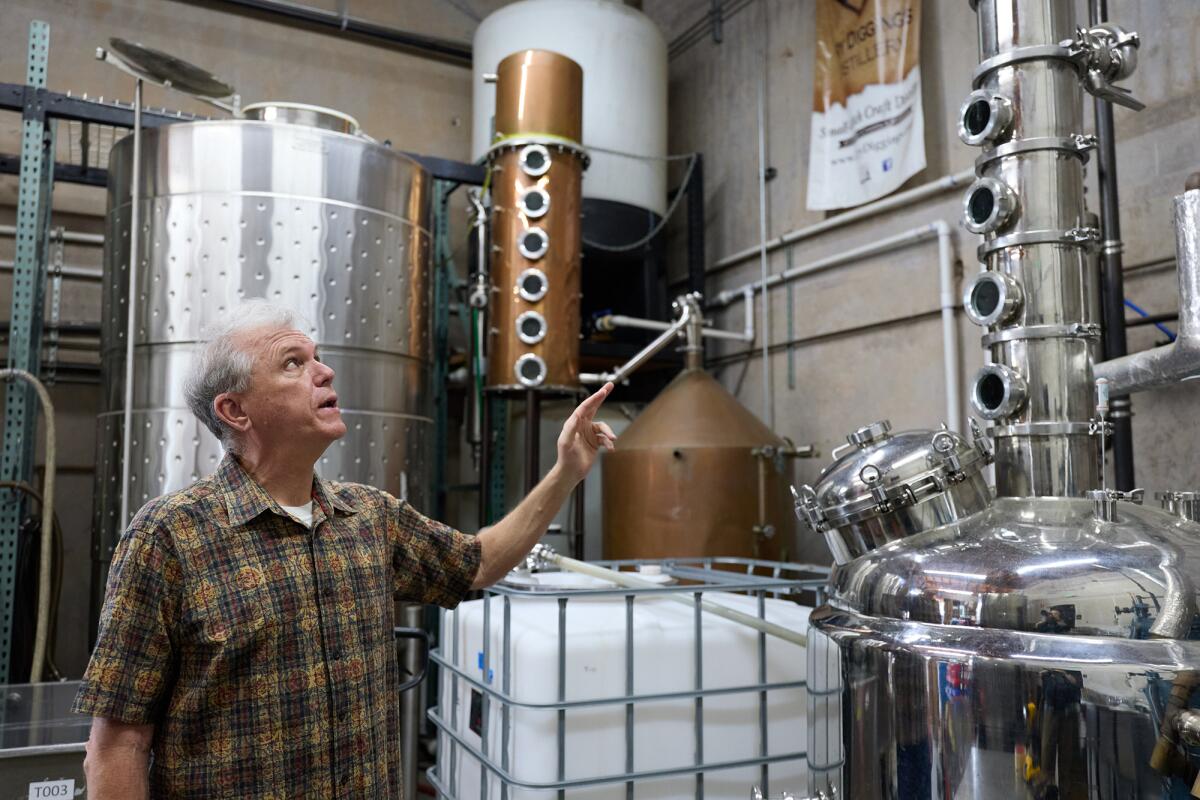
Cris Steller, owner of Dry Diggings Distillery, talks about the various products that are made in his distillery.
(Fred Greaves / For CalMatters)
“They went directly to legislators’ offices and basically torpedoed any effort we came up with,” said Cris Steller, acting executive director of the California Distillers Assn. and the owner of Amador and Dry Diggings Distillery in El Dorado Hills, a family-run business that makes whiskey, brandy, vodka and gin.
The fight is about more than whether Californians can have a bottle of whiskey or gin delivered. It illustrates how decisions are made in Sacramento, where wealthy and powerful interests can shape or kill policy in secret negotiations with lawmakers. Politicians, in turn, benefit when proposals die quietly because they don’t have to explain their decisions to voters.
Opponents insist they aren’t using the political system to crush competitors as national alcohol sales slump.
Instead, representatives of the major alcohol wholesalers and distributors that stock shelves at liquor retailers say they oppose the proposal because it primarily benefits out-of-state companies and weakens safeguards that include preventing alcohol deliveries to minors.
Teamsters lobbyist Matt Broad said the labor group’s truck drivers aren’t opposed to allowing craft distillers to ship their product. They just want them to use established shipping companies that have actual employees, including those that employ Teamsters, such as UPS. Those companies, Broad said, have standards to ensure liquor is delivered legally.
Those companies have standards to ensure legal delivery, Broad said. When they employ drivers rather than use contractors, the companies — not the drivers — bear legal liability.
Federal law preempts California from mandating hiring unionized truck drivers, Broad said.
“We are absolutely not opposed to the little guys being able to ship directly to consumers, and in fact, we have a track record of supporting the proposal but with meaningful guardrails that protect our members and protect the public,” he told CalMatters.
The California wine industry, which has been allowed to ship bottles directly to customers in California for decades, isn’t necessarily opposed either. But its representative says wine sellers are leery of giving little alcohol sellers delivery rights when big liquor companies deserve the same. Wineries of any size can ship to their customers in California.
Big Booze, Big Labor spend big
The U.S. Postal Service prohibits most alcohol shipments to homes, but California allows certain types of alcohol sellers to use private shipping companies. Breweries are prohibited from shipping directly to California customers.
Hoover hoped his Assembly Bill 2211, a proposal to give craft distillers the ability to offer tastings and sell spirits at locations other than their distilleries, could be amended to give craft distillers a permanent direct-to-consumer provision.
It has advanced through the Legislature without formal opposition or any lawmaker voting against it, according to CalMatters’ Digital Democracy database. The measure is pending before the full Senate.
There may be no formal opposition, but reports filed with the California secretary of state show an extensive behind-the-scenes lobbying effort aimed at preventing any changes.
At least six groups, including some of the biggest national alcohol distributors, have reported lobbying on Hoover’s bill.
The reports show those groups spent more than $1 million on lobbying this year. State ethics laws only require entities to report the total amount they spent lobbying the government in a year. They’re not required to report how much they spent on specific legislation, so it’s unclear how much they spent trying to influence lawmakers as they considered AB 2211 and its never-published direct-shipping amendment.
Those groups, along with the International Brotherhood of Teamsters and the Wine Institute, have given at least $11 million to both Democrats and Republicans in California since 2000, according to Digital Democracy, including at least $738,000 since 2025, the start of the current two-year legislative session.
By comparison, California’s craft distillers reported spending $54,000 on lobbying this year.
They reported just three donations to lawmakers in the past decade, according to Digital Democracy. One was a $42 bottle of whiskey in 2022 to former Napa Democratic Sen. Bill Dodd, who now lobbies on behalf of the craft distillery industry. In 2023, Assembly Speaker Robert Rivas received $215 in tequila. Democratic Assemblymember-turned U.S. Rep. Adam Gray received a $1,300 campaign donation in 2016.
Hoover said he has been trying since last year to add language to his bill that would allow craft distillers to permanently keep shipping. He succeeded last year in getting the extension that expires Dec. 31, but this year he’s been unable to overcome the opposition to expanding the tasting room measure.
“I’m always open to figuring this out, if there’s a way that we can make this work. … but I don’t have a lot of hope that this bill is going to preserve those provisions this year,” he said.
With less than a month left before the Legislature finishes for the year on Aug. 31, Democratic leaders would probably need to sign off on changes to Hoover’s tasting room measure. They’ve offered little indication they intend to intervene for craft distillers.
Rivas, who’s received at least $108,000 in donations over the years from opponents of Hoover’s unpublished proposal, declined CalMatters’ request for an interview. Senate President Pro Tem Monique Limón, who’s received at least $33,000, responded to an interview request with an emailed statement saying she is aware of the pending deadline.
“This bill will continue to work its way through the legislative process as intended,” it said.

Bottles of spirits produced by Dry Diggings Distillery in El Dorado Hills on Aug. 4.
(Fred Greaves / For CalMatters)
Democratic Sen. Susan Rubio and her sister, Democratic Assemblymember Blanca Rubio, oversee the committees that regulate California’s alcohol industry. When Hoover’s measure passed through their committees, the chairs could have allowed Hoover to add the direct-to-consumer amendment. They did not.
Susan Rubio has received at least $65,000 in donations from the groups blocking the direct-shipping proposal, according to Digital Democracy. Blanca Rubio has received at least $129,000.
Sen. Rubio’s spokesperson, Giovanni Ruiz Reyes, responded to interview requests with emailed statements. The first said “conversations between stakeholders are ongoing” and that she “looks forward” to reviewing potential legislation.
Ruiz Reyes said in a second statement Thursday that she’s supported four previous extensions of the craft distiller shipping policy.
“There is currently no bill or amendment before the committee seeking another extension,” Ruiz Reyes said. “Accordingly, it would be inaccurate to suggest that Senator Rubio or the committee has blocked or refused to hear an extension when no such proposal is currently before the committee.”
Assemblymember Rubio didn’t return interview requests.
Fewer Americans are drinking
The liquor industry is facing a nationwide decline as more Americans cut back on drinking.
In that difficult business climate, corporate liquor wholesalers and distribution companies lobbied “to obliterate competition,” said Dodd, the former state senator from wine country lobbying on behalf of craft distillers.
“We oppose any effort to make DTC (direct to consumer) permanent,” the Wine & Spirits Wholesalers of America, the California Beer & Beverage Distributors and the California Family Beer Distributors wrote in a joint statement to CalMatters.
Craft distilleries’ direct shipping “was always meant to be temporary pandemic relief, and it’s expiring exactly as designed, six years later,” said the groups, which represent local and national companies that move many of America’s best-known beer, wine and liquor brands. They argue that after the law expires, spirits can still be delivered to customers through services such as DoorDash. DoorDash is listed as a member of the Wine & Spirit Wholesalers of America on its website.
The groups’ representative, Kevin Luckey, declined an interview request.
Steve Gross, president and chief executive of the Wine Institute, said the wine industry has worked hard over the decades to have large and small wine sellers treated equally under California and national alcohol distribution laws. He said it would undermine his industry’s efforts if small distillers get delivery rights in California when large ones don’t have them.
“They have the option to go in and try and fight for a bill that we and others could also support,” Gross said. “They’ve chosen not to because those larger distillers are not their members.”
The Wine Institute is a lobbying group that represents more than 700 large and small wine sellers, including one of the world’s largest, Modesto-based Gallo Winery.
Craft distillers say they’ve tried to work with the groups blocking their bill to address their concerns, but they have gotten nowhere.
In the meantime, Steller, the El Dorado Hills distiller, has already started pulling back on shipping bottles to his customers because the Legislature won’t budge.
“I don’t want to keep putting money into a program that’s going to get yanked,” he said.
Ryan Sabalow writes for CalMatters.