Unlock the Editor’s Digest for free
Roula Khalaf, Editor of the FT, selects her favourite stories in this weekly newsletter.
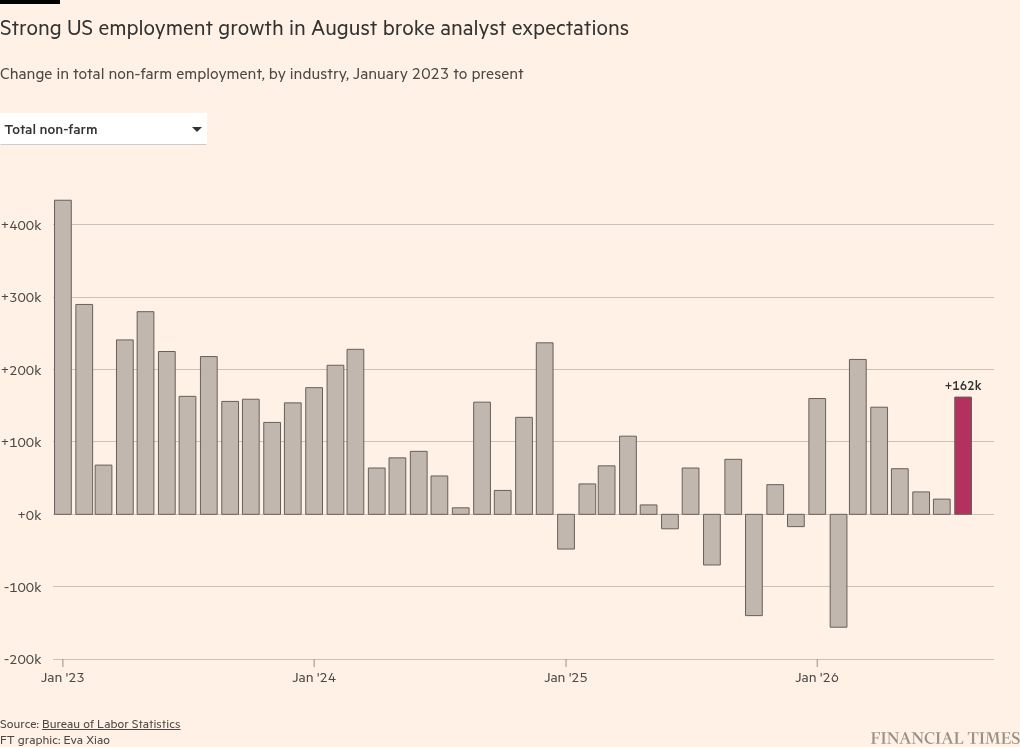
The US economy added 162,000 jobs in August, smashing Wall Street expectations and indicating that the labour market retains momentum ahead of a crucial Federal Reserve vote on interest rates this month.
Friday’s figure from the Bureau of Labor Statistics marked a rebound from July, when the world’s largest economy added 21,000 jobs, upwardly revised from an initial estimate that 23,000 positions had been lost.
August’s total, which was well above the 55,000 forecast by economists in a Bloomberg poll, reinforces Fed chair Kevin Warsh’s view that the labour market in the world’s biggest economy remains robust.
Donald Trump hailed the job figures on Friday while also urging Warsh, whom he appointed central bank chair earlier this year, to slash borrowing costs at the Fed’s meeting in mid-September.
“Lower the interest rates because the U.S.A. is a much stronger credit than it was just a short time ago! A STRONG COUNTRY MEANS A LOWER INTEREST RATE – IT’S A BETTER CREDIT…Very simple!” the president said on his Truth Social platform, adding, “The Fed Board, with its great new leader, must get smart – BE PATRIOTS for a change.”
But Beth Hammack, president of the Cleveland Fed and a voting member on the Federal Open Market Committee, which sets rates, responded more hawkishly — underscoring the debate facing the Fed this month.
“Inflation is still above 3 per cent. The labour market is stable and near my estimate of maximum employment,” Hammack said.
“Both the hard data and the anecdotes are telling me the same thing: policy is not restrictive. Inflation is too high—and the longer it stays above our objective, the harder it will be to bring it back down,” she added.
Analysts also said the strong job figures meant that the central bank’s focus should be on cooling rapid inflation, which at 3.7 per cent in July was almost double the Fed’s 2 per cent target.
“Today’s number is tipping the scale further and further in the direction of a hike,” said Jason Granet, chief investment officer at BNY.
Andrew Hollenhorst, chief US economist at Citigroup, echoed that view, saying, “on the margin, this report favours the Fed hawks”.
“It keeps the labour market off the table as a concern and keeps the focus on inflation,” he added.

Stephen Brown, chief North America economist at Capital Economics, said that “even the most committed dove would struggle to find anything in the August employment report to justify keeping interest rates unchanged”.
The two-year Treasury yield, which reflects expectations for US monetary policy, rose 0.04 percentage points to 4.38 per cent following the release of the data on Friday. Traders in futures markets added to their bets that the Fed will increase borrowing costs by a quarter point later this month, taking the market probability from 50 per cent to about 60 per cent.
The US dollar also advanced on Friday, gaining about 0.2 per cent against a basket of half a dozen of its peers.
US jobs growth has been volatile this year, with the labour market cooling in recent months.
Warsh said last week that despite a string of lacklustre hiring figures earlier in 2026, the jobs market was “doing well”.
August’s snapshot of the jobs market is the last before the Fed’s rate-setters give their latest decision on rates on September 16.
In a sign of the divisions on the FOMC, Chris Waller, a top official, said on Thursday that he would be “inclined” to hold borrowing costs if the inflation data improved in the coming weeks. Fed officials will see the August consumer price index inflation report ahead of the vote.
“Unless you get a weak inflation print, it makes a hike in September pretty likely,” said Mike Bell, head of market strategy at RBC BlueBay Asset Management.
The unemployment rate remained at 4.1 per cent. Despite the positive jobs report, hourly wages are still growing at a slower pace than inflation, rising by an average of 3.1 per cent in the year to August.
Additional reporting by Myles McCormick