As a kid growing up in Los Angeles, there was no greater barometer of class than the department store.
As my grandmother loved to explain, May Co. was affordable when there was a sale. Broadway was a bit pricier but you might find a deal on a good day. Bullocks was for the Buick and Lincoln crowd. Robinson’s: strictly Cadillacs and I. Magnin: the land of Mercedes and Rolls Royce.
She was mostly a window shopper. But department stores were her passport into the different strata of post-war L.A., a chance to aspire to a different life even if all she left with was a perfume sample sprayed on her palm.

Bullocks Wilshire interior
(Teena Apeles)
L.A.’s class barometer
This summer marks 20 years since the classic L.A. department store died. It was this time in 2006 when workers removed the last of the Robinsons-May signs from stores and malls across Southern California, marking the end of an era in more ways than one. Rob-May outlived Bullock’s and Buffums and Orbachs, but it was no match for the national chains and changing consumer behavior that favored discounters like Target and Kohls.
In a world of one-click purchasing and window-shopping on Instagram, it’s hard to imagine the status and influence these brick-and-mortar stores imparted on 20th century Los Angeles.
Their ads dominated the pages of the newspapers, and even there you detected a caste system. Mid-market chains like May Co. and Broadway advertised in the news sections with pages and pages of photos showing off their wares. The upscale chains like Robinsons were reserved for the features sections, with glorious hand-drawn sketches of beautiful women and handsome men against dramatic landscapes that were worthy of framing.

The May Company’s Lakewood Center
The stores got their start with huge emporiums in downtown L.A., a street car ride away. But the stores easily adapted to the car and post-war suburbia. With every new tract, they would anchor the shopping malls that became the downtowns of suburban life.
The arrival of a Bullocks or a Robinson’s in your community was a mark of status, that you were living in a sophisticated place.
My grandmother’s Disneyland
What we forget is that they were more than places to shop. My grandmother bought all her clothes at the down-market Fedco, usually “half-size” polyester blouses with the brand name “The Discriminating Woman.”
The fancy stores were her amusement park.
She took us to the ornate tea room atop the art deco masterpiece, Bullock’s Wilshire, where we lunched and marveled at the one place in late 1980s L.A. where women still wore hats and gloves.

A sepia-tone postcard shows the Pasadena location of Bullock’s department store.
She made the rounds at the Robinson’s in Beverly Hills, spying for celebrities and likely unaware of all that went into the edifice: Travertine stone from Peru. Rose marble from Portugal. Black granite from Brazil. Rosewood from Madagascar. When the outpost closed in 2006, longtime employees lamented L.A. was losing not just an expensive store but a unique public space. “I did ladies’ shoes and later men’s shoes and clothing. Now I’m doing demolition,” one said.
My grandmother died a few years before Rob-May. But I cannot help but think about her when I roam through the stores of my youth.
A few years ago, two friends and I got inside the empty building on Wilshire that once housed I. Magnin. It was a symphony of marble, grand etchings and elegant curves. Now, it’s boarded up, the black marble exterior faded by graffiti and neglect. Down the block, the Bullocks Wilshire has been lovingly restored and protected by the Southwestern Law School. But the last time I walked into the property, I was shooed away by a security guard.
Like so many in her generation, my grandmother saw those iconic names as markers of discriminating taste without considering the dark side of all that exclusivity. The tea room whose pretensions she so loved was the subject of protests and lawsuits in the 1940s by Blacks who were refused service there. They eventually prevailed and got to join my grandmother in the escapism (and tyranny) of these retail temples that insisted they represented the L.A. ideal.

Former Robinsons–May store at the Westfield Fox Hills shopping center
(Myung J. Chun / Los Angeles Times)
Seeing ‘how the other half lives’
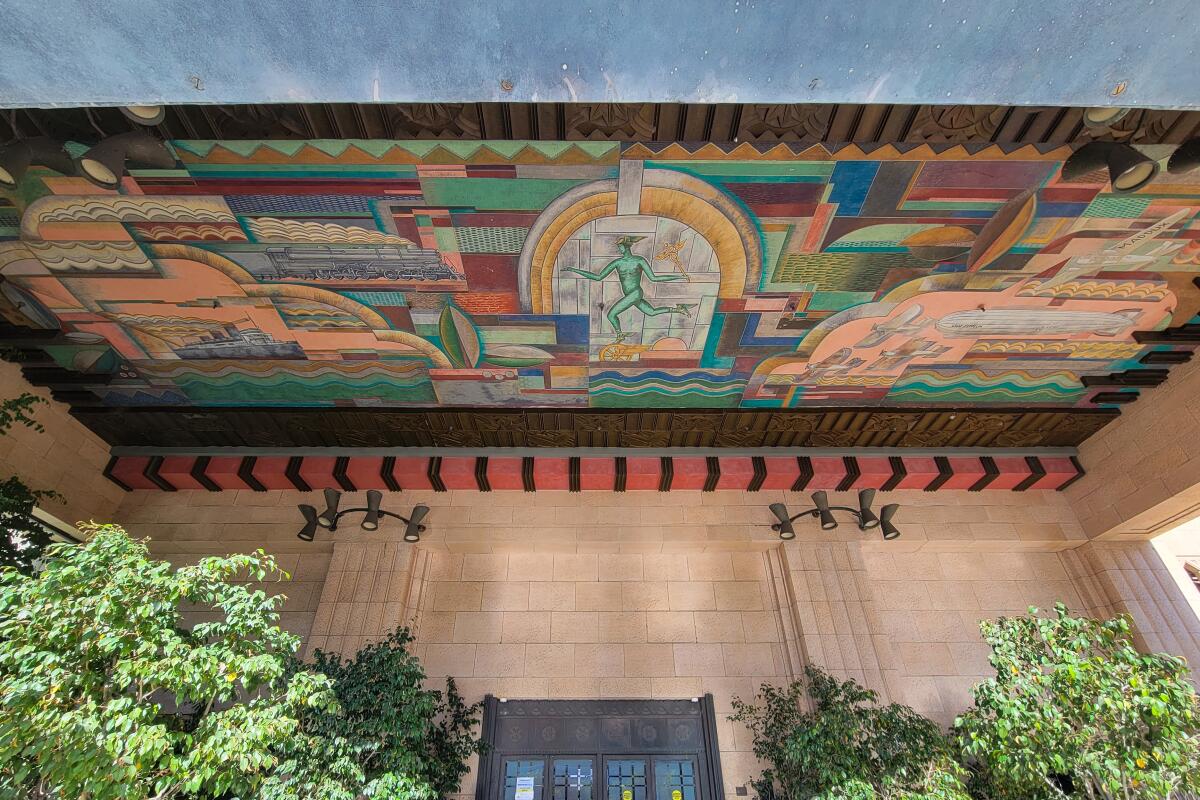
One of the last places you can experience the department store the way my grandmother did is on Lake Avenue in Pasadena. The Bullocks (now Macy’s) was one of her favorites: A whimsical space that transports you back in time with vintage fixtures and furniture, an old-fashioned elevator, and murals and wallpaper galore.
My grandmother would pile us into the car and head to Pasadena “to see how the other half lives.”
Every time Macy’s announces another round of store closures, I hold my breath to see if 401 S. Lake Avenue will be on this list. It’s surviving for now.
Today’s top stories

With repairs nearly completed on a massive water main break that flooded a swath of West Hollywood a week ago, another leak occurred Thursday morning nearby at Santa Monica Boulevard and Laurel Avenue with far less damaging results.
(Myung J. Chun/Los Angeles Times)
Another leak in West Hollywood puts a hold on repair plans
- Workers had already finished repairs on the 3-foot-wide trunk line that sent 17 million gallons of water gushing onto Sunset Boulevard when crews discovered a “pinhole sized leak.”
- But the utility said its plans to reopen Sunset Boulevard have remained intact.
How long will Southern California’s broiling heat wave last?
- Peak temperatures may finally be past us, but you can expect high heat through the weekend.
- A heat advisory is in effect for many areas, including the beaches of Los Angeles and Ventura counties and the southern coast of Santa Barbara County, through 8 a.m. Monday.
ICE detention center detainee numbers hit a new high
- More than 43,000 people were booked into detention centers nationwide in June, new data from the U.S. Immigration and Customs Enforcement show.
- Immigrants without criminal records make up 74% of the average daily population in California detention centers and 79% nationwide.
Graffiti towers begin clean up
What else is going on
- Homelessness has increased in L.A., dealing a fresh setback to Mayor Karen Bass.
- Another cyclosporiasis outbreak is being investigated as cases of the diarrhea-causing illness continue to mount.
- A new drug could help people stricken with Valley fever.
- GOP gubernatorial candidate Steve Hilton pleads his case to anti-Trump voters.
- California is letting more drivers add their license and ID card to their phones. Here’s how.
- In L.A., playing ball in the streets is a crime. A City Council member wants to change that.
Commentary and opinions
This morning’s must-read
Another must-read
For your downtime

Mickey Mouse beignets from Royal Street Veranda, a quick-service outdoor restaurant at New Orleans Square in Disneyland.
(Bill Addison / Los Angeles Times)
Going out
Staying in
A question for you: What do you like about daylight saving time?
Susan H. writes: NOTHING. I wish we could go back to standard time year-round, or at least for a full six months out of the year instead of four.
Email us at [email protected], and your response might appear in the newsletter this week.
And finally … your photo of the day

Contractors working for KPC Square LLC begin power washing and removing graffiti off the Oceanwide Plaza during a test run of graffiti removal in downtown Los Angeles.
(Allen J. Schaben/Los Angeles Times)
Today’s photo is from Times photographer Allen J. Schaben at Oceanwide Plaza in downtown Los Angeles, where crews have started cleaning the notorious graffiti towers.
Have a great day, from the Essential California team
Hailey Branson-Potts, staff writer
Hugo Martín, assistant editor, fast break desk
Kevinisha Walker, multiplatform editor
Andrew Campa, weekend writer
Karim Doumar, head of newsletters
Shi Bradley, audience intern
How can we make this newsletter more useful? Send comments to [email protected]. Check our top stories, topics and the latest articles on latimes.com.