Ryan Avent is a journalist, author of In Good Faith, and writes a newsletter called The Bellows.
It’s been a long hot summer just about everywhere, but markets seem to think there’s been some cooling across the US economy.
Things felt uncomfortably warm a few weeks ago, as the Iran conflict simmered and Kevin Warsh dissembled. A few chilled-out inflation, employment and retail-sales prints later, the odds of a September rate hike are slipping, and equity prices are once more off to the races.
Could it be the case that demand is slackening? Could this create conditions for a Kevin cut? Never say never, but the totality of the data seems to suggest we’re experiencing structural shifts across the economy rather than any cyclical weakness.
Labour supply is falling
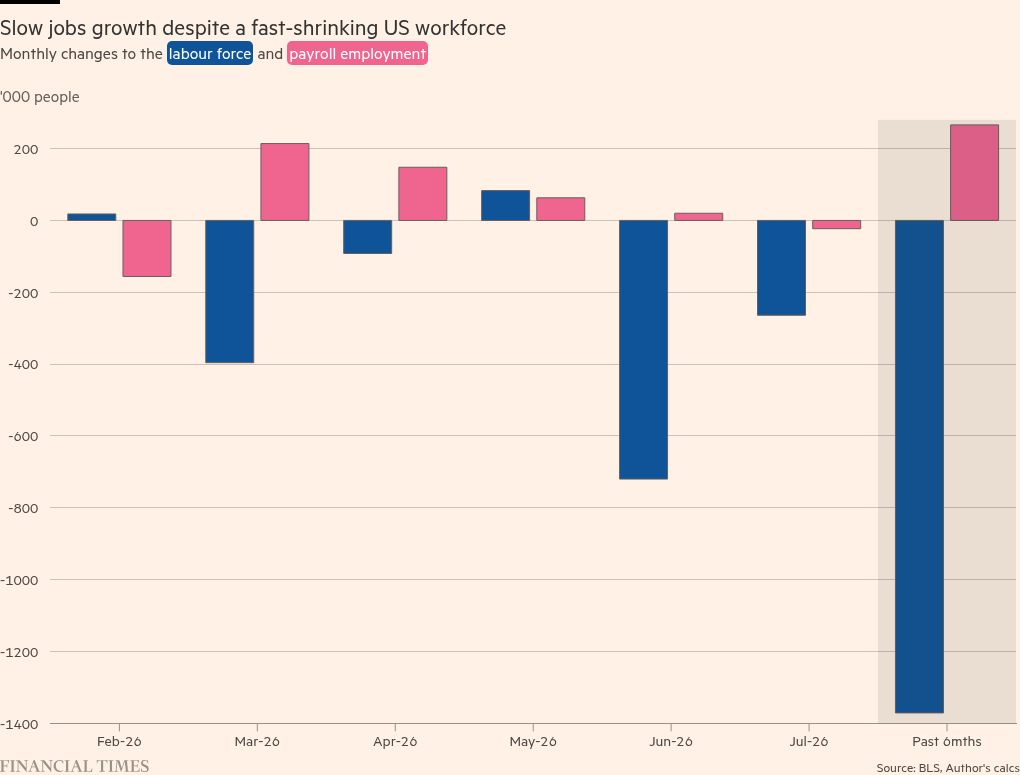
Start with the labour market. The latest jobs report erased just over 100,000 jobs from the hiring numbers announced in May and June and showed an absolute decline in employment in July. Employment growth has now fallen for four consecutive months, which certainly seems like a disconcerting demand signal.
Is it, though? Other indicators of labour market slack look pretty good. For the past two years, the number of unemployed workers per job opening has been basically flat at a level around 1.0, a strong number relative to the pre-pandemic norm. Claims for unemployment insurance remain very flat and very low.
Crucially, reduced hiring looks like a supply-side issue rather than a demand-side one. America’s civilian labour force has been shrinking for months. Relative to last July, the labour force is 1.3mn workers smaller while the level of employment is more than 300,000 workers higher. It certainly looks concerning that payrolls were only 60,000 jobs larger in July than in April, but on the other hand the labour force was 900,000 workers smaller.
This is America’s economic reality now, given demographic change and the ongoing deportation of roughly 50,000 people per month. And in that reality, employment increases like those we saw in March and April are honestly more than the economy can handle.
Consumption is no longer the main driver of growth
Next, turn to the consumer. Last week, we learnt that retail sales declined outright in July, in nominal terms. This was only partly about falling petrol prices, and the drop reflected a second consecutive month of deceleration. Surely, this is evidence in favour of weakening demand?
Maybe it isn’t.
Consumer spending has been the overwhelming driver of economic growth since the pandemic, responsible for something like three quarters of incremental output. But over the past two years, the structure of economic growth has shifted away from such heavy reliance on the consumer. In fact, in recent quarters the contribution to GDP growth from AI-adjacent investment has rivalled that from personal consumption.
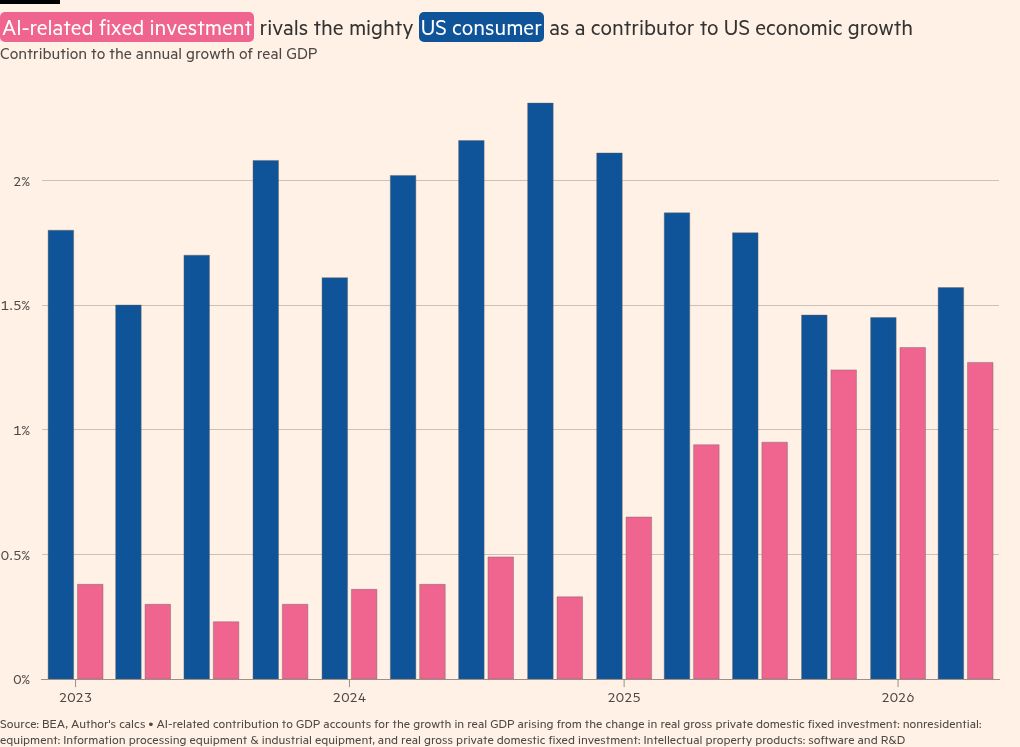
Nonetheless, we might worry that weaker consumption growth leaves the economy more dependent on an investment boom of uncertain durability, and thus more vulnerable to a sharp slowdown. But before we draw this conclusion, we need to understand why consumption is contributing less to growth. If consumers were cutting back amid rising unemployment, that would clearly be bad. Unemployment isn’t rising, though. Something else is.
Interest rates! Since early 2022, when central banks began yanking up policy rates to combat high inflation, personal consumption’s contribution to growth has declined by about 50bps. This has occurred alongside a decline in household debt as a share of GDP, from nearly 63 per cent to under 58 per cent. Federal government borrowing offset this decline exactly, rising from 103 per cent of GDP in 2022 to 108 per cent today. In the first half of 2026, corporate borrowing (which initially fell as a share of GDP as rates rose) also began to climb again, as the AI complex stuck its enormous straws into the credit-market milkshake.
So sure, consumers are watching their spending closely, as they have done since 2022. More importantly, the cost to finance purchases keeps rising. In other words, households are being outbid for scarce capital. Personal consumption is increasingly being crowded out by government consumption and massive AI-related investment, through the mechanism of higher interest rates. That should mean that if and as borrowing in those other sectors slows, interest rates will come down, unleashing latent household demand.*
The big debt crunch
So where does this leave us? The economy appears to be more constrained by supply (of workers, inputs to AI, and loanable savings) than by demand. The pressure is showing up in higher interest rates.
Rates are up a lot; you may have noticed. Since the start of the war, yields on 10-year and 30-year US Treasury bonds are up close to 70bps and 60bps, respectively, unless they’ve gone up even more since I typed this.
Inflation isn’t really the big contributor here. Relative to the immediate prewar period, break-even inflation rates are basically unchanged. I think you can see a Warsh factor in the five-year, five-year forward break-even inflation rate, which is up about 10bps since his first Fed meeting. That should discourage Warsh from concluding that he’s been vindicated by recent data.
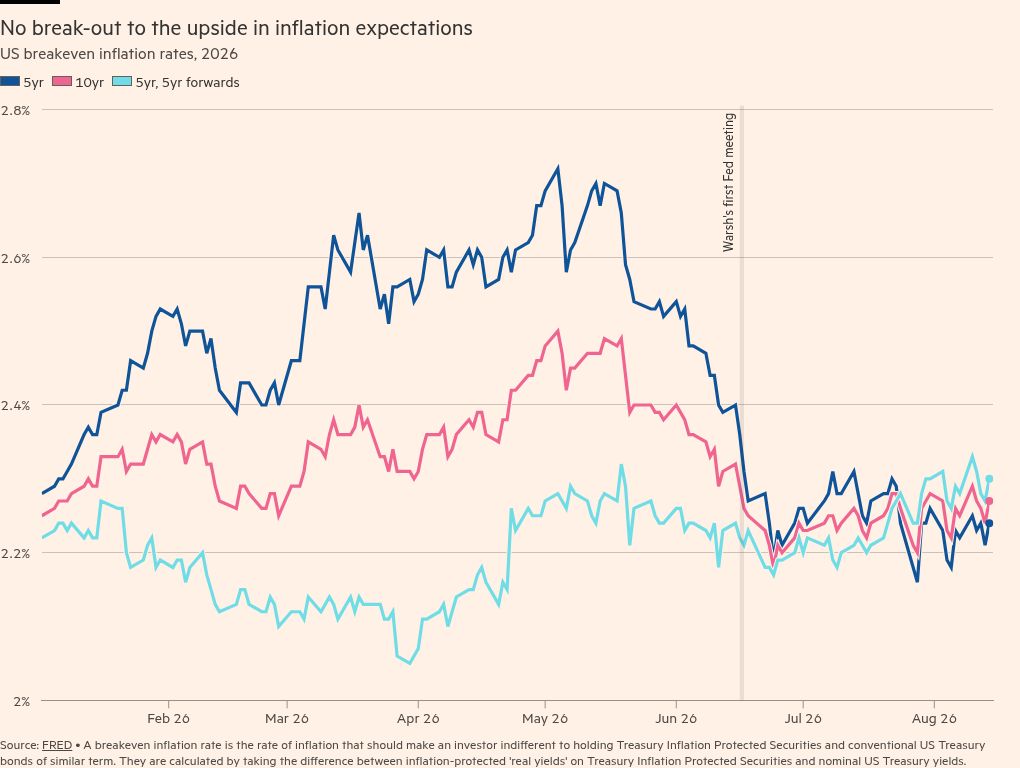
For the most part, nominal yields are up because real yields are up.
Is this the market doing Warsh’s work for him, as the Fed chair suggested in his July press conference? It’s hard to give that idea too much credence. As the chart shows, higher interest rates are not translating into falling inflation expectations, at least not since Warsh took over. Meanwhile, equity-market indices are sitting at or near all-time highs. And despite higher interest rates, financial conditions have actually loosened in recent months.
All things considered, it seems premature to be forecasting a break in the heat. And if the Fed doesn’t work to bring demand into better balance with supply, then the temperatures will keep rising.
*Assuming, that is, that “lower borrowing needs from the AI complex” isn’t accompanied by “major financial crisis”.