Ezequiel Romo’s gang had plagued Panorama City for decades.
Named after Blythe Street — a short thoroughfare flanked by overcrowded apartments — the crew had robbed, stole, peddled drugs and shot up rivals since the 1980s, seemingly untroubled by the city of Los Angeles’ attempts to defeat it.
The city poured millions into fixing blight, lining the street with trees and turning a vacant lot filled with stripped cars into a park. It dispatched extra police patrols, threw up concrete barricades to block roads that functioned as crack cocaine drive-throughs, and obtained an injunction that prohibited Blythe Street members from living in Panorama City.
But the gang endured, and after getting out of prison in 2014, Romo seized control of Blythe Street. In the years that followed, it seems that Romo may have succeeded where the city failed.

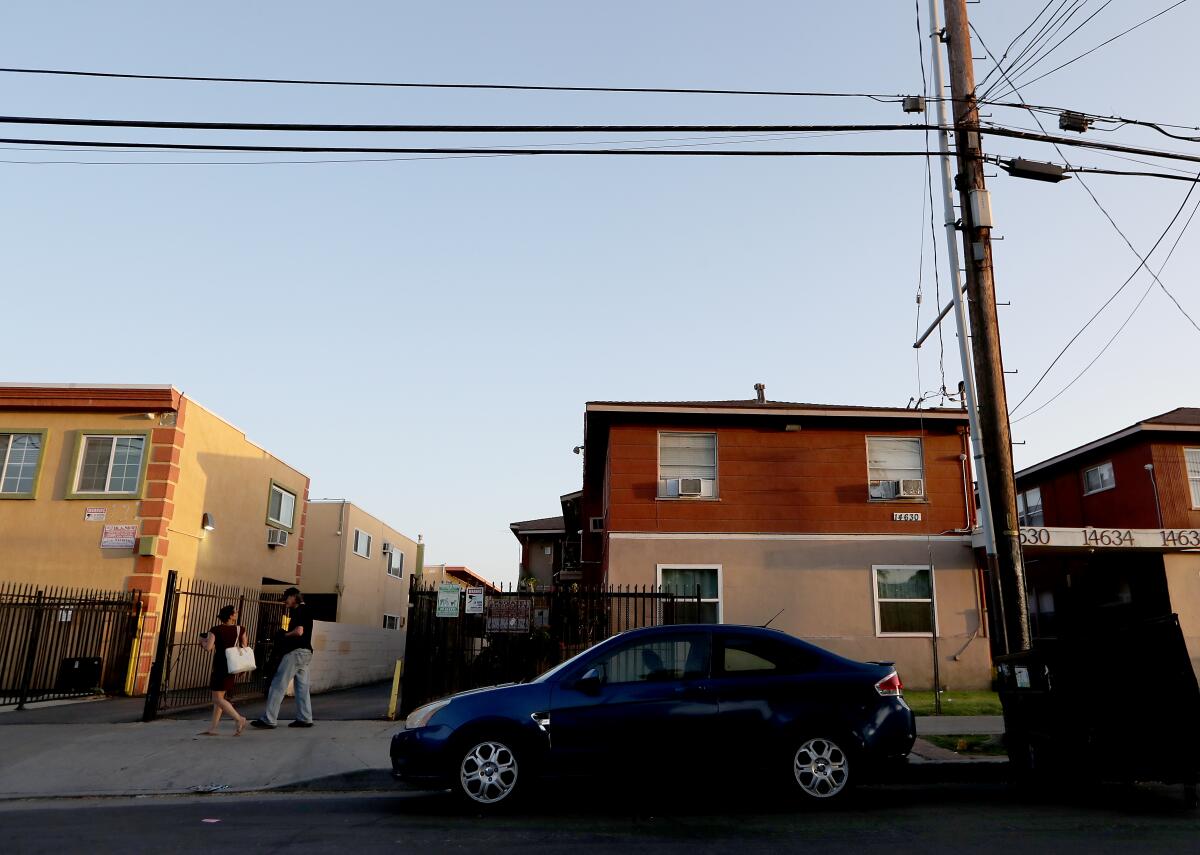
Apartment buildings line Panorama City’s Blythe Street, which was long terrorized by the Blythe Street gang.
(Luis Sinco/Los Angeles Times)
Ruthless and suspicious, Romo ordered the deaths of internal rivals, suspected informants and even a young hanger-on who got an unsanctioned tattoo. The aftershocks of his rule are felt to this day. Earlier this year, two Blythe Street members were convicted of murdering a senior member of their gang whom Romo had deemed a liability. A jury also found the pair guilty of killing a woman who they believed witnessed the murder.
The gang still exists, but most of Romo’s followers are dead, imprisoned or hiding after becoming government witnesses. Blythe Street “is no longer a serious gang,” said Deputy Dist. Atty. Eric Siddall, who prosecuted Romo. “It has no shooters. It has no serious leadership.”
But that’s not to say Panorama City’s ills are over. Every change has unexpected consequences, including the downfall of Romo, who was known on Blythe Street by another name: “Wicked.”
‘The worst block in the Valley’
Panorama City is a poor, mostly Latino neighborhood in the middle of the San Fernando Valley. Master-planned by the steel magnate Henry Kaiser and developer Fritz Burns, it drew families that flocked to L.A. during the post-World War II boom.
As decades passed, Panorama City became home to more immigrants from Mexico and Central America. The neighborhood lost a major employer in 1992 when General Motors closed its plant at the eastern end of Blythe Street, where some 2,600 employees made union wages producing Chevrolet Camaros and Pontiac Firebirds.
That year, The Times ran an article that declared Blythe Street “the worst block in the Valley.” Overcrowded apartment buildings were plagued by vermin, spotty electricity and poor plumbing — but the biggest problem was the gang.
In an affidavit, a police officer reported that some residents learned to carry two wallets, one with a few dollars that could be surrendered when a gang member stuck a gun in their face, and the other with the rest of their money. Children as young as 7 patrolled the neighborhood on skateboards and bicycles with walkie-talkies, paid by the gang to act as lookouts for police.
In another affidavit, Ernani Bernardi, who represented Panorama City on the City Council, described how authorities had put up a barricade blocking an entrance to Blythe Street. It backfired when a car full of out-of-town teenagers took a wrong turn and found themselves trapped between the barrier and some Blythe Street members who opened fire, killing a 16-year-old boy.
“The Blythe Street gang appears to be the most powerful force in the community,” Bernardi wrote, “one that is able to wait out the special eradication efforts of the LAPD and other city agencies.”
The breaking point came on Halloween in 1992. Gang members swarmed the truck of Donald Aragon, who owned a building on Blythe Street, demanding his keys so they could drive to a party in Hollywood. Aragon reached for the revolver under his seat. When the shooting was over, Aragon, 55, lay dead, and a 19-year-old Blythe Street member was fatally wounded.
City officials obtained a court order that made it a crime for Blythe Street members to associate with one another and barred them from living in most of Panorama City.
But the root causes that led generation after generation to join Blythe Street remained: crowded, shabby housing. A drug trade that offered easy money. A general sense of disorder and fear in the neighborhood.

LAPD Det. Gabriel Bucknell investigated the murders carried out by Blythe Street gang members Lorenzo Gonzalez and Eder Mendoza on the orders of gang leader Ezequiel Romo.
(Myung J. Chun/Los Angeles Times)
Gabriel Bucknell, a Los Angeles Police Department detective who years later would investigate Romo, was dispatched to Blythe Street during his first week as a patrol officer in 2001. A group of Blythe Street members had pulled their car alongside a Mexican immigrant who was holding his infant child, Bucknell recalled in an interview.
“Where you from?” they demanded before opening fire.
Bucknell rode in the ambulance with the father and child to the hospital, where the child died. “I remember the dad trying to take the baby,” Bucknell said. “He starts pulling out all the tubes. I had to handcuff the dad because he was trying to take the body.”
Some 15 years later, Bucknell, by then a homicide detective, turned his attention back to what he called “that blighted little section of Panorama City.” Blythe Street members were turning up dead — and he had an idea who was behind it.
WhatsApp, a ‘bandit cab’ and murder
In 2014, Romo was released from prison after serving 18 years for manslaughter and assault. While in prison, Romo became “enthralled” by the Mexican Mafia, said Deputy Dist. Atty. Nicholas Kang, who prosecuted several of Romo’s underlings. Also called La Eme, the Mexican Mafia is a group of about 140 men who oversee Latino gang members behind bars and on the streets of Southern California.
Now back on Blythe Street, Romo wanted to show his gang could do the Mexican Mafia’s legwork in the San Fernando Valley. But Romo found his old gang to be disorganized and aimless. Before he could begin to clean house, he was arrested in 2015 with a pound of methamphetamine in his car. Romo, then 38, was sentenced to four years behind bars.

Oscar Molina took orders from Ezequiel Romo, authorities said.
(California Department of Corrections and Rehabilitation )
Held at Centinela State Prison, Romo used a contraband cellphone to direct shakedowns, drug deals and gun sales in Panorama City. Younger members of Blythe Street did his bidding without question.
“He’s ambitious, he’s disciplined and he’s smart,” said Siddall, the prosecutor. “Those are natural leadership qualities that people gravitate toward.”
Romo’s right-hand man was Oscar “Smokey” Molina, a stocky 34-year-old who seemed delighted to take orders from a prisoner. “Sweet dreams,” he told Romo in a WhatsApp message after spending the day running errands for his boss. “I’m living the night light on for u so the shadow monsters won’t Bug u.”
On Romo’s orders, Molina and others from Blythe Street killed Isidro “Topo” Alba, a veteran of the gang who challenged Romo’s authority; Cesar “Toker” Galvez, a Blythe Street member who failed to return fire when attacked by rivals; and Carlos Rios, a wannabe who tattooed his face with a “B” — an honorific reserved for true Blythe Street members — without Romo’s permission.

Carlos Rios was spray-painting a fence in Van Nuys when a fellow member of his gang, Santos Martinez, shot him in the back on Oct. 28, 2017.
(Los Angeles Superior Court)
In his WhatsApp exchanges, Molina appeared eager to help Romo kill members of their gang. When Molina reported an internal snitch, Romo requested the police report. “I do not want a look stupid killing the wrong dude,” he wrote on WhatsApp. Molina provided the document.
And when Molina said he’d given a lethal cocktail of heroin and battery acid to a Blythe Street member whose loyalty Romo questioned, Romo wrote back: “Purrrrrfect.”
Romo hinted he was on track to become a member of the Mexican Mafia, boasting to Molina that no one else from Blythe Street had “made it this far.”
“U be surprised how people offer me things or ask my opinion instead of some big homies,” he wrote, referring to Mexican Mafia members.
Taking orders from ‘Wicked’
Dutiful as he was, Molina was addicted to heroin. His boss berated him when he slept in and missed calls. “Get ur ass up answer,” Romo wrote. “We got business to talk.”
Romo grew increasingly concerned about Molina’s drug use and suspected him of theft, according to testimony. He handled those concerns in a predictable way.
Just before 4 a.m. on Feb. 10, 2018, Molina got a text from another Blythe Street member, Eder “Mousey” Mendoza.
“I’m outside your pad homie,” Mendoza wrote in a text displayed in court. “I just wanna talk my boy. Low key smoke a bowl too.”
Molina had once allowed Mendoza to live at his apartment after he became homeless, according to testimony. Molina replied in a text: “I’m come outside right now don’t trip.”

Eder Mendoza, a member of the Blythe Street gang, ambushed fellow gang member Oscar Molina.
(Christina House/Los Angeles Times)
Molina stuck a revolver in the waistband of his blue gym shorts. When he opened the door, Mendoza shot him while another Blythe Street member, Lorenzo “Scooby” Gonzalez, stood watch down the hall, according to surveillance footage shown in court.
When the LAPD arrived, they found a woman hiding inside Molina’s apartment. As Karen Tobar pleaded with the officers to let her leave before Molina’s wife showed up, she sent a Facebook message to Mendoza, her on-again, off-again lover.
“Smokey’s dead,” Tobar wrote.
Though he was, in fact, the killer, Mendoza replied, “What the f—!!! What do u mean he’s dead?” He then asked where she was.
“Outside his house,” Tobar said. Then she added the word that likely sealed her fate: “Cops.”
Mendoza and Gonzalez believed Tobar witnessed the killing and was talking to the police, prosecutors argued during the pair’s trial.
A kiss, then a killing
Twelve days later, Tobar got in an unlicensed “bandit cab” with Mendoza and Gonzalez.
The driver, who was identified in court only by his initials, testified Gonzalez directed him to Carey Ranch Park in Sylmar. Mendoza and Tobar shared a kiss in the back seat. When they arrived, Gonzalez told the driver to wait in the car and got out with Mendoza and Tobar.
Only Gonzalez and Mendoza came back. The driver testified he dropped off the two in Panorama City, and Gonzalez paid the fare with drugs.
The next morning, a park employee found Tobar’s body. She lay face down. Her brown leather jacket was pierced with 60 stab wounds, and her throat had been slashed nearly ear to ear.
When detectives arrested Gonzalez and seized his phone, they found a text exchange with his girlfriend, who had erupted in anger when he said he wouldn’t be home the night Tobar was last seen alive.
Gonzalez offered an explanation for his absence. “It was a order from up there,” he wrote. “Wat u want me to do.”

Eder Mendoza, below left, was sentenced to life in prison by Los Angeles County Superior Court Judge David Walgren.
(Christina House/Los Angeles Times)
A jury convicted both men of the murders of Molina and Tobar. Before he sentenced Mendoza in August to life in prison with no chance of parole, Los Angeles County Superior Court Judge David Walgren said of Tobar’s death: “I can only say that was an incredibly brutal and heinous murder.”
Gonzalez has yet to be sentenced. In a separate case, he is charged with yet another murder — of a jail cellmate.
‘No real ones out there’
After Molina’s death, Romo’s new No. 2 told him that rivals were encroaching on Panorama City. “No real ones out there,” Romo remarked in a WhatsApp message. “Let them kill those fake blytheros.”
He showed little regard for those he felt contributed nothing. Told a Blythe Street member in a wheelchair had been taunted by the rival Columbus Street gang, Romo wrote: “They should did us favor.”
In 2023, Romo was convicted of murder, attempted murder and conspiracy crimes and sentenced to life without parole. Seven of his followers also were sent to prison for life.
With Blythe Street weakened, a Black gang called the Original Valley Gangster Crips saw an opening. The morning of Feb. 8, 2024, two gunmen ambushed a Blythe Street associate, Luis Gaona, outside the same Tobias Avenue building where Molina died.
Prosecutors charged three men with Gaona’s murder: Anthony “Devious” Coleman, Joshua “H3” Barney and Javel “2K” Thomas. The investigation took a dark turn when authorities learned that Thomas had been accused of a sex crime, a charge he denies. According to a detective’s testimony at a preliminary hearing, Thomas raped a 15-year-old girl while forcing her to insult Blythe Street.
In an affidavit, a detective wrote the battle over drug turf was “creating conflicts between many of the Black residents in the neighborhood and Blythe Street.” Six months after Gaona was killed, Clyde Moore, a 70-year-old Black man, stopped his car outside the same Tobias Avenue building. Prosecutors allege that Andrew Lopez, a Blythe Street member, shot Moore in the head. Lopez has pleaded not guilty to a murder charge.
Romo, meanwhile, had been sequestered for his own safety after officials concluded the Mexican Mafia wanted to kill him, according to prison records. After Romo — who dismissed the threats as “jail rumors” — demanded to be housed in general population, authorities sent him to Centinela, the same desert lockup from which he directed the purge of his gang. Not long after he arrived, three inmates stabbed him to death.
The motive for Romo’s killing remains unclear. Some informants claimed Romo double-crossed people in the L.A. County jail drug trade, Siddall said. Another possible reason: Romo held himself out as a Mexican Mafia member when he was not.

Ezequiel Romo tattoed a butterfly, a symbol of the Mexican Mafia, on his neck.
(California Department of Corrections and Rehabilitation)
“He got ahead of himself,” said Bucknell, the detective. “He made some bad choices and stepped on too many toes. Or the wrong toes.”
Just as the young man whose death Romo ordered had inked a “B” on his face that he did not earn, Romo had tattooed his neck with one of the Mexican Mafia’s symbols — a butterfly whose wings form the letter “M.”