Unlock the White House Watch newsletter for free
Your guide to what Trump’s second term means for Washington, business and the world
It’s not necessarily insane to keep trying the same thing and expecting a different result, but without doubt it’s exceedingly foolish. Just when you thought Donald Trump was thoroughly engaged with other misadventures like the Iran war, he decided to pick another tariff fight with a neighbour that has faced him down before. With inflation posing a risk to his already slumping popularity, Trump’s tariff follies are politically ever more ill-advised.
As I wrote earlier this week, the demands the US apparently made of Canada in return for holding off tariffs were so politically toxic that it would have been impossible for Prime Minister Mark Carney to accept them. Unless, improbably, that was the US plan, it was a terrible misjudgement.
Familiar problems beset Trump’s tariff campaign. Canada is principally a supplier of energy and intermediate goods like lumber, aluminium, car parts and potash for fertilisers to the US. Blocking them principally hurts US industries.
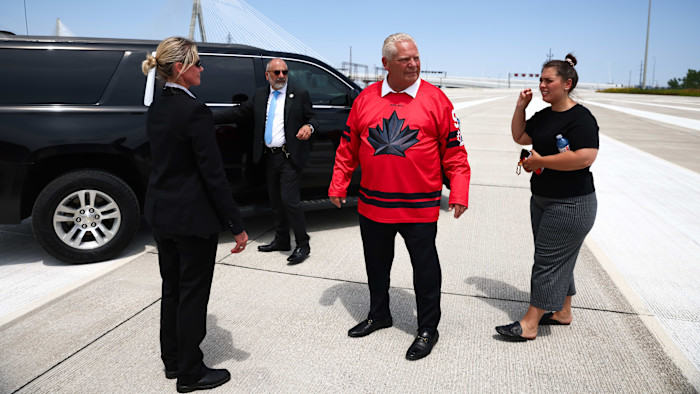
Far from weakening the target country’s resolve, a mindlessly aggressive campaign frequently unites it in opposition. One prominent weathervane is Ontario premier Doug Ford, who since Trump’s inauguration has oscillated between proposing a “Fortress North America” trade relationship with the US and expressing belligerent opposition. This week he tested the boundaries of conventional diplomacy with an invitation to Trump to “kiss my ass”.
The other lesson Trump has failed to absorb is that tariff wars don’t actually do much damage, except to the US’s credibility. The research service Global Trade Alert estimates that the steep tariffs Trump is imposing now, unless they escalate to the destruction of the US-Mexico-Canada (USMCA) trade deal, raise Canada’s average US tariff by just 1.9 percentage points to 6.3 per cent.
The consultancy Oxford Economics estimates that even including Canada’s dollar-for-dollar retaliation — Ottawa announced reciprocal tariffs on $20bn of imports on Tuesday — the tariffs will reduce Canada’s annual GDP growth over the next year by only 0.3 percentage points and permanently reduce its level by 0.2 per cent. (By comparison, Brexit has recently been estimated to have permanently reduced UK GDP by 6-8 per cent: that’s what a proper trade shock looks like.)
I’ve long hoped a country targeted by Trump would simply shrug its shoulders and decline to retaliate, resisting the temptation to shoot itself in the foot just because the US has. Sadly, governments evidently think Trump will take that as a sign of weakness and raise tariffs further, and therefore feel the need to be seen to be hitting back.
Ultimately, even for an open exporting economy like Canada, modern advanced countries are dominated by their domestic service sectors, not goods exports. The Canadian economy is hurt much more by services and product barriers between its provinces than anything Trump has done.
Even the expanded 50 per cent tariffs that Trump is threatening from January 1 would push the average tariff up to 11 per cent, damaging but not catastrophic. In reality, given the very long lead time, I’m assuming those tariffs will never happen, and that Canada negotiates a more reasonable deal before then. Of course, if Trump smashes USMCA to pieces the damage will be considerably greater, but that would be a truly self-destructive act by the US.
Trump has now spent a year and a half throwing rocks into the rivers of world commerce, only to find trade flowing over and around them. He set out in his second term determined to stop China simply rerouting its exports to the US through third countries, as happened during his first. The howling anger of the White House’s recent screed against what it wrongly calls “transhipment” shows he knows he is failing.
How long will his experiment continue? Consumer prices have been rising rapidly. Although much of the increase in core inflation is in services, tariffs will mean Trump catches at least some of the blame — just as Joe Biden unfairly got a lot of flak for inflation because of his fiscal stimulus.
Perhaps there are echoes from the past. As noted before, there are some parallels between Trump’s experience with tariffs and that of Richard Nixon, another president who started off practising protectionism and then retreated. Fred Bergsten, the director emeritus of the Peterson Institute think-tank, served in the Nixon administration and remembers a fierce internal battle in 1970 over a modest rise in meat import quotas, particularly the cheaper meat used for hamburgers.
But by 1972, with food prices rising quickly and an incipient El Niño weather system pushing them higher, Nixon suspended meat quotas altogether. Trump last week similarly announced a suspension of tariffs on 300,000 tonnes of ground beef, kicking off a similar fierce political debate. He also faces what looks like a huge El Niño episode later this year.
How and when this extraordinary exercise in self-destructiveness will end is anyone’s guess. But with each iteration, Trump’s trading partners should be that bit more confident that his tariffs are a measurable threat that can be dealt with, not a catastrophe to be avoided at all costs.