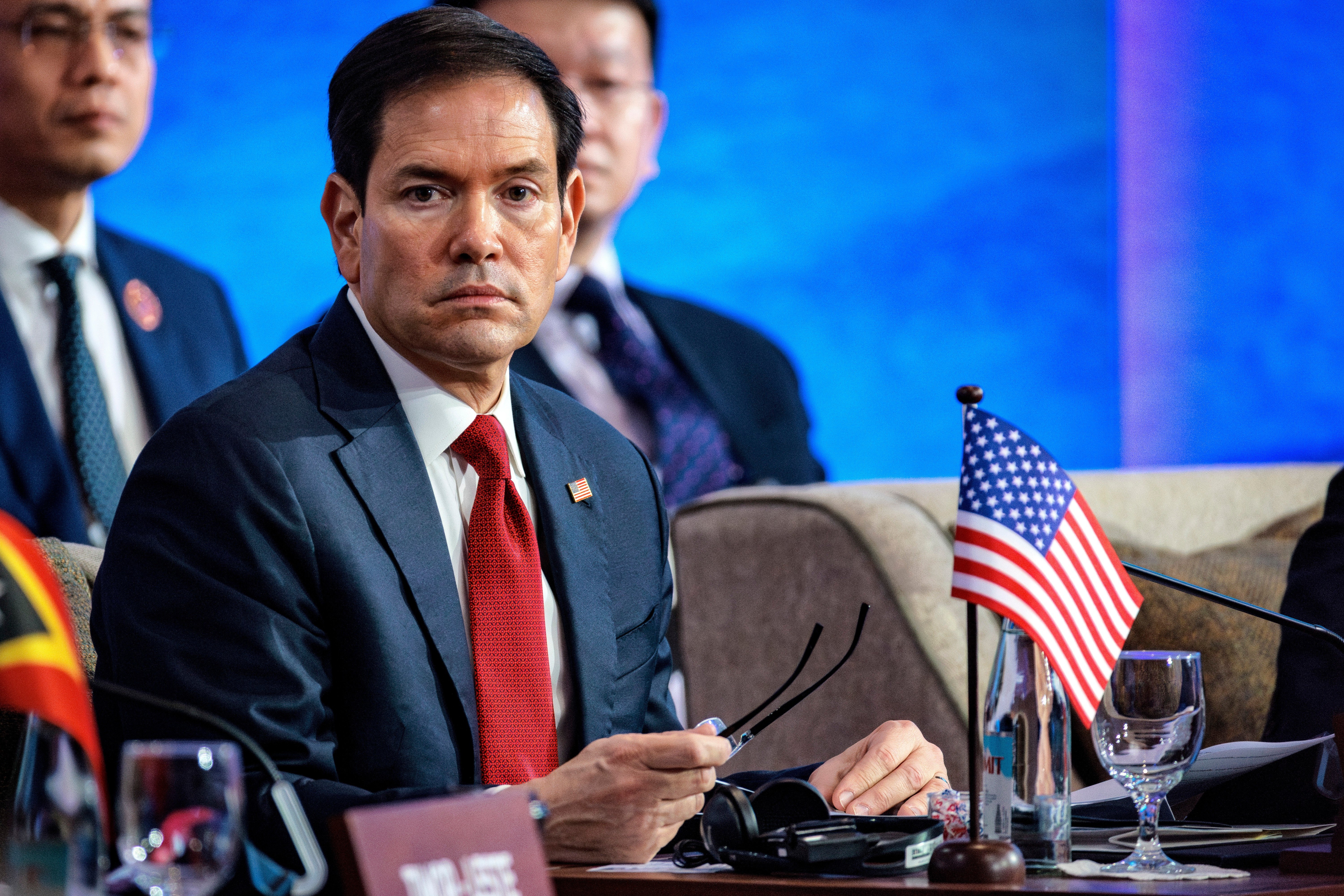
U.S. Secretary of State Marco Rubio said Thursday the Trump administration is poised to help end the “senseless war” in Ukraine but acknowledged there is no quick path to a deal, saying diplomacy will require sustained effort and new ideas.
Rubio, who earlier held talks with his Russian counterpart Sergei Lavrov, said Moscow and Kyiv should have the incentive to end a “very bloody war” that devastated both sides.
Rubio alluded to how U.S.-mediated talks have stalled, calling them “unsuccessful or at least unfruitful” in the past but insisted President Donald Trump was committed to the work “if conditions and factors have changed to make that possible.”
“That’s been the challenge, an end that both sides can accept. And we’ve tried and we’ll continue to try to see if we can, you know, find a middle ground that brings this about. And we’re prepared to play that role if the opportunity presents itself,” Rubio told reporters.
Lavrov largely ignored questions from reporters but the Russian Foreign Ministry in Moscow said he emphasized to Rubio “the unacceptability of further arming” Ukraine and “the destabilizing policies of European countries, which continue to seek a ‘strategic defeat’ for Russia.”
Lavrov reiterated Russia’s readiness for “a political and diplomatic resolution of the conflict” and commitment to agreements reached at a summit between Russian President Vladimir Putin and Trump in Alaska last year, the Russian ministry said.
Washington’s military support for Ukraine remains unchanged, with arms transfers continuing through NATO’s PURL initiative, Rubio said.
“There’s been no change to our policy in that regard. We want a peace deal. We want the war to end,” he added.
ASEAN talks focused on international conflicts
The meeting was held on the sidelines of an annual gathering by foreign ministers of the Association of Southeast Asian Nations in Manila.
Three days of closed-door talks that started Tuesday have focused on the resurgent war in the Middle East, the conflict between Russia and Ukraine and, closer to home, the South China Sea, where a new clash flared Thursday.
Before Rubio and Lavrov met, they ignored shouted questions from reporters about whether Russia was helping Iran by providing targeting data on U.S. locations in the region and when Russia would stop its war in Ukraine.
Lavrov did not answer questions but appeared to be challenging reporters by saying, “Speak louder,” even though the room was quiet and questions could be clearly heard.
When he left the meeting about half an hour later, Lavrov was asked again if Russia is helping Iran target U.S. troops.
“Nice hairstyle,” he said while staring at the reporter.
U.S. efforts to broker an end to the Russia-Ukraine war have dropped off as indirect talks stalled and the Iran war took center stage. Renewed strikes by Washington and Tehran have been intensifying after an interim ceasefire deal collapsed.
Rubio told reporters in Manila on Wednesday that he planned to raise the conflict in Ukraine with Lavrov, saying that the U.S. remained open to playing a role in ending the conflict “if that opportunity presents itself.”
He acknowledged that those efforts have “kind of fallen off a little bit over the last few months” but said the meeting would explore whether there’s an opportunity to renew talks.
“We have to have a relationship with the Russian government, even though we have areas of disagreement,” Rubio said, noting they are the two largest nuclear-armed countries.
Lavrov, speaking to reporters earlier, said he would ask Rubio about the latest statements by U.S. President Donald Trump predicting that a settlement is getting close.
Expectations for renewed discussions about ending the war comes as Ukraine has made significant progress this year but a rift between defense leaders has threatened to derail its efforts. President Volodymyr Zelenskyy has undertaken a major government reshuffle, including its top military brass.
But Ukraine would not be the only issue on the table. Rubio said he would use the meeting to find other areas of potential cooperation between the U.S. and Russia — the kind of wide-ranging agenda that the ministers have touched on in their huddles around the ASEAN meeting.
China defends maritime military actions
Australian Foreign Minister Penny Wong renewed her country’s alarm over the Chinese navy’s recent test-launch of a missile from a nuclear-powered submarine in the region, which she said “came with too little information and notification, including to the Philippines — over which the missile flew — and Pacific nations, near where the missile landed.”
“It comes in the context of a rapid military build-up of China’s nuclear arsenal without the transparency or reassurance the region expects,” Wong told a university forum in Manila on Thursday. “This is why Australia has described the test as provocative and destabilizing.”
China has defended its actions, saying the launch was part of annual exercises and that it gave countries in the area appropriate notice in advance.
Rubio also had a long meeting Wednesday with Chinese Foreign Minister Wang Yi and separately with Indian External Affairs Minister Subrahmanyam Jaishankar.
Rubio told reporters he and Wang discussed a new altercation this week between Chinese and Filipino forces in a disputed shoal in the South China Sea, which Beijing claims virtually in its entirety. Rubio called the incident “escalatory.”
“Those need to be managed very carefully, because obviously, a conflict — be it economic or otherwise — between the U.S. and China would have a dramatic global impact,” Rubio said.
In Beijing, the Chinese coast guard said it took necessary measures, including monitoring and blocking, to drive away two Philippine ships that disregarded repeated warnings from the Chinese side in a confrontation on Thursday.
China said its operations were professional and lawful and urged the Philippines to stop its provocative actions infringing on Chinese territory. Philippine officials did not immediately issue a comment.
The Trump administration has repeatedly criticized China’s assertive actions in the South China Sea to the disadvantage of smaller claimant countries like the Philippines, Washington’s oldest treaty ally in Asia. Taiwan and ASEAN members Vietnam, Malaysia and Brunei have also been involved in the often-tense territorial standoffs.
ASEAN foreign ministers discussed the territorial disputes Tuesday, welcoming progress in yearslong negotiations between China and their regional bloc on a proposed non-aggression pact that both sides hope to conclude this year, according to a draft of a joint communiqué seen by The Associated Press.
The so-called code of conduct aims to prevent a major conflict in the disputed waters, a key global trade route, that could draw in the United States.
___
Associated Press journalists Ken Moritsugu in Beijing, Haruka Nuga in Bangkok and Fu Ting in Washington contributed to this report.