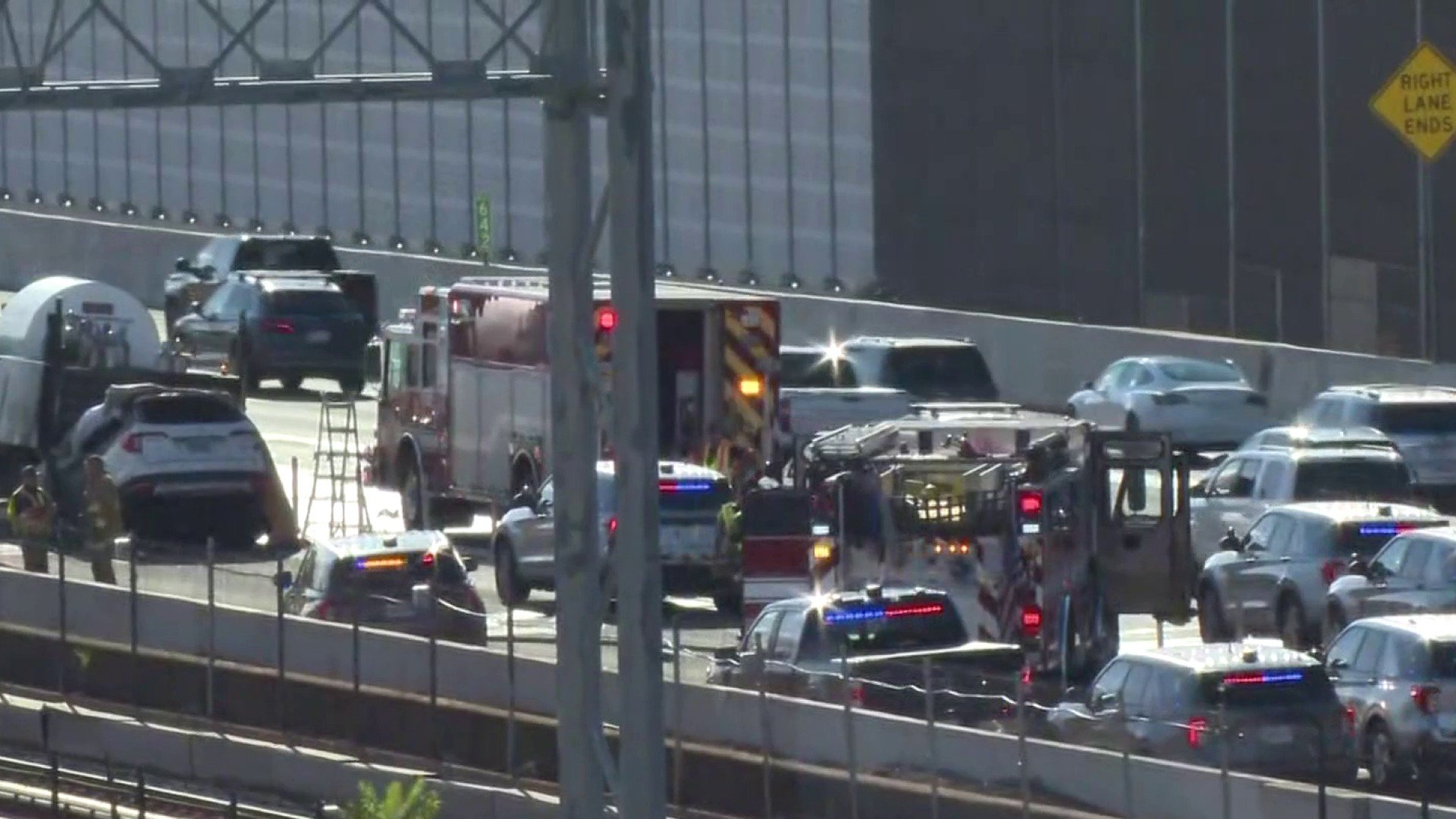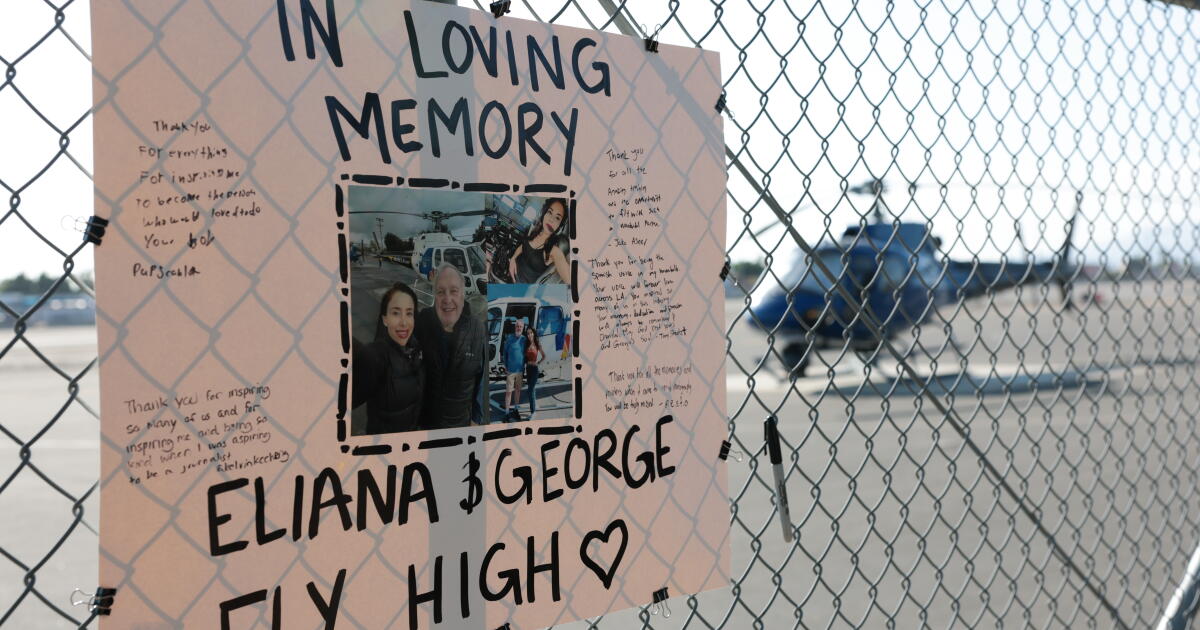
NBC4’s helicopter was one of several news aircraft flying over the scene of a deadly bus crash in Chatsworth on Tuesday evening at sunset.
It’s common for multiple news choppers to arrive at the scene of breaking news, beaming live images for newscasts and streaming.
But around 7 p.m., something went horribly wrong. In a matter of seconds, the NBC4 chopper dropped out of the sky, crashing into shipping containers and vehicles outside a warehouse a few blocks away, bursting into flames. Two station journalists, reporter Eliana Moreno and pilot George Marciniw, were killed along with a bystander on the ground.
Federal investigators are now trying to figure out what went wrong. The Times interviewed several experts, who reviewed recordings of the chopper’s final moments. They offered insights into the helicopter itself, its movements that afternoon and what is known about how its mechanics work.
Here’s what they had to say.
Low altitude flying, then a horn
A video stream from the helicopter, as it was covering the bus crash, appears to show the helicopter hovering just before it came crashing down. An alarm can be heard blaring as the helicopter appears to be quickly losing altitude.
That alarm would be triggered by a potential engine failure, causing low propeller rotation, or a problem with the hydraulic system, said Jack Cress, a former helicopter pilot for the U.S. Marine Corps and a helicopter accident investigation instructor at USC’s Aviation Safety and Security Program.
If the helicopter suddenly loses revolutions per minute, or RPMs, there is a safety maneuver known as autorotation, in which the pilot can try to gain enough momentum and upward flow on the rotor blades as it descends and moves laterally to increase rotation and control its landing. But Cress said the fact that the helicopter appeared to be hovering in the air, and at a low altitude, would make it difficult for the pilot to execute the maneuver.
Jeff Guzzetti, a former National Transportation Safety Board and Federal Aviation Administration investigator as well as an instructor in USC’s Aviation Safety and Security Program, also believes the horn heard in the video was a low rotor RPM alarm, he said, and that the audio seems to indicate a mechanical problem moments before the crash.
“You can hear something mechanical that is winding down in the background,” he said. “It does seem like something mechanical suddenly happened to the helicopter while it was in stable flight.”
What investigators are saying
NTSB investigators have also zeroed in on that recording. In it, the sound of the engine’s motor winds down and a horn blares, possibly warning the pilot that the main rotor speed had dropped too low or the helicopter had lost hydraulics. Moreno responds to the noise with a quiet, “Uh-oh.”
The angle of the camera begins to descend and Moreno is heard asking, “You can’t pull up?” before the video cuts out. Moreno, Marciniw and 29-year-old Edy Gutierrez Mejia, who was on the ground when the chopper went down, were killed.
“That video is probably the most important piece of evidence we have recovered so far,” said NTSB Investigator Fabian Salazar.
‘A dangerous place to be’
Cress compared the autorotation maneuver to a fixed-wing airplane gliding through air with the force generated by its wings, but the helicopter would use the upward force on its rotors caused by descending, or moving forward, to make the rotors turn fast enough to keep itself in the air.
In this case, Cress said, the pilot may not have had that chance.
“He’s in the worst part of the height-velocity curve,” Cress said, referring to a chart referenced by helicopter pilots that tracks height and air speed for safe flight conditions. “That is a dangerous place to be.”
Helicopter pilots are trained to stay away from those conditions, Cress said, because the lack of altitude and forward momentum give them little recourse if there is engine trouble.
But Cress points out that for news helicopters, and police choppers, hovering and maintaining low altitude is a common practice.
So what about the helicopter itself?
Thomas Anthony, director of USC’s Aviation Safety and Security Program, said the AS350 B2 helicopter in Tuesday’s crash is not only a popular helicopter to see in the skies, but one that is typically very reliable.
It is the most commonly used helicopter for both law enforcement and news gathering, he said, adding that it’s “the workhorse of the helicopter fleet.”
The helicopter is known for its reliability, is easily fixed when an issue arises, and has a reputation for “robust maintenance support” from its manufacturer, Anthony said.
But the nature of the work in both news and police helicopters increases their risk, Anthony said. While pilots and instructors stress standardizing procedures and flight paths, news incidents such as police chases, fires and crashes force pilots into new conditions during every flight.
The AS350 B2, Cress said, is a reliable model and popular across the globe with a good safety record. But he added some of the features that make the model reliable may have contributed to the crash.
“In 999 out of 1,000 flights, this is a great helicopter,” Cress said.
The single-engine and light design is reliable and maintains a good track record, but Cress said any kind of engine failure can also mean there’s no secondary engine to help the pilot bring the helicopter down.
The light design of the rotors also means that if there is an engine failure, the light blades can lose their momentum in rotation quickly, Cress said.
Those conditions of hovering in the air, with little altitude and no momentum are commonly referred to by helicopter pilots as a “dead man’s curve,” said Guzzetti.
“That’s the worst place to be if you have a problem,” Guzzetti said.