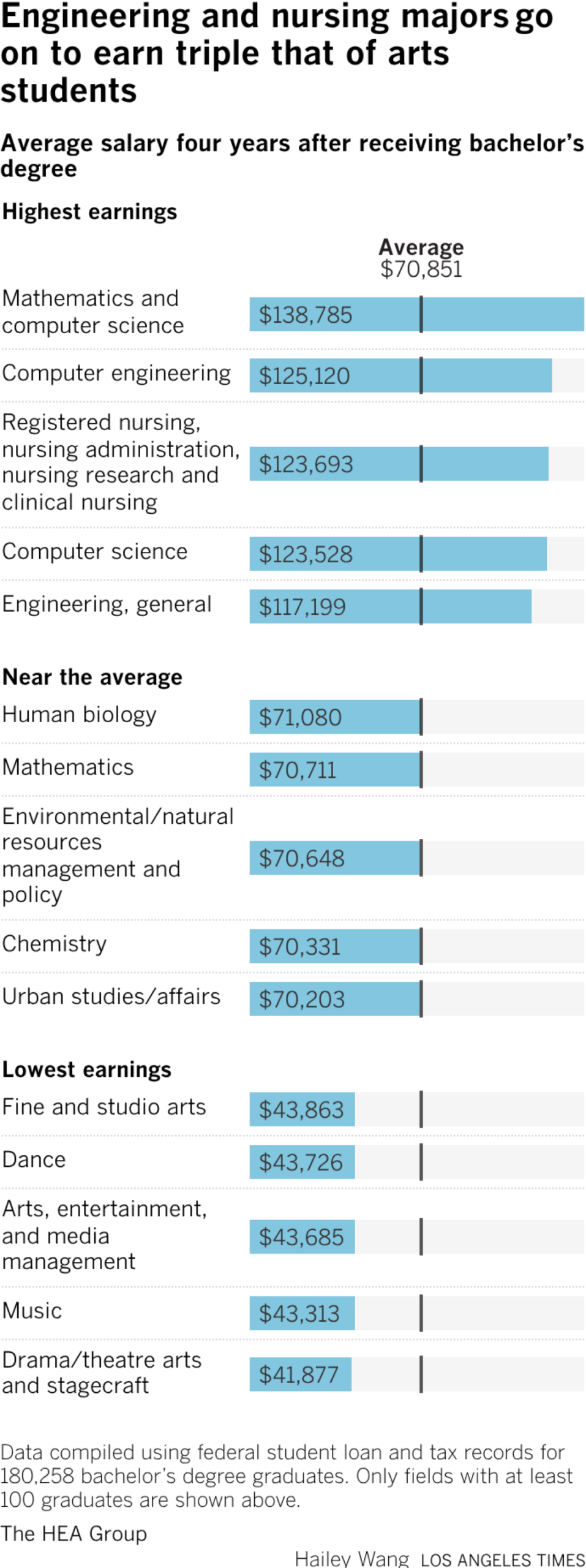
A new analysis of California data shows that four years after college graduation, students who obtain among the most competitive and in-demand bachelor degrees, mostly tied to fields in STEM — science, technology, engineering and math — are the highest-earning graduates, with salaries over $100,000 a year.
Also among the top tier is an ultracompetitive nursing degree, which translates to an annual income at about $125,000, according to an analysis released Friday by the HEA Group, a national education research firm. The highest-earning degree is a combination mathematics and computer science program with an average income of nearly $140,000.
Many humanities and social science majors — pursued by students with a passion for sociology, history, art, music and English — tend to earn far less, around $40,000 to $60,000, the data show.
And there is the middle rung, including business administration, urban studies and chemistry, whose graduates take home around $70,000 on average.
The analysis comes amid a changing landscape in higher education as parents and prospective students are increasingly questioning the value of postsecondary education, evaluating how a tuition investment on a future degree will translate into a job and salary years later. Also, when it comes to borrowing money to attend college, the Trump administration is addressing the student loan default crisis by cracking down on colleges whose graduates routinely make low incomes by restricting their ability to accept federal student loans.
The analysis, which includes a searchable database, covers nearly 3,000 certificate, associate and bachelor programs at private, nonprofit and public universities across California.
It does not breakdown income by graduates at specific universities, nor does it take into account how degrees can provide an enriching education that sets students up for graduate degrees — and higher-paying jobs years down the line as attorneys, business executives and corporate managers, for instance.
The difference in earnings potential in large part reflects today’s modern economy and America’s tech and healthcare needs. But in general, even a degree in the humanities and other non-STEM fields tends to result in higher incomes compared with those who never finished college.
Graduates of English bachelor programs, for example, earned an average of about $55,000 four years after completion compared with an average of $36,082 for people who only graduated high school, HEA’s analysis shows.
Across all programs, those who graduate with professional certificates — such as HVAC maintenance and precision metal working — earn nearly $6,000 more annually than someone with only a high school education.
Students who earn associate degrees, largely granted by California community colleges, earn $24,000 more than someone who only graduated high school. Bachelor degree holders earn $35,000 more.
“This report shouldn’t be viewed as a comparison of good and bad majors — a social work degree and a computer science degree exist for very different reasons and both have different kinds of values beyond a paycheck,” said Michael Itzkowitz, president of the HEA Group. “This is about being better informed.”
Itzkowitz said one way potential students could use the database, which draws from federal data, is to find how much they probably would make in their field of choice and then pick a college that offers the education at a cost they can afford.
“It’s just critical that folks have this information upfront, because historically sometimes we’ve seen people who are spending large sums of money, without an understanding that they would actually be earning less than expected,” Itzkowitz said.
Ted Mitchell, president of the American Council on Education, cautioned against picking a less expensive college solely based on the HEA data, because such statewide data doesn’t break down average earnings by individual institutions, which can vary.
Still, he said called the tool a “good contribution.”
“You are much less likely to be surprised and disappointed at the end,” Mitchell said. “You know what you are signing up for.”
Here’s a breakdown of the top-five-earning bachelor degrees, the middle five and the bottom five:

The top earning certificate program and associate degree programs with at least 100 graduates were registered nursing, nursing administration, nursing research and clinical nursing, with earnings over $100,000.
Nursing schools are hard to get into because there are not enough spots to fill demand. But for students who do get a spot, they can expect to make more than some of the most popular bachelors degrees — at least within four years.
Graduates of the state’s most popular major — business administration, management and operations — earned an average of just over $74,000.
The second-most-popular bachelor’s degree was psychology, whose graduates earned nearly $54,000 four years after completion.