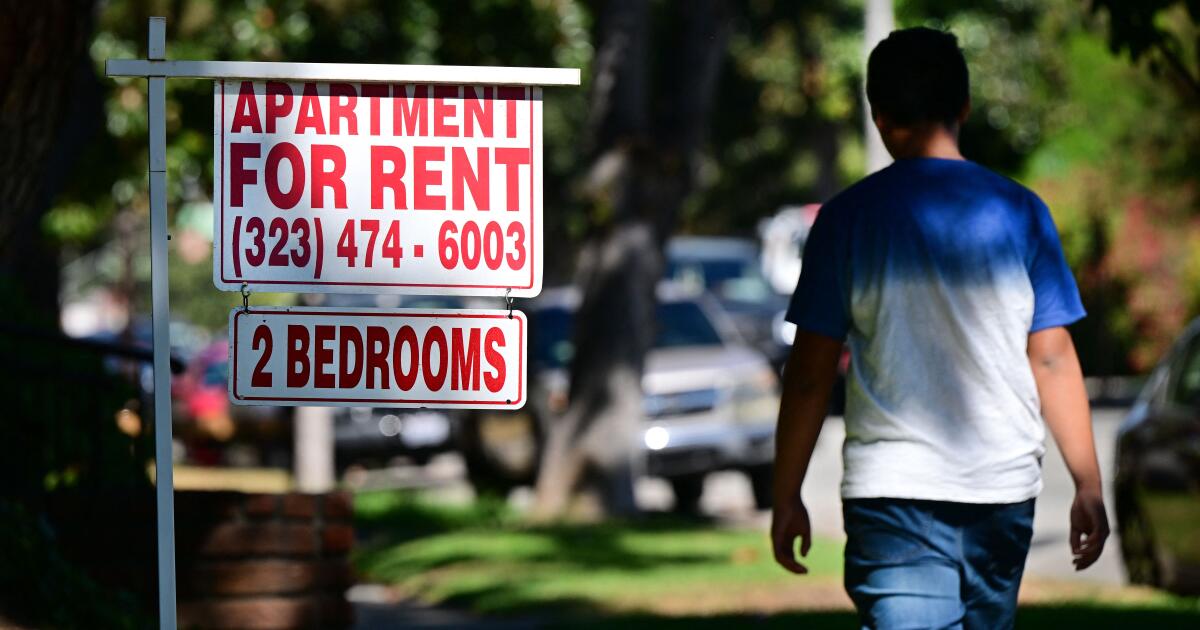
Some Los Angeles-area renters may feel a secret shame of not owning their homes, but maybe they should be bragging. Right now, renting is a much better deal.
People in the Los Angeles-Long Beach-Anaheim metropolitan area looking to get into a smaller home on average would save more than $2,000 a month by renting rather than buying, according to the latest estimates from Realtor.com. That’s a lot of potential savings to invest and hold until interest rates and home prices cool.
Last month, for homes with up to two bedrooms, the gap between the median rental cost per month and monthly cost of buying
was the highest in the 50 largest metropolitan areas in the U.S., according to the real estate listing and data company. The median cost to buy in the Los Angeles area was $4,836 per month, while the median rent for the same size homes was $2,787, a $2,049 difference.
The average gap in the U.S. was $858. In New York, it was $1,823.
Jiayi Xu, a senior economist at Realtor.com, said starting out with a rental may help those still hoping to buy a home in the long run.
“The monthly savings, like the $2,000 renters enjoy relative to buying [in L.A.], can be put directly towards the down payment, which could create a faster path to homeownership,” she said.
Developers say there is limited supply of new homes because the costs of land and labor, as well as the regulations, taxes and fees connected to construction, make it difficult to profit from projects in and around L.A.
The gap favoring renting has persisted for years, according to Realtor.com data. Nationwide there has been 36 consecutive months of annual rent decreases nationwide, even as mortgage rates and home prices have remained stubbornly high in many metropolitan areas.
Indeed, condominium prices have been cooling in L.A. , but people continue to prefer to rent. Condominium buying recently fell to a 20-year low as potential buyers have been discouraged by high interest rates and building fees.
The advantages of renting could be good news for many people in L.A. More than 60% of occupied housing units in L.A. County are occupied by renters.
Of course, many residents rent because they can’t get a mortgage. But even for those who have the ability to buy, renting can still be a better choice if renters invest the savings rather than spend it.
Although people think they have to buy a home to avoid being exposed to rent hikes and to profit from rising real estate prices, the huge commitment of a mortgage sometimes isn’t the best option, said Richard Green, director of the USC Lusk Center for Real Estate.
“There are still good reasons to buy, but is it a slam-dunk better investment than renting and taking the money that you would have put in a house and instead put it in an index fund or something?” he said. “It’s not clear that the financial benefits in Los Angeles of owning are superior to the financial benefits of renting, maxing out on your 401(k), and investing in some sort of diversified fund.”
Meanwhile, renting leaves people the flexibility to buy later when conditions have improved.
This is not to say that the costs of rent and homes in Southern California are reasonable. For years, the L.A. housing market steadily has grown more unaffordable. The environment for renters and buyers is “terrible,” and would require much more affordable housing to improve, Green said.
“We just don’t build stuff,” he said. “I mean, we really haven’t for years. It takes forever to get anything built here.”
Fewer people are moving into California because of the cost of housing, he said, and that is what is pushing rental prices lower.
“I think prices reached a point where people are just not moving here,” Green said. “That relieves pressure on the market, and so we have seen vacancies go up, even though we’re not building”
Xu said that in the L.A. area, the numbers suggest the advantage of renting, at least for smaller homes, could be increasing. Recent policies that make it easier to build accessory dwelling units could help create a new source of rental units, she said.
San Francisco, in contrast, is seeing the gap narrow as the massive influx of investment and newcomers tied to the artificial intelligence boom has been ratcheting up rents.
“Renters in Los Angeles are actually in a much better position than renters in north California,” Xu said.