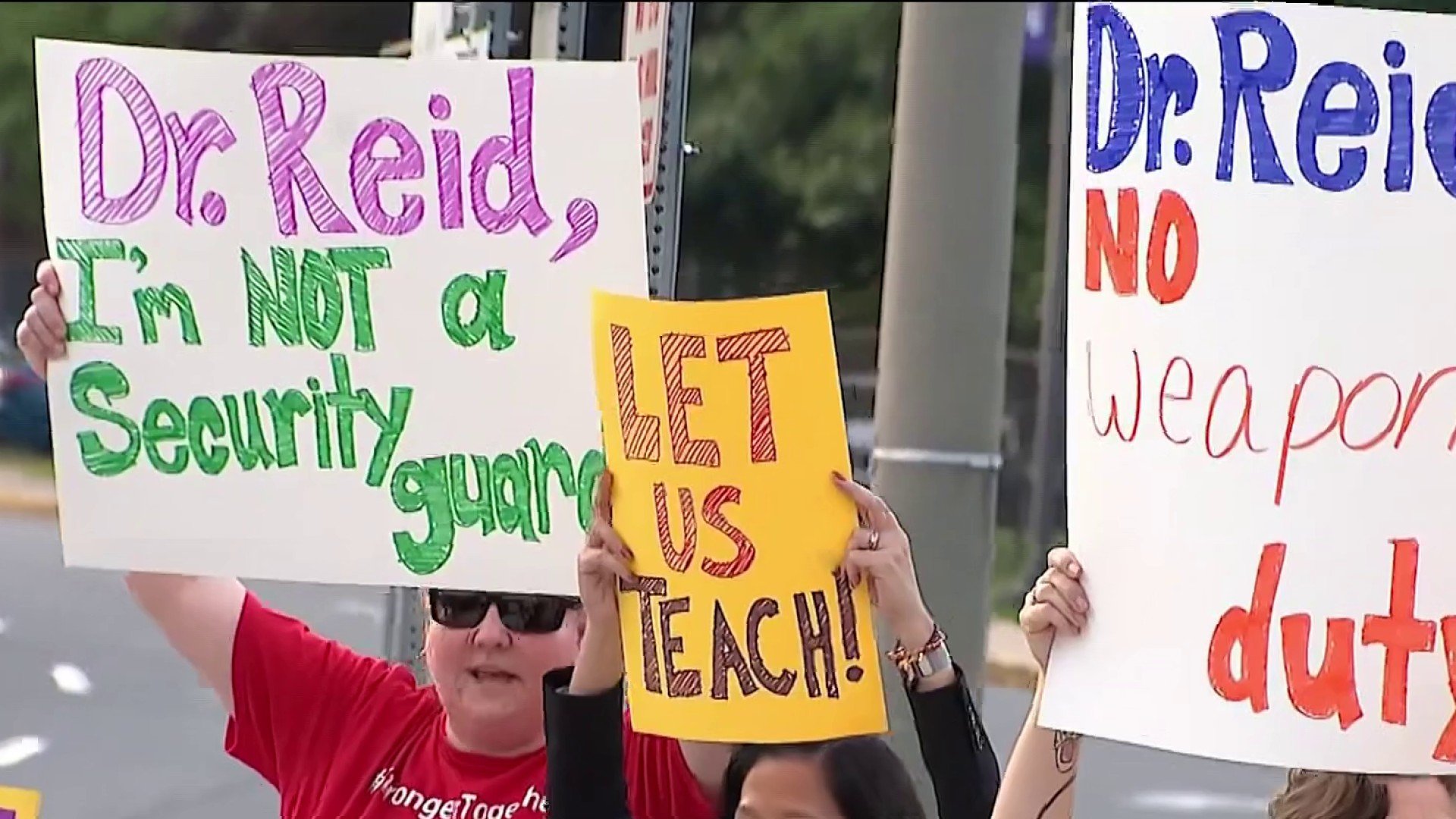
It was back-to-school night Tuesday at Lake Braddock Secondary School, but some teachers were outside protesting.
A requirement from the school says that all teachers have to pitch in with weapons detection duty. In other words, they have to help man the metal detectors by the front door.
“Let us teach!” the teachers chanted.
“They didn’t enter teaching to be on the front lines of weapons detection,” said Emily VanDerhoff with the Fairfax County Federation of Teachers.
“I asked what would happen if someone were to horribly pull out a weapon, and we were told to press the panic button we have and to get out of there,” said Bill McCabe with the Fairfax County Federation of Teachers and the Lake Braddock Secondary School shop steward.
McCabe said he refused the weapons detection duty last year because he didn’t feel safe, and the school then reprimanded him. He appealed it and received a decision from the superintendent’s office saying that weapons detection does not carry any additional risk, because “incidents of violence can occur in any area of a school.”
“It’s really about student safety,” McCabe said. “Because there should be someone that is willing and physically able and has signed up to do the job of security at the front of the school.”
Fairfax County Public Schools (FCPS) told News4 that teachers at all middle, high and secondary schools are expected to help with weapons detection duty.
A memo from an FCPS official shows the time commitment is two-and-a-half hours per year. FCPS says it has no impact on planning time, and teachers do it alongside administrators and security staff.
FCPS also said in a statement, “All staff play a role in protecting the safety and security of our students […]” and “We all share a mutual commitment to making sure our students are able to learn in the safest environment possible.”
However, Carla Okouchi, the president of the Fairfax Education Association, said her members are still worried.
“There are a lot of employees who are very concerned about the safety and where they’re being placed, and they’re voicing their concerns and making sure that they are heard,” she said.