Unlock the Editor’s Digest for free
Roula Khalaf, Editor of the FT, selects her favourite stories in this weekly newsletter.
European natural gas prices hit their highest since 2023 and oil touched a five-week high on Wednesday, keeping bond markets under pressure, as the resumption of hostilities between the US and Iran raised fears of a period of prolonged global inflation.
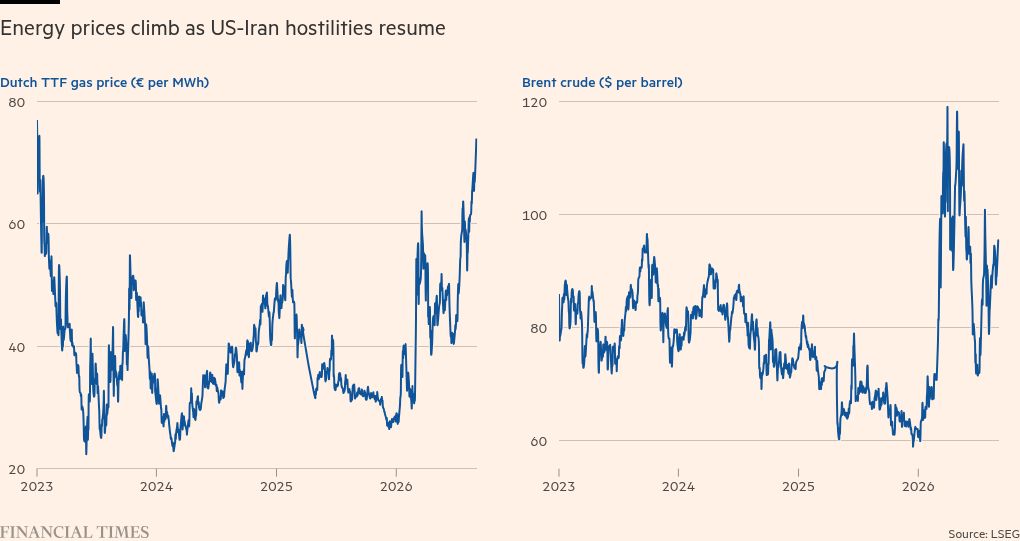
The price of natural gas trading at the European TTF hub in the Netherlands broke above €75/MWh for the first time since the start of the war in February, reaching its highest level since early 2023, as energy companies grow increasingly anxious about heading into winter with scarce stores for colder weather. The price later slipped back to around €73.67/MWh, up 2.1 per cent on the day.
Brent crude, the international oil benchmark, rose as much as 2.5 per cent to just over $97 before retreating to trade 1 per cent higher at $95.55.
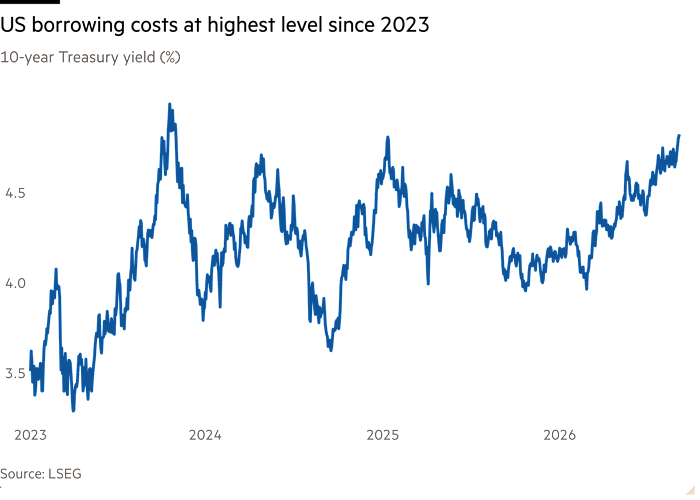
The rise in prices continued to rattle global bond markets, driving US 10-year borrowing costs to a three-year high amid concerns that central banks will need to lift interest rates to respond to the resulting inflation.
The advances followed a wave of strikes by the US against Iran on Tuesday, its second round in recent days, which deepened investors’ fears over the spectre of further escalation between the foes after a month of relative calm in August.
“The perception that this [conflict] is all going to be over by Christmas is fading fast,” said Mike Bell, head of market strategy at RBC BlueBay Asset Management. “That’s driving the market.”
Washington and Tehran are vying for control of the Strait of Hormuz, a key waterway for oil supplies.
European gas prices have been grinding steadily higher since hitting a low of less than €40/MWh at the end of June, while Brent crude has risen from a wartime low of $70 a barrel in early July.
The yield on the 10-year US Treasury rose as high as 4.82 per cent on Wednesday morning, hitting its highest level since 2023, before slipping back to trade flat on the day. Bond yields rise when prices fall.
The 10-year German Bund yield rose 0.04 percentage points on Thursday, closing at 3.38 per cent. The yield briefly touched 3.4 per cent during the day, the highest level since 2011.
UK borrowing costs hit a post-2008 high for the second consecutive day, rising as high as 5.29 per cent before slipping back to 5.24 per cent.
Gas companies traditionally store up supplies over the summer months to smooth out any disruption over the winter, but this year stores are at their lowest level for more than a decade. Across the EU, stocks were only 63 per cent full in the last week of August.
The EU has set a target of filling storage to 80 per cent by the winter. Anna-Kaisa Itkonen, a spokesperson for the Commission, said, “We do consider that it is possible to fill the storages as per the regulations,” adding that storage levels will be discussed at a meeting of national experts on Thursday.
Germany, which has the largest volume of gas storage on the continent, warned last week that it risked failing to meet its statutory target of 70 per cent full by November. In contrast, Italy, the EU’s second-largest consumer, has built up storage and already reached 83 per cent of capacity.
Officials have said they do not expect a security of supply crisis over the winter, although countries will face higher costs to buy gas on spot markets during the winter months if they fail to fill storage facilities sufficiently.
As prices have risen, energy companies have been reluctant to buy expensive gas to store it, preferring to wait for a resolution to the conflict in the Middle East and lower prices.
“I have been saying for six months that we need to be more careful about storage or we will have high prices going into winter,” said Anne-Sophie Corbeau, a gas expert at Columbia University’s Center on Global Energy Policy. “I would be very careful about not being too complacent because we have seen again and again that when problems arrive, they all come together,” she added.
The advance in gas prices has put particular pressure on European bond markets. Eurozone inflation accelerated to 3.3 per cent in August, official figures showed on Tuesday, with energy prices up 14.3 per cent.
Mohit Kumar, chief European economist at Jefferies, said the investment company was “toning down” its exposure to riskier assets following the advance in energy prices.
Kumar said bond yields were “reaching a level where a further sell-off in rates would be increasingly negative for both equities and credit”.
The S&P 500 rose 0.4 per cent on Wednesday but remains in negative territory so far this week.
Japan and South Korea, two major oil importers, led declines in Asian equities, with the Nikkei 225 down 3 per cent and the Kospi 3.8 per cent weaker. The Stoxx Europe 600 fell 0.2 per cent.