Unlock the Editor’s Digest for free
Roula Khalaf, Editor of the FT, selects her favourite stories in this weekly newsletter.
It is a great time to be in the business of air travel — provided you are not actually an airline. Companies that supply and maintain aircraft have rarely had it so good, nor been valued so highly, thanks in part to delays in carriers’ new plane orders. The trouble is that strains in one part of the aviation ecosystem rarely remain isolated for long.
The supply chain is currently stretched to perfection for those within it. Boeing and Airbus are working through a backlog dating back to the pandemic. As a result, their suppliers have blockbuster orders requiring relatively little extra investment, which can instead go towards preparing for newer models now appearing hazily on the horizon. Older planes still in service require more upkeep than new ones, too.
Two-thirds of maintenance providers and those supplying manufacturers felt demand had picked up or remained unchanged over the past six months, according to a recent McKinsey survey. Valuations match the optimism. Parts supplier Heico, whose market capitalisation has doubled in four years to more than $40bn, trades on 48 times its estimated earnings two years hence, down from a hypoxia-inducing peak of 58 a year ago.
Mighty engine-maker General Electric, meanwhile, is still close to its 10-year peak of just over 40 times 2028 earnings. Its Parisian partner Safran is in “a tailwind situation” too, according to its boss Olivier Andriès. And Rolls-Royce chief Tufan Erginbilgiç says margins on the jet engine maker’s civil aircraft maintenance contracts would be 28 percentage points higher by 2028 than in 2022.
Airlines themselves aren’t as buoyant: more than half of those McKinsey surveyed said demand was getting weaker. In June, airline industry group Iata more than halved its 2026 global passenger growth forecasts to 2.1 per cent and predicted an industry net profit margin of just 2 per cent, citing the uncertainties caused by the US-Iran war.
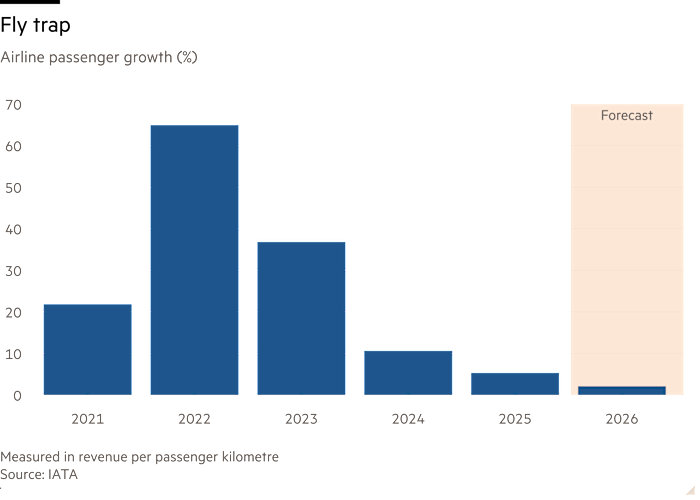
So far airlines have merely trimmed capacity to maintain market share through the profitable summer months. But it may get more tempting to ground planes rather than pay high maintenance costs on unprofitable routes as the weather turns chilly. British Airways owner IAG on Friday maintained it was focused on margins, not market share. In April, Lufthansa took two jumbo jets out of service and retired the last of another aircraft type.
Those in the supply chain may well shrug. A few grounded planes here or there won’t materially affect them — if, of course, that’s all it turns out to be. However, it’s still hard to see how things can get any better for them if life doesn’t get easier for their customers. Economy or first class, everyone ends up at the same destination.
Lex sends a newsletter every Wednesday with additional insights, the pick of the week’s columns and links to what we’re reading. Premium subscribers to the FT can sign up here