Cheryl Palumbo was out shopping for herself and her husband last week to pick up some items she had forgotten the day before at the supermarket — and couldn’t quite believe her bill.
The 78-year-old retiree had already spent $150 and here she was back at her local Ralphs forking over another $70 for fruit, vegetables and other food crammed into three bags.
“My Haagen-Dazs ice cream can go for like $6.99 a pint, and they had it on sale today for $3.99. But you finish that in two sittings,” complained the Chatsworth resident. “I bought a pear the other day — one pear for $1.91. Everything is just so crazy.”
Palumbo’s exasperation is widely shared these days.
It seems wherever Angelenos turn, their wallets and pocketbooks are getting picked clean, whether it’s at the grocery store, the pump or paying their auto insurance bill. And they aren’t just imagining it.
At a time when President Trump’s on-again, off-again tariff disputes and war with Iran are driving up inflation nationwide, L.A. residents are getting hit harder than many.

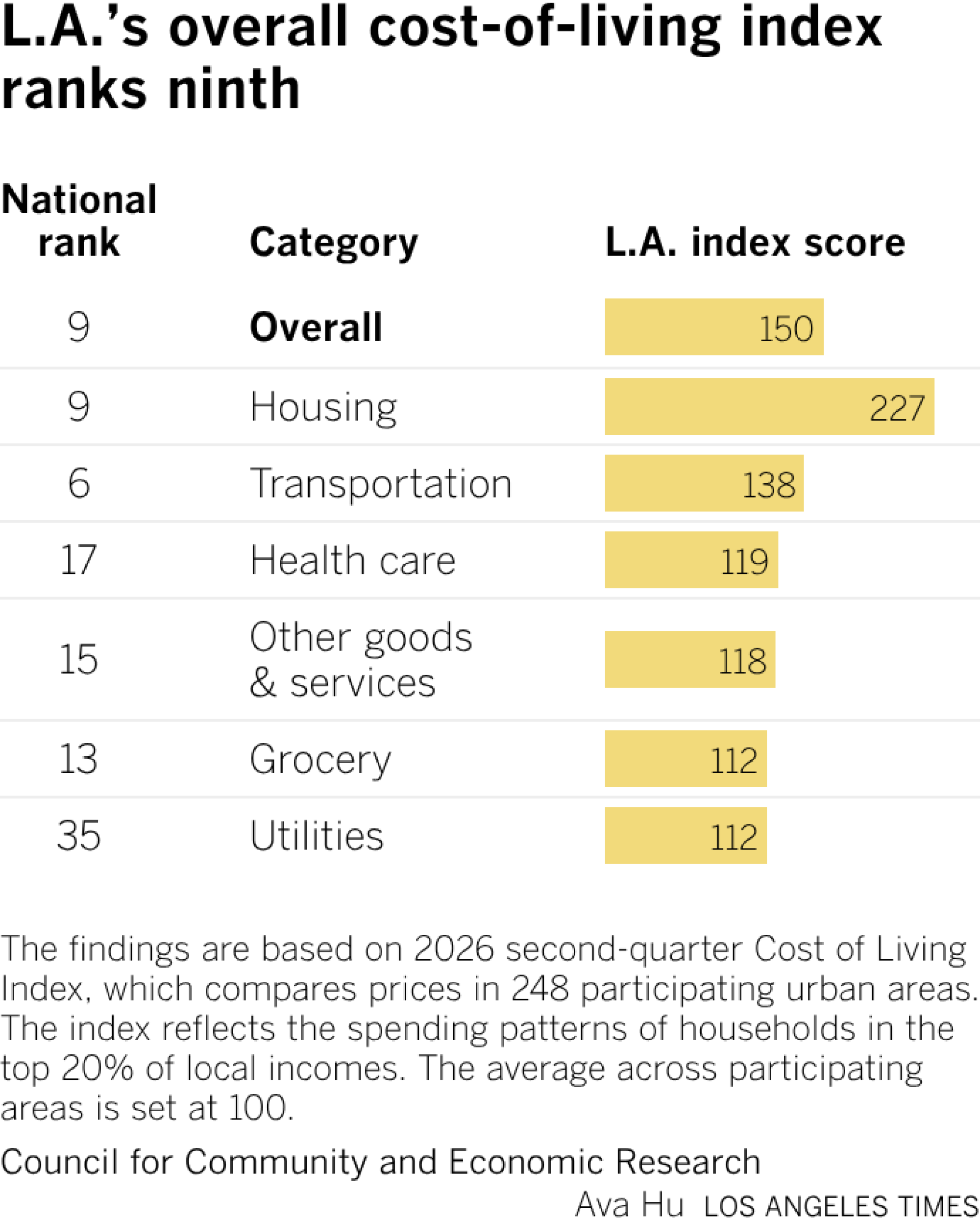
The Los Angeles-Long Beach area ranked as the ninth most expensive place to live in the nation in the second quarter, according to the C2ER Cost of Living Index of 248 urban areas.
The ranking by the Arlington, Va., nonprofit research group is a composite derived from six baskets of goods, including groceries, housing, transportation and utilities. The 57 items that make up the index are individually priced each quarter, with home costs given the greatest weight.

Jessica Ross shops at Ralphs in Chatsworth.
(Carlin Stiehl / For The Times)
It does not include sales taxes, which are among the highest in the nation in California.
Manhattan and Honolulu, two notoriously expensive cities to live in, rank No. 1 and No. 2 on the index nationally, with San José, San Francisco and Orange County rounding out the top five. Three other New York City markets also top L.A.

Exacerbating the affordability crisis, according to economists, is L.A.’s relatively lower average wages compared with other expensive urban areas, despite growth in high tech jobs in industries such as aerospace and defense.
While it might seem that Angelenos would catch a break buying food, given California’s large agriculture industry and the city’s highly competitive supermarkets, the L.A. region nevertheless ranks 13th in grocery prices.
Nate Rose, a spokesperson for the California Grocers Assn., said a supermarket bag reflects multiple costs, which are high in the state. Those include costs for land, fertilizer and diesel, which have been affected by trade disputes and the U.S. war with Iran.
“If you’re paying more at the pump, you might not think about the fact that it’s costing more to truck the food around, but that is the reality,” he said. “It’s all connected.”
Cost of housing
One of the biggest drivers of inflation in L.A. is, unsurprisingly, the cost of housing, which ranks ninth nationally. The city is topped only by Honolulu, four New York City-area markets and three California urban areas: San José, Orange County and San Francisco.
The monthly mortgage on a new home is given the single highest weight in the cost of living index since it is typically the single highest cost of any family’s budget.
The survey compares the price of a 2,400-square-foot residence on an 8,000-square-foot lot, which is larger than the typical L.A. home or lot, but allows for a precise comparison to the other 248 urban areas.
The average price for such a property is $1.34 million in the L.A. area, less than half the price of No. 1 Manhattan (where the lot size is waived), but about twice as much as Chicago. The average monthly mortgage is $6,318, ranking eighth nationally.
The city also ranks 15th in the cost to rent a 950-square-foot apartment at $3,084 per month.

Shane Phillips, a housing expert with the Lewis Center for Regional Policy Studies at UCLA, said the high price of homes reflects the lack of construction of new housing over decades.
“When the rest of the country was booming in the 2000s, Los Angeles was building effectively nothing. We did not respond to the boom at all,” he said.
Housing costs could come down if the city were to allow four-story, 12- to 15-unit residences on standard home parcels, which could lower the price of a new home below $500,000, Phillips said. But he believes that would be politically impossible due to neighborhood opposition.
Such a price would make a home more affordable for the average L.A. County resident, who made $1,704 weekly in the first quarter, according to the latest Bureau of Labor Statistics data.
While the average L.A.-area wage is above the nationwide average, it is well below that of some other high-cost areas, such as $4,902 in New York City and $4,650 in San Mateo County.
Michael Bernick, former director of the California Employment Development Department, said that while L.A. is a high tech center, it also has many jobs in food prep, building maintenance, personal care and other low-paying industries.
“There’s also a very large low-wage workforce in Los Angeles,” he said.
The index does not include the cost of home insurance, which, amid a rise in wildfires statewide, cost Angelenos $2,248 on average last year, up a whopping 75% since 2021, according to mortgage lender Newrez.
Still, California home insurance premiums have trended below the national average for decades. So, despite the recent rise, L.A. ranks 14th in cost among the 20 largest metro areas nationwide, according to the lender’s study.
Pain at the pump
If there’s one unpleasant economic experience that binds Angelenos together, it’s pain at the pump — and since the start of the Iran war it’s only gotten more acute.
The average cost of a gallon of gas was close to $5.98 in the second quarter, according to the index, tied for second nationally and topped only by San Francisco and Oakland, which tied for first.
In fact, the top 10 high-cost urban areas nationwide were all in California, with the state seeing a sharper rise in gas prices than elsewhere around the nation. Other high-cost California cities included San Diego, San Francisco and Oakland.
After dropping this summer, prices are on the rise again as hostilities resume between the U.S and Iran. A gallon of gas hit $5.92 in Los Angeles this week, according to AAA.
Diesel prices also hit a record national average of $5.85 a gallon last week, with California nearing $7.71, squeezing the state’s trucking, farming and trade industries.
The high cost of gasoline in California has been largely attributed by experts to high taxes, environmental fees, a special summer blend to reduce smog and the closure of refineries.
Energy expert Severin Borenstein, faculty director of the Energy Institute at UC Berkeley’s Haas School of Business, said no one should expect prices to come down in the state any time soon.
It is unlikely, he said, that gas taxes or environmental fees will be cut, and even if Californians continue to switch over to electric vehicles, reducing the demand for crude oil, that might result in the closure of refineries.
“That could actually lead to some market power that would drive up their margins,” he said.
The cost of living index does not include the price of auto insurance, which has risen more than 30% statewide since 2022, driven by more expensive vehicles, complex repairs and other factors.
Statewide, rates are near the national average due to California’s tightly regulated insurance industry. Nevertheless, in congested L.A., drivers paid on average $3,730 last year, nearly 50% higher than the statewide average, according to insurify.com.

After dropping this summer, gasoline prices are on the rise again as hostilities resume between the U.S and Iran.
(Carlin Stiehl / For The Times)
Rising utility bills
Utility bills are another area where Angelenos often pay higher rates than much of the rest of the country.
While Southern California Gas charges ranked low nationally in the survey, electricity costs are another story. The L.A. area ranked 35th nationally, or in the top 15%, for overall utility charges in the index — with a wide disparity in charges.
Much of the area is served by Southern California Edison, which charges a higher rate than the other large electricity provider, the Los Angeles Department of Water and Power, according to a report last year on state utilities by the Little Hoover Commission.
Residents of Northern California pay even more after the 2019 bankruptcy of Pacific Gas & Electric, due to catastrophic wildfires caused by its transmission lines, the Hoover report noted. San Francisco and Oakland rank higher in the utility cost index than L.A.
And rates may go even higher.
Edison is now also facing billions in potential liabilities due to the January 2025 fires, with the utility already receiving a 9% rate hike last year, partially driven by projects to mitigate the fire risks posed by its transmission lines.

The index also surveys a variety of miscellaneous costs, including for prepared food and personal services. The L.A. region is the most expensive place to visit a beauty salon at $106.25, perhaps no surprise in a glitzy city that is the home of the nation’s entertainment industry.

Although it might seem that Angelenos would catch a break buying food, given California’s large agriculture industry, the L.A. region ranks 13th in grocery prices.
(Carlin Stiehl / For The Times)
Still, there are some bargains to be found, according to the index, including in apparel, with the costs of shirts and pants cheaper than in many places.

Political fallout
Complaints about higher prices for just about everything have reverberated nationwide.
With the costs of goods and services rising more than 25% nationally since the pandemic in 2020, affordability has become an issue that has crossed political lines.

Disgruntlement with the inflation that followed some $5 trillion worth of pandemic-related stimulus fueled Trump’s unprecedented political comeback.
Last month, Assembly Republicans — who typically point to the state’s high taxes and regulatory burden for driving up costs — cited rising grocery, gas and utility prices in calling for Citizen Cost Impact Reports on several bills.
Whatever the causes of rising prices, locals are doing what they can to get by.
Mike Giovannelli, 47, was filling his Jeep last week at the Speedway Express station in Chatsworth, where the price for a regular gallon of gasoline was $5.49.
The unemployed animator said it’s getting harder to afford to drive his two children to school, with the family surviving only on his wife’s salary as an interior designer. So he stays home more and relies on a foolproof method to reduce his driving.
“I don’t fill up the tank anymore. I come with like $20 or $30. Put that in, and see where I can get from there,” Giovannelli said.