Unlock the Editor’s Digest for free
Roula Khalaf, Editor of the FT, selects her favourite stories in this weekly newsletter.
In normal person-speak, the grand-sounding term “financial repression” is sometimes translated as like holding a gun to someone’s head and making them buy your bonds. It is not supposed to be taken literally.
And yet a week ago, Donald Trump hinted at precisely that. Asked about Scott Bessent’s recent efforts to support the US government bond markets, the president casually observed that the Treasury secretary’s upsized buybacks are “one type of intervention” and that “the ultimate intervention is our military. And if we have to use that, we will”.
Analysts and investors appear willing to let this wild statement slide — something it would be hard to imagine had it come from the lips of any other president of any country ever. Remember this the next time someone tells you America’s exorbitant privilege is dead or that its role as protector of the world’s premier safe asset and leading reserve currency is a burden. Just like its current president, it simply gets away with stuff in financial markets that no other country could.
But the idea of pushing US government bonds down the throats of otherwise unwilling investors, through coercion, regulation or other means, is being taken increasingly seriously. It is one way to wage a war with the bond market.
Other bond-boosting tactics are struggling. Arguably the slickest is to employ the kind of Jedi mind control trick used by European Central Bank chief Mario Draghi back in 2012. He was able to pull borrowing costs back down in a debt crisis then simply by stating he would do “whatever it takes” to get there. Even now, borrowing costs in, for example, France, are much lower than they might otherwise be thanks to the threat — not the exercise, just the threat — of forceful responses to push them down in a crisis. But this takes rock-solid credibility and in the US at the moment, that is in short supply.
The most durable way to win a bond war is to do the work to fix the underlying economic forces that have created it in the first place. In Turkey, for example, that meant letting the central bank crank up interest rates, despite howls of protest from the country’s president. For the US, it demands a large retrenchment in government spending, or large tax rises, or both to address the real underlying storm sweeping through global debt markets. All the big borrowers are feeling the pain, from Japan to the UK and US. Massive levels of borrowing and huge gaps between what governments collect in taxes and spend at the other end are not new. But in markets, things are fine until they are not, and this is starting to look not so fine. And yet few expect any of the key offenders here to do the work for a proper reset.
Right now, the US is spared the apparent risk of military intervention in markets by another useful resource for winning a bond war: luck. Inflation, the bond market’s traditional foe, has never been the main concern in this latest episode, but the recent fall in oil prices does give the debt markets some breathing room. Bessent also has at the very least succeeded in scaring some speculators out of pushing borrowing costs much higher right now. Yields have stabilised at elevated levels since his Treasury department announced state purchases of long-term debt.
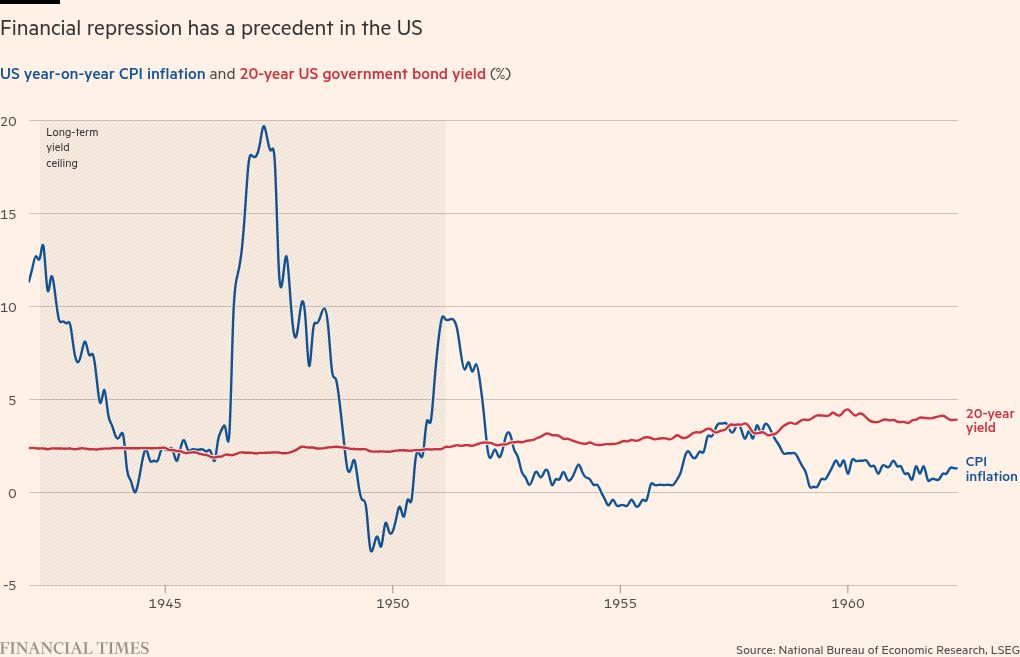
But luck has a habit of running out. If and when it does, the chance of the US reaching for the button marked “financial repression” is rising. It is a dirty phrase in finance circles, encompassing a range of efforts including bank capital requirements and even capital controls to force private sector investors to accept low returns so that countries can keep on spending on the cheap. It’s rather antiquated and very un-American — a refusal to let markets do what they do best: pricing risk.
“The primary preoccupation henceforth stands to be financing government expenditure, and with monetary policy being subordinated to this need,” warned David Skilling and John Llewellyn of Independent Economics in a note last week. “Monetary policy support will likely involve financial repression, with lower real interest rates for the US (and others) as yields are capped in various ways and ownership of Treasuries is required or incentivised . . . The US will use economic and geopolitical pressure to attract capital, in increasingly aggressive ways. These capital wars stand to be markedly more consequential than the recent trade wars.”
Any serious moves in this direction would mark a profound shift in the global financial regime. And yet it is already a sufficiently live possibility that money managers are starting to advise clients on what to do if it happens.
“Initiatives that result in financial repression and yields being brought down artificially should be favourable for equities, while gold would be another beneficiary,” was the breezy assessment of UBS Wealth Management in a note this week.
If the past few years have taught us nothing else, it is to imagine the unimaginable. This is the latest example to add to the list.