Stay informed with free updates
Simply sign up to the Mining myFT Digest — delivered directly to your inbox.
China-backed MMG has urged EU regulators to approve its $500mn deal to buy the Brazilian nickel assets of Anglo American despite concerns that the deal would give Beijing greater control over a key component for Europe’s struggling steel industry.
“Ultimately, we’re confident that DG COMP will put geopolitical considerations aside and judge this on the data,” said Troy Hey, MMG executive general manager of corporate relations, referring to the European Commission’s Directorate-General for Competition, which is investigating the transaction.
The probe is seen as a test of how far Brussels is willing to go to protect European industry from potential economic coercion by Beijing. EU regulators are set to issue a formal warning over the deal next week, people familiar with the decision said. The commission declined to comment.
EU officials worry that a sale of the Brazilian assets to MMG, announced last year, would reduce supplies of ferronickel to Europe’s stainless steel producers, leading to higher production costs and affecting their ability to compete.
Christophe Moulin, senior nickel analyst at Benchmark Mineral Intelligence, said the deal was “highly political for Europe and its stainless steel producers, who rely on importing ferronickel to feed their meltshops”.
MMG insisted those risks were overstated. “The independent data commissioned by DG COMP is very clear and consistent. There is no ability to foreclose the market, nor is there any incentive to do so,” Hey said.
Brussels is keen to reduce its dependence on China for a swath of metals and critical minerals that European businesses rely on, after Beijing imposed export restrictions on a wide range of materials.
While ferronickel is not a critical mineral, the European steel industry is worried about growing Chinese ownership of overseas supplies. Steel industry body Eurofer said the outcome of the commission probe “must safeguard Europe’s ability to source responsibly and continue producing high-quality stainless steel in Europe, while avoiding a situation in which any single country is able to dominate the global market”.
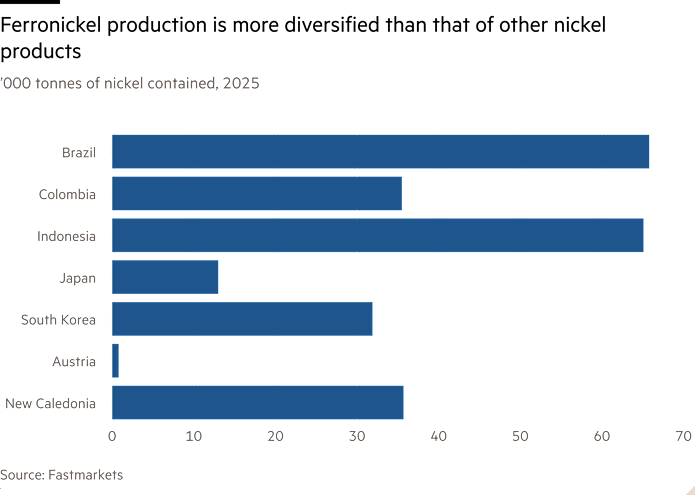
Brazil and Indonesia are notable producers of ferronickel, while China does not produce the material, according to price reporting agency Fastmarkets. China is a major producer and consumer of “pig iron” nickel, a different input for stainless steel, while European companies also rely heavily on recycled material.
Anglo said: “European customers have shown how readily they can and do switch between their various suppliers.”
Opponents of the Anglo-MMG deal say it should be viewed in the context of a global race for resources and the escalating US-China trade war. MMG’s reassurance on Brazil was “like Putin assuring Merkel on gas supplies”, said one person following the deal.
Critics also say ferronickel supplies are not easily interchangeable. Differences in nickel content, quality, reliability and carbon intensity can make alternative sources difficult or expensive for European manufacturers to use. The Brazilian assets are considered low carbon given the country’s high level of hydroelectric power.
CoreX Holding, a conglomerate founded by Turkish investor Robert Yildirim and a rival ferronickel supplier, said European steelmakers would struggle to replace Anglo’s Brazilian production if supplies were redirected.
“Slowly, step by step, companies are disappearing from the supply side. The Chinese are controlling everything,” he told the FT. “Down the road, Chinese aggressive ownership will push the competitors to bankruptcy,” he added.
Yildirim, who was also in the running to buy Anglo’s Brazilian mines, said he was still interested in a sale.
“We want to produce quality material together, not depending on China,” he said. “We know how to do mining, how to produce this ferronickel . . . We can solve the problems of the future in Europe and the US.”
Additional reporting by Andy Bounds in Brussels