Unlock the Editor’s Digest for free
Roula Khalaf, Editor of the FT, selects her favourite stories in this weekly newsletter.
Walmart shares tumbled after it reported its weakest US sales growth in more than six years and pledged to use a major tariff refund to fund price cuts, as squeezed American consumers remain mindful of their spending.
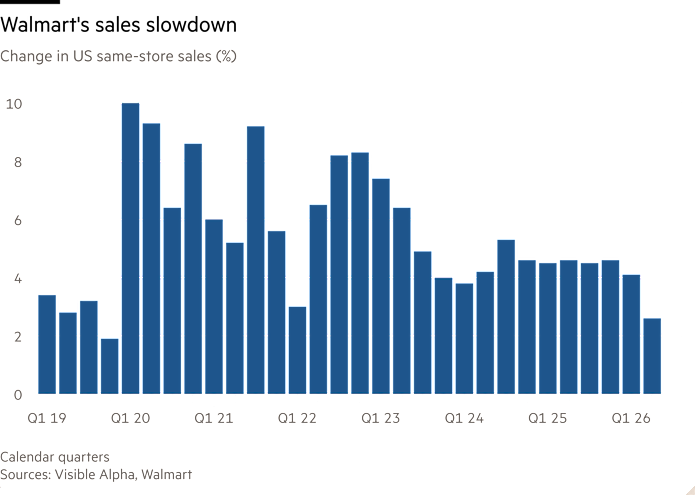
In the three months to July, US same-store sales rose by 2.6 per cent, the slowest pace since late 2019, Walmart said as it released quarterly results on Thursday.
Walmart is the country’s largest retailer, with annual sales of more than $700bn. The slowdown comes as higher fuel prices caused by the US war with Iran have pinched consumers and follows national retail sales that declined in July. The company warned of an extra $2bn in fuel costs for its own trucking fleet.
The retailer’s shares fell by more than 9 per cent in Thursday morning trading, on track for their worst day since May 2022.
With about a third of its US merchandise imported, Walmart said it received almost $2.9bn in refunds after emergency tariffs enacted by Donald Trump were struck down by the US Supreme Court in February.
Walmart said it planned to deploy most of its US tariff refund to lower prices for its merchandise and groceries until at least the end of the year. Trump in July praised Walmart for cutting prices on thousands of items, lauding the company as “absolute patriots”.
Its decision to keep cutting prices will increase pressure on US supermarket chains, which have been losing market share to Walmart, Costco and Aldi, as consumers seek out cheaper food. However, it may result in lower profits in the short term.
“We’re investing heavily in price because customers need us to, and because we believe it drives market share gains over time,” said John Furner, chief executive.
Walmart said US sales were reduced by federal price caps on certain prescription drugs that took effect earlier this year. Without those caps, which affected its pharmacy business, same-store sales would have been 3.4 per cent. Analysts had expected US same-store sales of 3.7 per cent, according to Visible Alpha.
“Sales of core merchandise categories have been consistent,” said John David Rainey, chief financial officer.
Investors had propelled Walmart to a more than $1tn valuation early this year on hopes that its booming ecommerce business and low prices would help it win market share in the competitive retail sector.
But its shares have since pulled back on worries about the spending power of US households and Walmart’s lofty stock price multiple, which at about 37 times expected earnings as of Wednesday was 1.5 times the average US consumer staples stock.
US retail sales fell 0.6 per cent in July, Census Bureau data last week showed, their biggest drop in more than a year. Analysts pointed out that the pullback was in part due to Amazon moving its Prime Day back to June this year, causing ecommerce sales to cool the following month, but the report also showed that grocery spending declined on an inflation-adjusted basis.
Walmart’s US same-store sales increase came entirely from its fast-growing ecommerce business, whereas sales at its brick-and-mortar stores declined by 2.5 per cent in the quarter. The retailer’s ecommerce sales rose by 23 per cent year-on-year.
Company executives said that this reflected stores’ increasing role as ecommerce delivery hubs, even if customers were making their purchases online. The drug-price caps also disproportionately affected stores, which house Walmart pharmacies.
“I want to be really clear; stores are an asset,” Furner told analysts.
Walmart’s revenue rose 5.9 per cent in the quarter to $187.9bn, surpassing consensus estimates of $186.8bn. Operating profit jumped by 28.8 per cent to $9.4bn, exceeding estimates of $8.6bn. The sum included tariff refunds received, Walmart said.
“While we acknowledge the US [same-store sales] number may hold shares back today, we remain encouraged by [Walmart]’s ability to gain share and grow profits faster than sales,” TD Cowen analyst Oliver Chen said.
The company raised its financial outlook for the year, and now forecasts net sales to increase 4 to 5 per cent, up from previous guidance of 3.5 to 4.5 per cent. Adjusted operating income was forecast to rise 7 to 8.5 per cent, up from 6 to 8 per cent.
Other retailers, including Target, TJX and Home Depot, this week disclosed hundreds of millions of dollars in tariff refunds received in the second quarter.