This week could bring Southern California its most sweltering temperatures of the year — a heat wave made all the more miserable, and dangerous, by oppressive muggy conditions and little nighttime relief.
“This looks to be the hottest stretch so far this year,” said Ryan Kittell, a meteorologist with the National Weather Service’s Oxnard office.
And it’ll be quite a stretch. The mercury could hit triple digits across much of the Southland Tuesday through Monday.
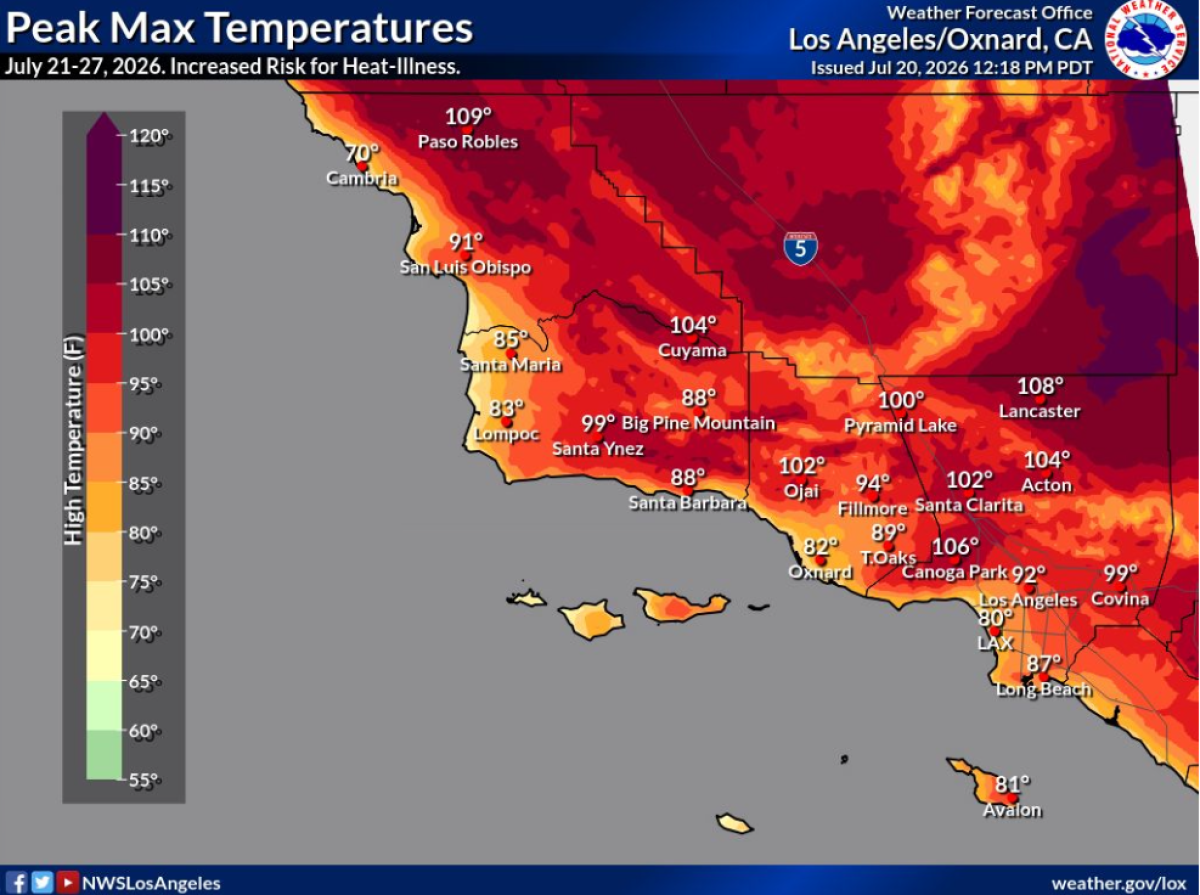
Over the next week, temperatures could hit 109 in Paso Robles, 108 in Lancaster, 106 in Canoga Park, 102 in Santa Clarita, 99 in Covina, 92 in downtown Los Angeles and 87 in Long Beach. Temperatures could also exceed 100 degrees in the Inland Empire and some parts of San Diego County’s interior valleys and surpass 110 degrees in the deserts, said Sebastian Westerink, meteorologist with the weather service’s San Diego office.
Here are five things you need to know about this potentially dangerous weather:
Oppressive and widespread heat
A heat advisory, signifying oppressive heat is imminent or occurring, will be in place across Southern California, including much of Los Angeles, San Diego, Orange, Riverside, San Bernardino, Ventura and Santa Barbara counties. (Some beaches were excluded.)
The National Weather Service’s heat advisory was slated to begin 10 a.m. Wednesday and last through 8 p.m. Monday.
The expected duration of the heat wave — at least several days, if not longer — “can really be concerning,” said Robbie Munroe, meteorologist with the weather service’s Oxnard office.

Little overnight relief
Exacerbating the misery will be the lack of cooling temperatures overnight. The L.A. Basin may see low temperatures of only about 70 degrees.
“That means the evenings will remain quite hot, and even overnight, when people might open their windows to try to cool off their homes, you’re not going to see a whole lot of help there in a lot of areas,” Munroe said.
Forecasters urged people to limit outdoor activities to just the early morning hours if possible, to stay in air conditioned spaces in the afternoon and evening hours, and take frequent rest breaks. If it’s necessary to be outdoors, residents should stay hydrated and stay in the shade as much as possible. Children and pets should never be left unattended in vehicles.
Fire weather returns
Officials warned of elevated fire danger across large swaths of Southern California starting Tuesday, with a high risk of fast-moving and “plume-dominated” fires driven by heat and instability. Such blazes have large vertical growth and can spread rapidly even when not driven by the wind.

The Station fire of 2009 was a plume-dominated fire.
(Don Bartletti / Los Angeles Times)
But wind-driven fires will still be a risk — especially for southwestern Santa Barbara County, where expected sundowner winds down the southern slopes of the Santa Ynez Mountains could cause a fire to explode if there’s ignition.

Potentially dangerous ocean conditions
Officials warned of hazardous conditions — such as high surf and strong rip currents — across much of the Southern California coastline.
There’s a persistent swell coming from the south, forecasters said, with peak surf as high as 4 to 8 feet. The hazardous surf is being sent from tropical storm systems south of California, including Tropical Storm Fausto and the remnants of Tropical Storm Elida.
“Always swim near lifeguards. Check in with and ask advice from lifeguards before entering the water,” the weather service said. “Stay off rock jetties!!!”
A number of Californians have died along the coast this summer, including a 5-year-old girl from San Bernardino who was swept into the ocean by powerful waves in Laguna Beach. On one recent day alone, Newport Beach lifeguards made more than 100 rescues.

Heat may stick around
Heat might persist into the last week of July. There’s a 60% to 80% chance of above-normal temperatures between July 27 and Aug. 2, Munroe said.