The Balboa Peninsula has a long and sometimes infamous history as a party beach.
A generation ago, drunken summers of house parties and spontaneous gatherings earned it the nickname “Zooport” and “the war zone.”
It was here where NBA star Dennis Rodman threw weekend-long blowouts in the early 2000s, once making his grand entrance for a birthday bash by landing on the beach in a helicopter.
But last weekend’s mayhem, in which thousands descended on the community and more than 400 ended up under arrest, has hit Newport Beach differently, spurring calls for the city leaders to take decisive action. Some residents want the city to consider actions from an earlier era, including limiting how many people can be in the beach zone at one time.

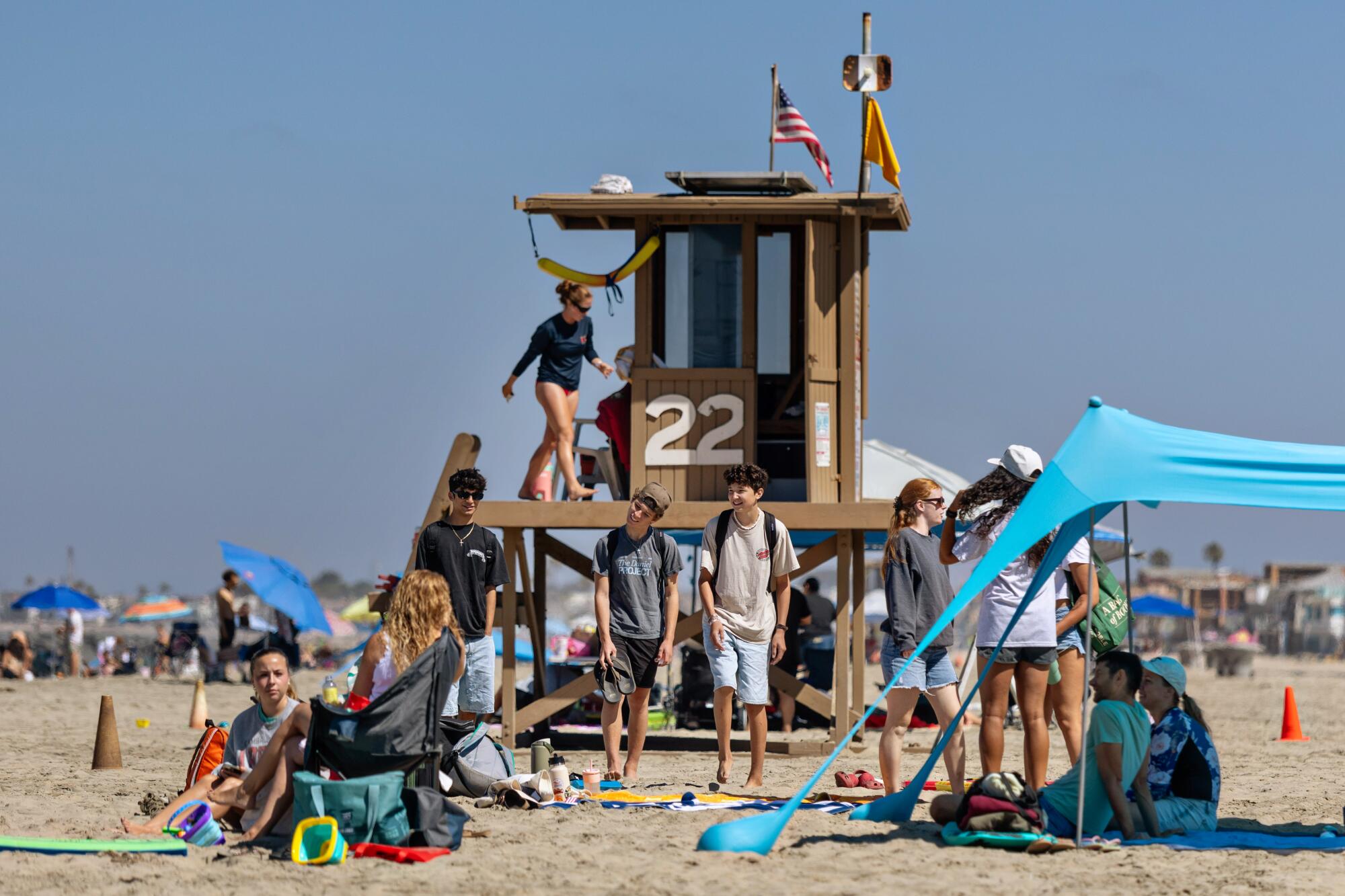
Beachgoers enjoy at day on the sand a few days after the July 4 “teen takeover” of Newport Beach on July 7.
Beach cities have always had a complex relationship with summer crowds.
Newport Beach relies on $1.2 billion in spending from roughly 4 million tourists annually, and has worked for more than a decade to revitalize the peninsula, in part to attract visitors. For visitors from inland areas, a trip to the beach offers a relief valve from triple-digit temperatures and is a relatively inexpensive family excursion.
The beaches are supposed to be open to everyone. And some in prime coastal areas are quick to blame out of towners when there are problems.
But some Newport Beach locals insisted what happened last weekend strayed from what’s typical with summertime crowds.
It was a chaotic Fourth of July, with people throwing fireworks at one another, vandalizing a grocery store and getting into fights. Officers were caught off guard by the size of the crowd, and it took hours to get matters under control.
Restaurateur Mario Marovic, who owns several bars and eateries on the Peninsula, said he closed his businesses at 9 p.m. after talking with the Police Department in the midst of the July 4 arrests. His staff had to shelter in place for hours.

Beach Ball owner Mario Marovic at his bar in Newport Beach.
Marovic said his businesses were on track to hit record sales on July 4, one of the busiest days of the year in the industry. But he didn’t hesitate to close early. “We had to keep the community safe,” he said.
At one point during the evening, his employees at Malarky’s Irish Pub — which is located near the Pavilions store that was vandalized — encircled the building to prevent people from entering the property.
Marovic applauded the police for their efforts across the peninsula.
“The problem is, there are just too many people in the area at one time,” Marovic said. “It’s just unmanageable. Local people in the community don’t wreck their own community, so we know a lot of the trouble is being caused by people [from] far out of the area.”
The concentration of short-term rentals around the Balboa Peninsula — frequently sought out by young people looking for a place to party with ocean views — has led to tensions between residents and visitors. Officials have long sought to balance public access to the coast, and the region’s immense tourist draw, with residents’ desire for quiet and safety.
Residents say the city restricted vehicle access to the peninsula for non-residents during the Fourth of July decades ago. There would be checkpoints on Newport Boulevard where drivers would have to show proof they lived on the peninsula or had a reservation there during certain peak traffic times.

Resident Fred Levine enjoys a day at his beachfront home a few days after the July 4 chaos and mass arrests.
Some residents say they would welcome a return to that method or something similar, not to restrict access to the beach but to control ingress to the peninsula during busy holidays.
“It clearly was effective, even then, when there was probably less intensity and volume of civil unrest,” said Denys Oberman, who has lived on the Peninsula for 31 years. “Residents have been saying for a number of years now that it’s something that should be done. There’s an inability and unwillingness to manage what goes on.”
Oberman said the problems had ebbed and flowed over the years, but she noticed worsening crowds during spring break and summer about two years ago.
“Newport has been branded as the place to go and go crazy,” she said.
“This is the worst I’ve seen it in 35 years,” added Fred Levine, sitting on his patio along the beach boardwalk.
Residents couldn’t leave their homes on July 4, or return once police blocked off vehicle access on the Peninsula after the melee. A family with children who rented a vacation home for the week on the boardwalk said they were so frightened by the situation that they wouldn’t return to the city during the holiday, Levine said.
“There were some failures on the part of the city,” he said. “The whole City Council has to be put on the carpet, and maybe we have to make some big changes. It’s ridiculous.”
City officials have said they stepped up patrols over the holiday weekend and enlisted mutual aid from other law enforcement agencies but have not announced any plans to restrict who can go to the beach.
Councilmember Joe Stapleton said the city would address the situation to ensure it didn’t happen again.

“Newport Beach has always set a high standard for public safety and quality of life,” he said. “We owe it to our residents to uphold that standard, and I am committed to making sure we do.”
Newport Beach’s battle over rowdy summers dates back to the 1980s, when a series of large gatherings and fights sparked aggressive action.
An out-of-control Fourth of July in 1986 in which 160 people were arrested and officers were injured in what officials said was a “rock and bottle-throwing melee” led to a bolstered police force and checkpoints the next year.
In 1987, the City Council gave the city manager and police chief the authority to declare a curfew in any portion of the city where they believed lives and property were in danger. The ordinance raised concern among civil liberties groups.
The chaos had calmed down in more recent years as even the oldest parts of Newport became home to some of the most tony addresses in the region.
But Newport Beach’s destination for the rich and famous also led to a new round of party problems involving one former resident in particular.

An August 2000 image of former NBA star Dennis Rodman’s home in Newport Beach.
(Jason Kirk / Getty Images)
Rodman, the larger-than-life L.A. Laker, made headlines for years for his wild parties and other antics at his waterfront compound on Seashore Drive. Police told The Times in 2004 that they were called to his home 80 times during his eight years as a city resident.
But only some of the issues happened at his home.
Rodman was arrested on suspicion of public drunkenness after an altercation at local hotspot Woody’s Wharf, where he was a regular, in 1999. There was also the time officials towed his 47-foot speedboat, Sexual Chocolate, after it was parked at a private dock.
But the age of social media has added a new layer to the party element, officials say.
The thousands of teens and young adults, most from out of town or other states, who descended on the beach Saturday evening were apparently brought to the area by what the Newport Beach Police Assn. called a viral “TikTok takeover.”
The result was chaos, officials say, with hundreds of arrests, fights breaking out on the sand, mortars exploding on the beach, and crowds blocking traffic and trashing outdoor displays at the local supermarket.
Most of the people cited or arrested over the holiday weekend were from elsewhere in California and Arizona. Others arrived at the beach city from Nevada, Utah, Texas, Florida and as far away as the Netherlands. Of the roughly 439 people arrested or cited between Friday evening and early Sunday morning, only 14 were from Newport Beach, according to preliminary data from the Police Department.
Neighbors told The Times they watched from their homes as illegal fireworks blasted above them, sending sparks raining down on Our Lady of Mount Carmel Church. Helicopters hovered overhead into the wee hours.
The city had launched its “Not in Newport” campaign across social media this summer to remind visitors that officials would have zero tolerance for public intoxication, illegal fireworks and other rowdy behavior. Fines for such infractions in West Newport Beach and the Peninsula — dubbed safety enhancement zones — were tripled through July 6.
But Oberman said it wasn’t enough to prevent teens and young adults from swarming the beach and causing problems.
“The city needs to have a more rigorous and robust patrol and enforcement program,” Oberman said. “It’s one thing to put out public relations pieces saying we want to be a family-friendly community, but in terms of a specific plan it was inadequate.”
On Tuesday afternoon, the beach was peaceful, with families setting up umbrellas and laying out beach towels for a day by the water.

Beachgoers enjoy at day on the sand at Newport Beach on July 7.
A heat wave that’s baking swaths of Southern California with temperatures 10 to 15 degrees above normal brought many to Newport Beach looking for relief. Kids dug giant holes in the sand and splashed in the surf as their parents watched from beach chairs.
Although there was no lingering evidence of the pandemonium from days earlier, the situation dominated conversations among visitors.
Some inland residents at the beach this week said they too were concerned about the violence but said there should enough room for both locals and those who come from other places. Some say they’ve been coming to the coast all their lives and consider their favorite piers and plots of sand a second home. They want everyone to have a good time but don’t think restrictions are the answer.
Amy Currell, a teacher from Temecula, drove out to the Peninsula with her daughter for a relaxing day with her sister-in-law and niece. Over the summer, she tries to get down to the coast once a week, in part to escape the brutal heat of the Inland Empire.
But she’s been around long enough to know to avoid the beach on major holidays, she said.
Although coastal access is important for her and others, she understands the concerns of locals.
“It just got out of control,” she said. “And it’s happened before.”