Last Wednesday, the Federal Open Market Committee’s decision to hold interest rates in a range between 3.5 and 3.75 per cent was easy to justify. It was the decision economists and financial markets had broadly expected. Keeping monetary policy unchanged allowed the US Federal Reserve more time to assess the duration and extent of the energy shock and to evaluate still-uncertain economic effects. All Fed chair Kevin Warsh needed to do was go to the press conference, explain these facts, talk about uncertainty and say the next move in rates would depend on the intensity, duration and propagation of the energy shock into the US economy. Job done.
This is not this Fed chair’s way of doing business. Instead, Warsh’s awful communications seem knowingly opaque: they are, in acronym form, Wacko.
Of course, there are some people who will praise a Fed chair come what may. After he spoke, Bloomberg’s Anna Wong said Warsh was a “political genius and talented rhetorician”. Financial markets and most others begged to differ, and it was not just deliberate opacity that was the problem.
There were multiple obvious failures of logic, which made Warsh look out of his depth. As Rob Armstrong argued in Unhedged, Warsh cannot claim the Fed is just a referee in financial markets — it is a player. Many financial markets are priced on what the central bank will do, not what participants think it should do. I am sure Warsh is smart enough to know this. Claiming otherwise, as he did, appears obtuse.
Another logic fail was when Warsh claimed that Goodhart’s Law should remind us to be careful that if the Fed hits its current 2 per cent target for inflation on the personal consumption expenditures (PCE) measure, it might not meet its underlying objective of stable prices. Goodhart’s Law states that when a measure becomes a target, it ceases to be a good measure. It stems from 1980s money supply targets, which were met but, as a result, lost their previous connection to inflation. A prerequisite for Goodhart’s Law to apply in this case, then, is that the Fed is hitting its PCE inflation target of 2 per cent. PCE inflation was 3.7 per cent in June.
Warsh also appeared unconcerned by inconsistencies with his previous statements. At the European Central Bank conference in Sintra on July 1, Warsh praised falling bond yields, saying they demonstrated that markets understood the Fed well. After the FOMC meeting, he praised bond yields for having risen since early July, saying they demonstrated markets were reacting to real economic events.
When speaking in Washington in April last year, Warsh said that one error that contributed to the post-pandemic inflation surge was the Fed’s belief “that its price stability objective was largely self-executing”. But last Wednesday, when asked why he did nothing about inflation while saying he had no tolerance for it, Warsh said “tightened financial conditions in this intermeeting period . . . [have] given us . . . some comfort that we’ve got the ability and capability to deliver”. The price stability objective was, at least in part, now self-executing.
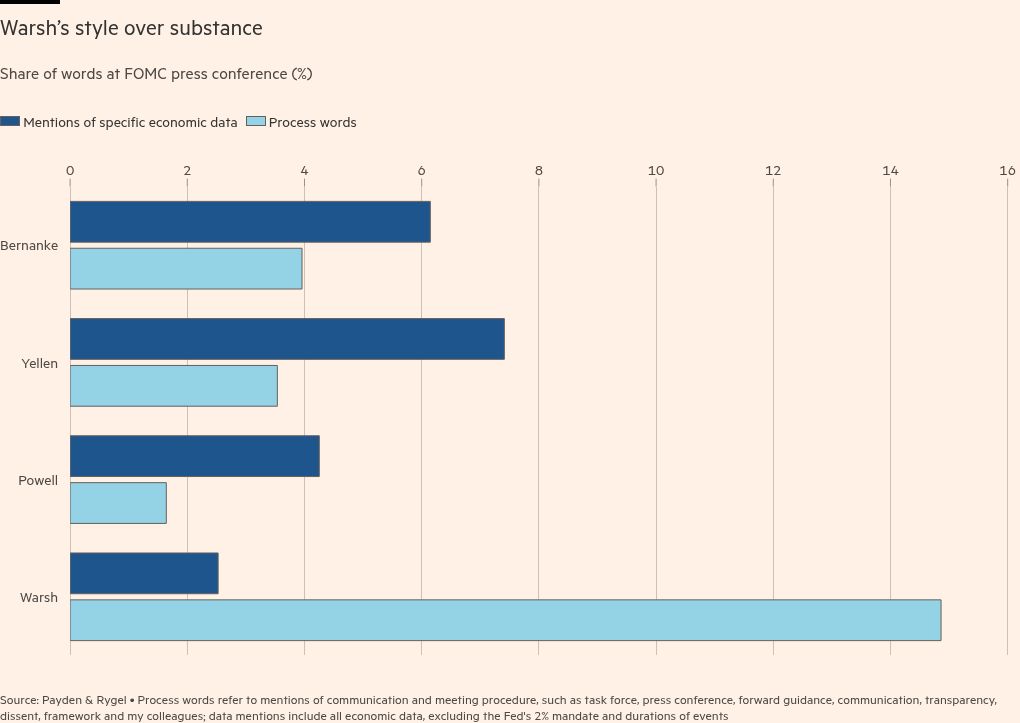
It is the obtuseness of many of his answers that wound people up. Instead of answering reasonable and soft questions about the economy, Warsh talked about process and how good the discussion behind closed doors had been. I am indebted to the asset manager Payden & Rygel for charting the ratio of economic substance to process words in Warsh’s FOMC press conferences against previous Fed chairs.
Over at Unhedged, Armstrong, when he was being kinder, tried to reason that Warsh’s communication added a deliberate uncertainty premium, raising US interest rates and encouraging less borrowing, thereby meeting one of his objectives. I do not think that works. Uncertainty is bad for economies and investment, not just through a borrowing channel, but because households and businesses will be less inclined to invest if they think policy is capricious. It can only be damaging.
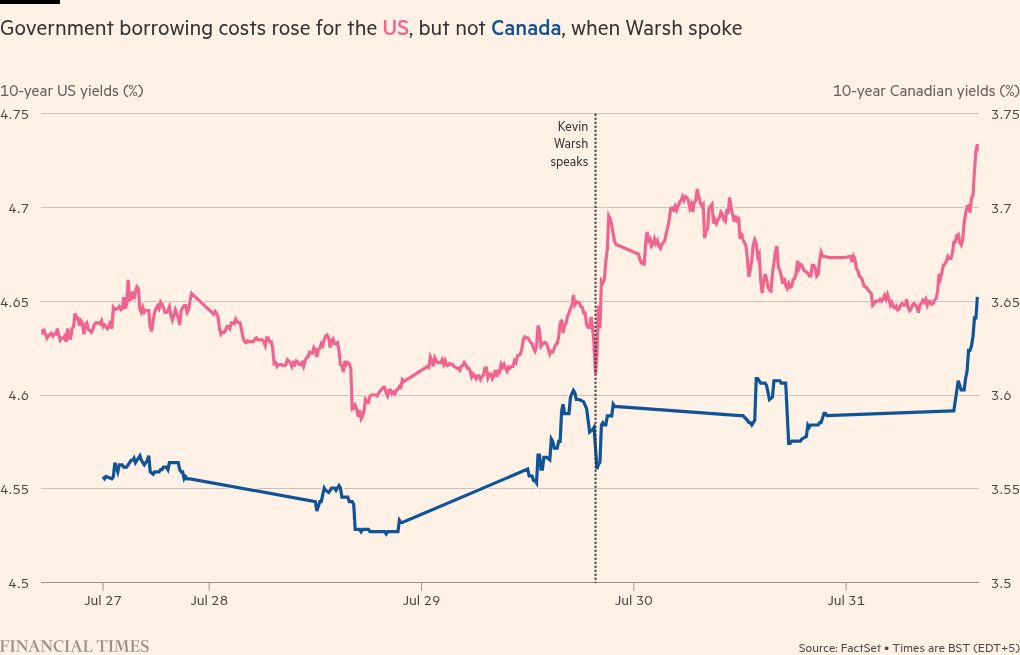
Nevertheless, Warsh’s press conference coincided with a rise in US borrowing costs not matched by equivalent rates in Canada, suggesting that financial markets were not convinced by the Fed chair’s words.
So, what can we conclude? The Fed chair likes to praise financial markets, regardless of what they say; does not offer substantive economic explanations; is not overly concerned about logic and consistency; and appears to hold the process of setting rates and his management of the Fed in very high regard. I fear this is exactly the sort of communication that makes an unelected institution appear unaccountable and illegitimate in a democracy.
It’s better at the BoE
Warsh and his communications task force would be well advised to look at the decision and communications from the Bank of England the following day. The BoE delivered everything the Fed meeting lacked.
After a 6-3 vote, the BoE’s Monetary Policy Committee held interest rates at 3.75 per cent. The central bank immediately published a short collective statement, detailed minutes and a couple of paragraphs of explanation from each MPC member. In committing to its 2 per cent inflation target, the statement said: “The policy stance required to achieve this will depend on the scale and duration of the [energy] shock, and how it propagates through the economy including via financial conditions.”
It is easy to explain the BoE’s thinking and the different points of view on the MPC. It was all written down in the minutes and quarterly monetary policy report. In truth, the press conference was a bit superfluous, but governor Andrew Bailey and the others who spoke did not contradict the written text.
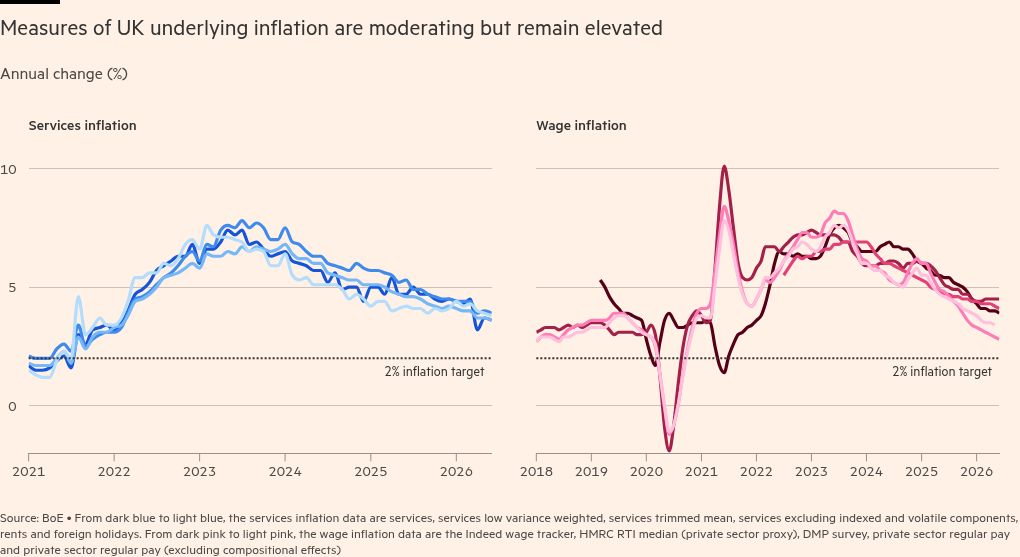
The economic starting point for the BoE is that measures of underlying inflation have been moderating but are still too high, as the charts below show. Some MPC members put more weight on the moderating trends; others put more weight on the level of underlying inflation.
The BoE explained that it was most worried about the direct effects of higher energy prices causing persistent inflationary pressure. This would occur if companies felt they could raise prices, households accepted paying higher prices and workers achieved higher pay settlements.
The central bank outlined the second-round effects it would be monitoring, noting that there were few flashing warning signs at present. Households were clearly sensitive to inflation, but an attempt to find signs of sticky prices did not yield much. Again, MPC members generally accepted the evidence but differed on the amount of comfort they drew from the analysis. The most important disagreement was over whether the current reasonably good signs will survive the high probability that inflation rises during the rest of the year.
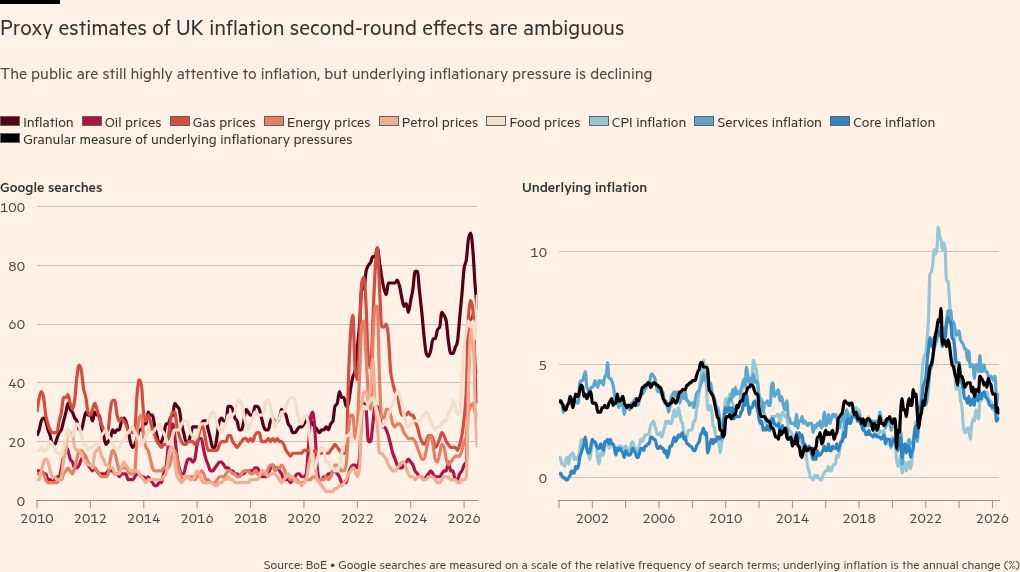
Bank staff also produced three scenarios as part of a forecasting exercise. In the “central” and “milder” ones, there was little need for urgent interest rate increases. The scenarios showed how dependent the outlook for monetary policy was on the conflict in the Middle East. Again, MPC members differed on whether they could wait and watch or whether they needed to act pre-emptively and raise rates in July. Reasonable people can differ on this.
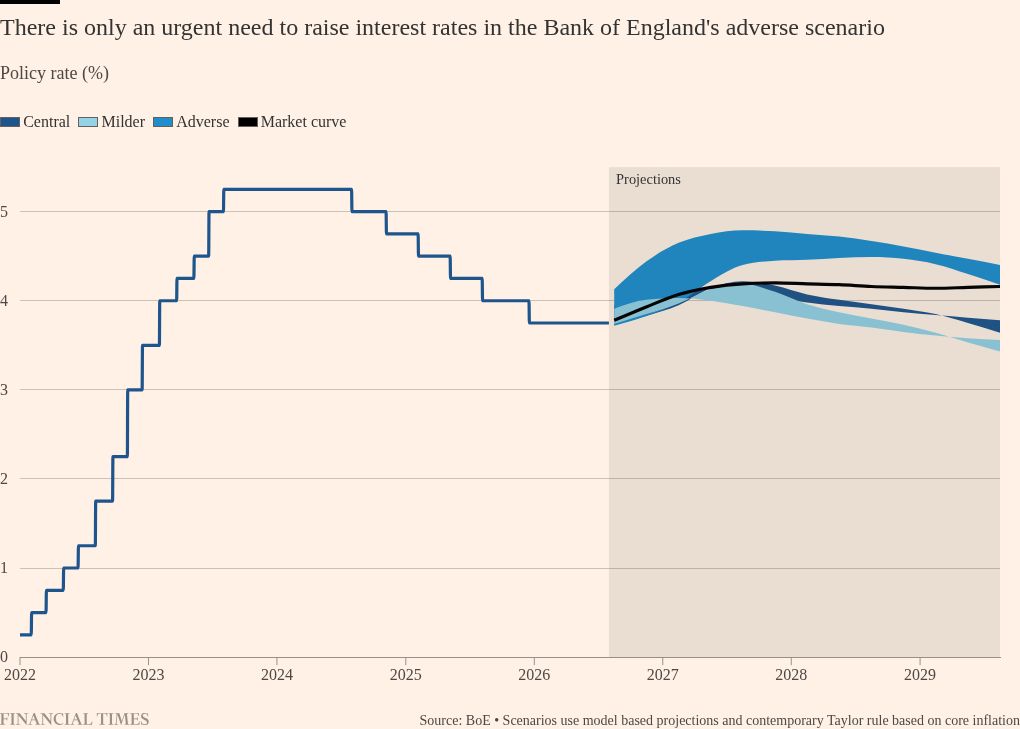
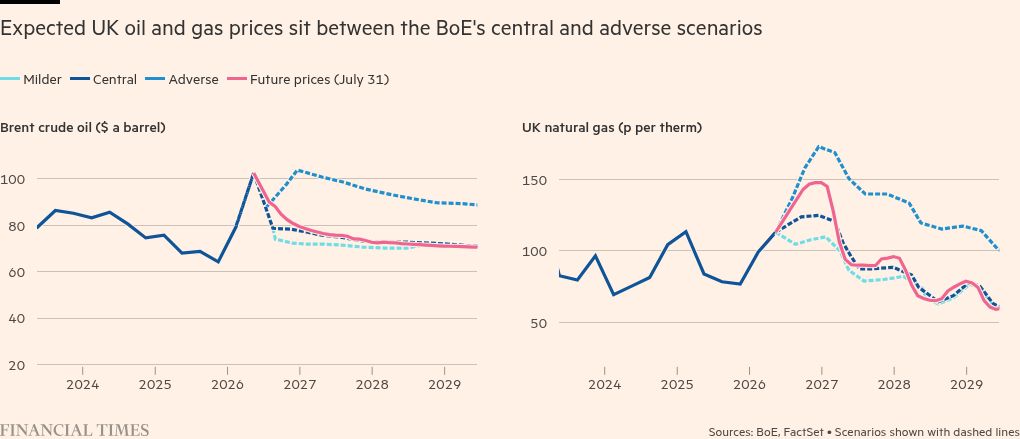
There was a bit of a sting in the tail if you looked closely at the underlying assumptions. At the end of last week, energy futures prices were significantly higher than the central forecast and closer to the “adverse” scenario, which would imply that a rate rise is likely if energy prices stay at those levels.
The BoE’s analysis was logical, straightforward and humble about what it did and didn’t know, demonstrating that it had learnt from its less successful past explanations and from the ECB’s better communications.
What I’ve been reading and watching
One last chart
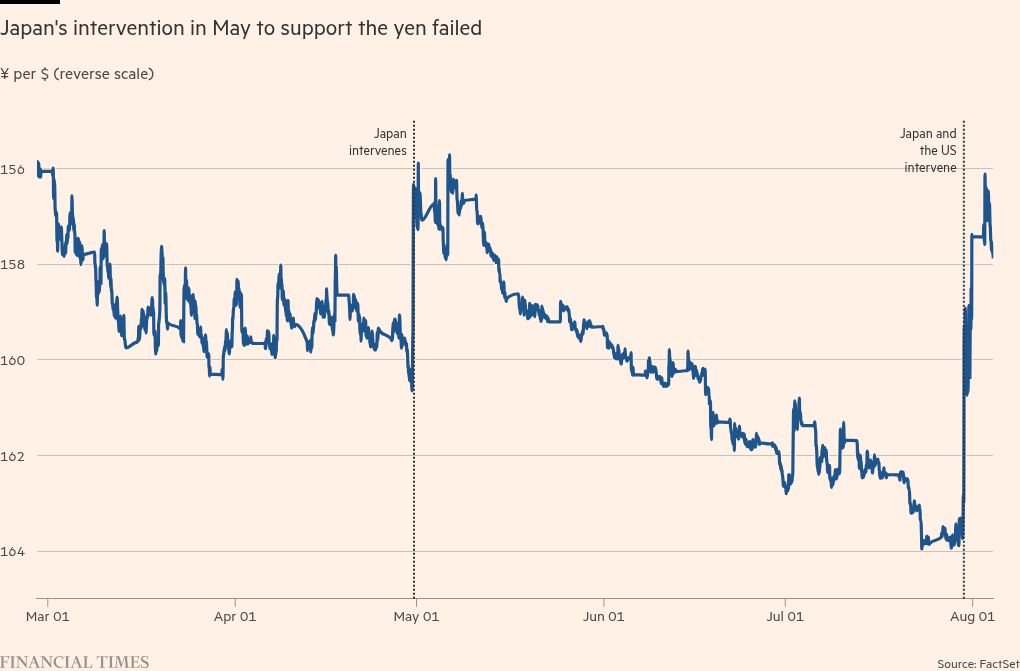
Japan and the US have been intervening in currency markets to raise the value of the yen. In early trading on Tuesday, the success of this operation was in the balance. Past efforts have failed.
Central Banks is edited by Harvey Nriapia