Stay informed with free updates
Simply sign up to the Global Economy myFT Digest — delivered directly to your inbox.
Developing economies stand to benefit more from AI boosting their workers’ output in the years ahead than they will lose in jobs being replaced by the technology, the World Bank said.
The biggest multilateral lender to middle-income and poorer nations said that “AI is more likely to lend their workers a hand than put them out of work”, in a report on Tuesday that predicted that a wave of cheaper AI tools could revive flagging growth across the developing world.
“As a rule, developing economies today have more to gain — and less to fear — from AI than richer ones . . . less than a tenth of their jobs are susceptible to AI automation, compared with more than a third in high-income economies,” said Indermit Gill, the bank’s chief economist.
The bank’s report sets a strikingly optimistic tone. Other experts have warned AI could leave many emerging economies even further behind rich countries, as fledgling middle-class knowledge workers will be replaced by bots and their governments will lose the race for data centres and chips.
“When we started the report, we were actually a lot less optimistic . . . our view of things was really coloured by the debates in developed economies” on job losses, Gill said.
But he added it soon became clear that AI was bringing efficiency gains such as more accurate medical imaging, faster clearance of court case backlogs and better weather forecasts in countries from India to Kenya, despite challenges such as less access to computing power and reliable electricity.
While economy-wide gains in productivity from AI are still difficult to measure, “there is a huge upside for doing things that would otherwise have taken decades, maybe even a century” in terms of having enough skilled workers for these tasks, Gill said.
Investor bets on these countries largely reflect a view that AI will favour a few high-tech emerging markets that benefit from chip demand, while hitting countries that supply cheap skilled labour for global services such as call centres.
An index of India’s big listed IT outsourcing companies has, for example, fallen 18 per cent this year, while Korea’s chipmaker-dominated stock market has surged 51 per cent.
The trend has reversed in the past month as investor doubts about the speed of the AI investment boom have increased, with the Indian gauge up 12 per cent while the Korean market has fallen by about a fifth.
The World Bank’s report said there was evidence that AI use had, meanwhile, been spreading rapidly across small businesses in emerging markets.
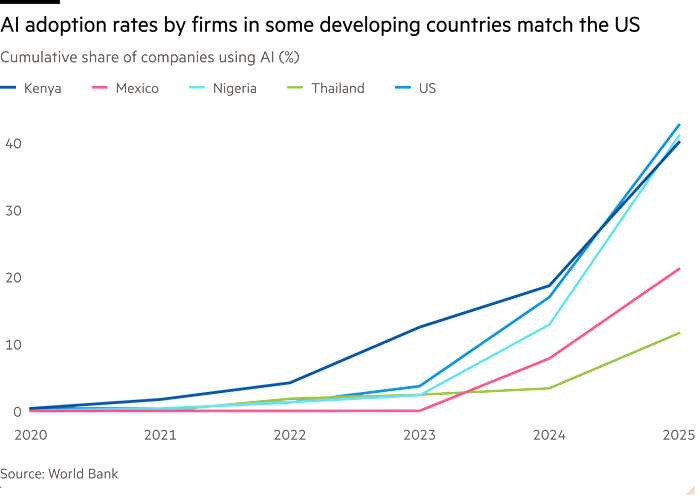
On average, about a fifth of firms with more than five employees surveyed in India, Jordan, Kenya, Mexico, Nigeria and Thailand had recently used AI chatbots in operations, versus a third in the US, it said.
The report warns that advanced countries are still set to see the biggest productivity gains based on their current higher rates of AI adoption, unless developing countries can catch up, such as by adapting models.
In an optimistic scenario based on current adoption trends, AI will raise the average maximum long-run growth of developing nations from 4.1 per cent to 4.9 per cent this decade, the report said, but boost it from 1.2 per cent to 3.6 per cent for richer countries.
The rise of so-called “small” models, which run on fewer parameters needing less memory, means that “AI can help solve important problems involving narrow tasks even when local computing power is limited, electricity is unreliable and internet service is dodgy”, Gill argued.
The bank warned that efforts by governments to spend big on “AI sovereignty”, investing heavily in data centres and chip production in a race to develop the best AI models, could be a “development trap” given the risk they do not pay off.
For smaller economies at every level of income, “it’s really hard to close the gap with the US and China . . . adaptation has to be the mainstay”, Gill said.