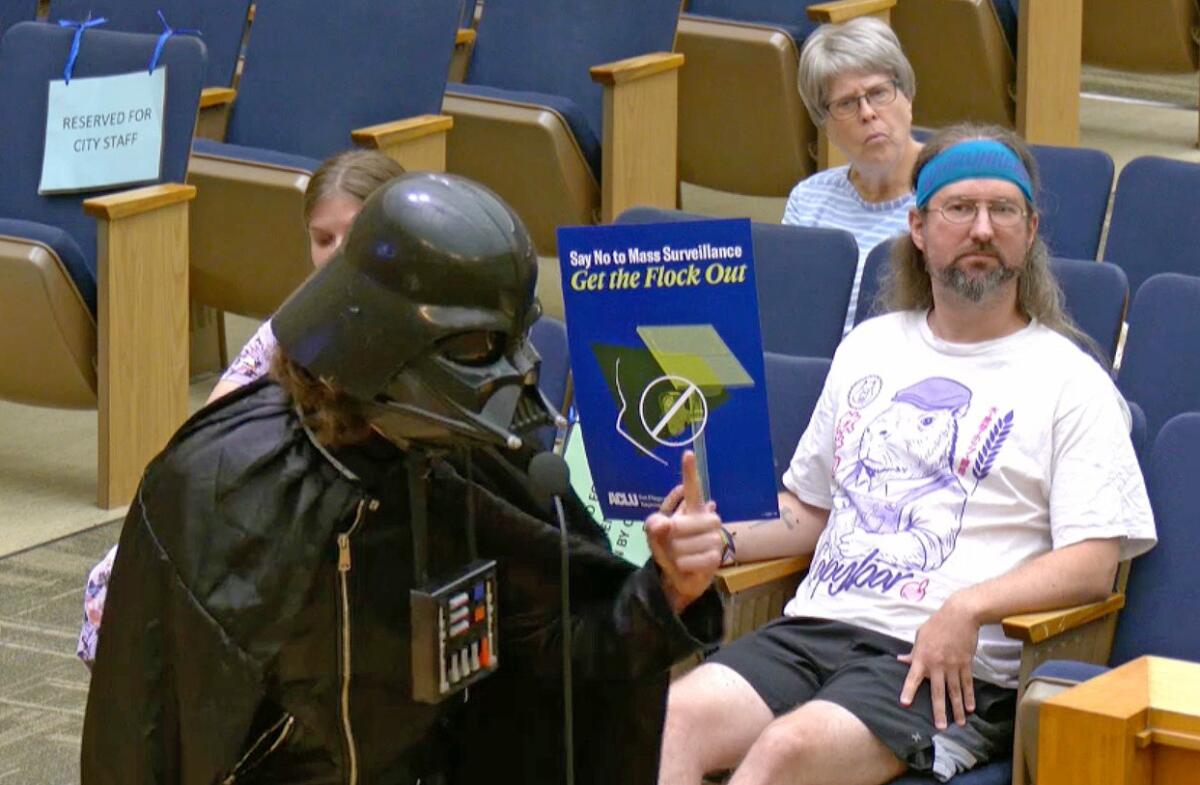
During a meeting at San Diego City Hall last week, where one hot topic is the growing use of Flock Safety technology — AI powered cameras designed to deter crime and track down lawbreakers — an attendee dressed in full Darth Vader costume approached the podium.
Breathing heavily into the microphone just like the famous movie villain, he told those sitting at the dais, “we must continue utilizing Flock technologies so that we can follow and surveil the Rebel scum,” according to a story by my colleague Hailey Branson-Potts.

(City of San Diego)
It was just the latest act of popular resistance against the nationwide use of a surveillance system critics describe as Orwellian.
On its face, the idea is to put in place a network of high-resolution cameras to create a database police can use to track down hit-and-run drivers, stolen cars and missing people. The mere existence of such a network, proponents say, would give would-be criminals pause, knowing there’s nowhere to run without being watched.
But the technology does not only record would-be criminals. Flock cameras across California have probably captured your license plate and/or face as you go about your regular day, and stored them in a database the owners of the cameras can use as they see fit.
And then there are the dozens of examples of rogue cops using Flock cameras for their own personal agendas, such as tracking wives, girlfriends or ex-girlfriends.
Despite opposition, cameras have never been more popular
It’s not like ordinary citizens don’t use similar technology.
My neighbors and I all have our own security cameras — they’re pretty ubiquitous in L.A. — and the first thing we do these days is share footage after a catalytic converter is stolen or a drunk driver careens into parked cars along our street. The images are usually too dark and grainy to be used as evidence in court, but they’re more than sufficient to show us who is shady.
To the person who failed to pick up the poop their dog left in front of my gate a few nights ago, I know who you are!
In light of the national debate, it feels worth mentioning that never, in all the time my neighbors and I have had our cameras, has somebody asking for my footage looked sheepish or prefaced the request with an apology for behaving like an authoritarian regime.
Many people crave authority when they feel like someone has done them wrong. But paying taxes to be watched by the government, 24/7, starts to feel a bit dystopian.
The Flock camera backlash
An online activist group that calls itself DeFlock has a searchable map of more than 135,000 of the cameras across the U.S., including several thousand in Los Angeles County. It also lists 132 cities that have rejected the technology by canceling contracts with the company that makes them.
In July, the LAPD said it stopped using data collected by Flock cameras installed around the city because of privacy concerns and questions about who else can access the data. Advocates worry the Trump administration will use the information to track down undocumented immigrants.
As the LAPD negotiates stronger safeguards with Flock, Mayor Karen Bass, who is locked in a tight reelection campaign, has apparently decided to sever ties to the company completely.
My colleague Libor Jany reported earlier this month that Bass said Flock had “lost the trust of Angelenos and residents across the country, especially in immigrant communities targeted by the federal administration.” She still supports the use of such cameras, she just wants the LAPD to find a less controversial vendor. Her opponent, Nithya Raman, had previously said the city should cut ties with Flock.
It’s such a fine line to draw. Presumably everybody wants the evidence to hold people who commit serious crimes accountable, but nobody wants to turn into the evil empire in the process.
Except Lord Vader. He loves the idea.
Top stories

(Justin Sullivan / Getty Images)
Worst time to buy a house in California?
- California’s eye-popping home prices feel unprecedented, but a Times analysis shows today’s market echoes the mid-2000s boom.
- The last supercharged market was fueled in part by ultra-lenient mortgages and lending that eventually sparked the global recession.
- Reforms have made lending more stringent, and along with rising prices, have altered the demographic of the California homebuyer over two decades.
Wine industry braces for Canada trade war
- California’s wine industry says it expects to take another hit as trade tensions between the U.S. and Canada flare up again.
- President Trump announced tariffs of up to 50% on Canadian goods this week and Canada responded with retaliatory tariffs on $20 billion worth of American products.
- Though wine was not explicitly mentioned, American alcohol has been the target of boycotts imposed by several Canadian provinces since last March.
Remembering Dolly Parton
More news
Commentary and opinion
Editor’s pick
More picks
Things to do

(Aspen Cierra Evans / For The Times)
Today’s recipe

(Stephanie Breijo / Los Angeles Times)
A basic vinaigrette is a balancing act between acidity and fat. Salt and other flavorings also play their part, but acidity and fat are your foundation. In this piece, Cody Reiss walks you through the basic skill that will improve any salad you make for the rest of your life.
Question for you
What is a Dolly Parton song you love and why? Email us at [email protected], and your response might appear in the newsletter this week.
Photo of the day

Tyrese Byrd makes a heart symbol with Izzy Hughes while jumping over a trash can at the Venice Beach Skatepark on Monday.
(Arwen Clemans / Los Angeles Times)
Games

Here’s today’s mini crossword, plus our other free, daily crossword puzzle, sudoku, word search and jigsaw games.
Have a great day, from the Essential California team
Jack Dolan, investigative reporter
Hugo Martín, assistant editor, Fast Break desk
Kevinisha Walker, multiplatform editor
Andrew J. Campa, weekend writer
Karim Doumar, head of newsletters
Shi Bradley, audience intern
How can we make this newsletter more useful? Send comments to [email protected].