For more than 25 years, Dr. James Harris Jr. had been trying to find Henry Ray, the counselor who once helped him find a path to college when he was a teenager in Fresno, California.
Harris had searched for him before, but he never had a phone number or a photograph and could not figure out where Ray had gone.
Then, on Sept. 16, Harris turned to social media for help.
Within hours, people had tracked down Ray’s phone number and connected Harris with his son.
So Harris called.
“Hey, this is James Harris. I don’t know if you remember me,” he said.
Ray remembered him immediately.
“You still sound the same, too,” Harris told him.
The last time Harris had seen Ray was when he had gone back to the continuation school after being accepted to UCLA Medical School. He wanted to show his former counselor the letter.
Now Harris, 48, is a general surgeon and chair of surgery at Johns Hopkins Howard County Medical Center. Ray is 80 and retired.
“I wouldn’t have made it if you didn’t do that for me,” Harris said. “If you didn’t take that chance on me, I wouldn’t be where I am now.”
“You were worth a chance because you were young,” Ray replied.
It was a modest explanation for an intervention that would have consequences far beyond the classroom.
Harris grew up in Fresno in a house where people used drugs. Dealers came and went, and outside he encountered gang violence. He spent much of his childhood afraid. By his early teens, he had started carrying a padlock and a Swiss Army knife, skipping school, stealing cars and getting into other trouble. He failed his first two years of high school, and at 14, his girlfriend became pregnant.
As a young child, Harris had been in gifted-and-talented classes and dreamed of becoming a physician. But by middle school, he no longer believed college was possible. When he was kicked out of regular high school and sent to Ted C. Wills Restart, a continuation school, Ray was the counselor who told him about Fresno State’s Educational Opportunity Program.
Harris had never heard of the program. Ray enouraged him to look into it.
“Mr. Ray reinvigorated a fire in me,” Harris previously told TODAY.
The turnaround did not happen all at once. Harris says he stopped stealing cars, began taking school seriously and, by 17, was working full time, finishing high school and preparing for college.
At Fresno State, he had to make up even more ground. He needed an extra year of math and a remedial English course before he could take the regular classes.
He did the work and eventually applied to UCLA Medical School, his first choice. He was accepted.
When he received the acceptance letter, he returned to the continuation school to show Ray.
“It was just wonderful,” Harris says. “It was such a great moment.”
He had not spoken to Ray since.
Ray declined TODAY.com’s request for an interview. His son, Lavance Ray, 47, says his father is “extremely private.” Even his children have had to work to get him to talk about his life.
That privacy appears to extend to the work his father did. Ray spent his career working with at-risk young people, but he rarely talked about the students he helped after they left his programs.
Lavance, who works with foster youth, says he has occasionally met people who recognized his last name and told him, “Man, your dad helped me out with this.”
Ray never told his family those stories.
“He holds it deep in his heart what happens to these kids after they leave,” Lavance says.
He was much the same way with his own children. Lavance says that he and his brother got into trouble when they were younger, and their father would show up to help them, no matter what kind of situation they were in.
Lavance says he and his brother have spent years piecing together stories about their father.
“It’s like pulling teeth trying to get him to open up,” he says.
Ray’s own background helps explain some of the values his children saw in him. He served in the Army as a paratrooper and attended Fresno State. He was also a member of Omega Psi Phi, a historically Black fraternity.
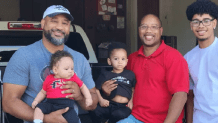
Lavance Ray, with his two children, and his brother, Jamel Ray, with his older son. Their father, Henry Ray, is an extremely private person and declined to share a photo of himself for this story.Courtesy Lavance Ray
When Lavance’s brother called him about Harris’s search for their father, Lavance was driving to work. He says he became emotional.
“I don’t cry much, but it did get to me,” he says. “It just made me proud. And it just kind of solidified my family legacy of what type of people we are, serving the public.”
Lavance has also followed his father into work with young people.
He works with foster youth and says he sees children every day who are dealing with difficult circumstances. He understands how much can depend on whether a young person knows that help exists and whether an adult takes the time to point them toward it.
Harris’s story with Ray is, in part, a story about what can happen when someone does exactly that. The teenager who had been failing high school went to Fresno State eventually made it to UCLA Medical School and went on to build a career in surgery at Johns Hopkins.
He also stayed with the girl who became pregnant when they were teenagers. Harris and his wife Rosina have now been together for 34 years. They married and raised three children.
After finding Ray, Harris wanted to thank him. He offered to send him a gift. But Ray had a different idea.
“Now send me that book,” he told Harris, referring to Harris’s memoir, Not Who I Once Was: My Unusual Path to Becoming a Surgeon. “And put your phone number in there again.”
Harris says Ray has never been interested in being recognized for the people he has helped.
“He just did it because he thought it was the right thing,” Harris says.
For Ray, there was no grand explanation for what he had done so many years earlier.
“You were worth a chance,” Ray told him.
This story first appeared on TODAY.com. More from TODAY: