A version of this story appeared in the daily Threat Status newsletter from The Washington Times. Click here to receive Threat Status delivered directly to your inbox each weekday.
SEOUL, South Korea — In an oddly coincidental development, both Pyongyang and Seoul replaced their defense ministers over the weekend.
The changes at the top of the two competing Korean states were both part of wider reshuffles.
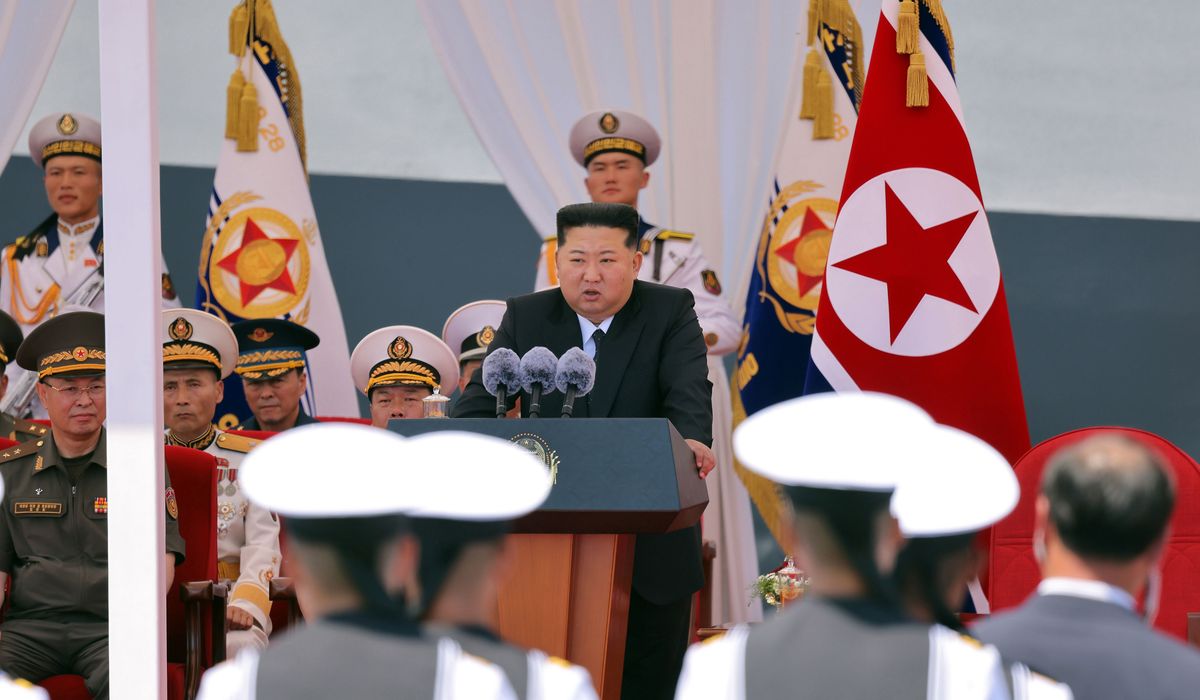
The North Korean decision was made during a Saturday meeting of the Workers’ Party of Korea’s Central Military Commission, overseen by state leader Kim Jong-un.
The South Korean replacement took place amid a Sunday Cabinet reshuffle under President Lee Jae-myung. Mr. Lee, who last week saw his approval ratings drop to a record low of 40%, replaced six ministers.
Both Koreas face military evolutions, but of very different natures.
North Korea is modernizing its army’s tactics while installing new military technologies. Both changes stem from Pyongyang’s decision to directly join Russia in fighting against Ukraine.
South Korea is in the process of taking back wartime operational control (OPCON) of its military from U.S. command. It is also mulling a potential change in officer education, while confronting a demographic/recruitment crisis.
North Korea modernizes
Advertisement
North of the DMZ, according to state media monitored in Seoul, Kim Song-gi, director of the General Political Bureau of the North Korean People’s Army, or KPA, was appointed as the country’s new defense minister Saturday, replacing No Kwang-chol.
Mr. No was appointed first vice-director of the Munitions Industry Department of the ruling Workers’ Party.
North Korea is reaping tactical and technological benefits as a result of its engagement in Russia’s war against Ukraine. It is the only nation, bar the two main combatants, to join a conflict that many believe is reshaping warfare.
A key challenge for Mr. Kim will be overseeing the incorporation of lessons learned at a high price in blood.
From August 2024 to April 2025, Pyongyang committed an estimated division — between 11,000 and 14,000 — of crack light infantry troops to Russia’s fight to push a Ukrainian incursion out of Kursk Oblast.
Advertisement
The North Koreans suffered as many as 7,000 casualties, of whom one-third to one-fifth may have been killed.
But not only did they impress Ukrainians with their offensive spirit, fitness and marksmanship, but their Russian allies dubbed them “Little Devils.”
“That started out as a kind of insult about their size,” said Chun In-bum, a retired South Korean general. “But it turned into a kind of grudging admiration for their tenacity.”
In addition, Pyongyang deployed engineering units tasked with mine and explosive ordnance clearance.
Advertisement
Also, according to Ukrainian media, North Korean artillery and drone units have been operating from positions inside Russia near the border with northeastern Ukraine since early this year.
Kyiv has warned that an additional 30,000 to 50,000 KPA have been massing in Russia amid rumors of an upcoming local mobilization by the Kremlin.
Prior to 2024, KPA combat inoculation had come in penny packets.
Special forces deployed against South Korea from the 1960s to the 1990s; jet fighter pilots fought in the Vietnam and Arab-Israeli wars; mini-submarines and fast patrol boats clashed with South Korea in the 1990s; and special forces may have fought alongside Russia in Syria in the 2000s.
Advertisement
Now, however, thousands of troops have gained their first up-to-date, large-scale war-fighting experience since the Korean War ended with an armistice in 1953.
That is important.
“Training and fighting are as different as watching porn and having sex,” said Gen. Chun. “When a round comes in, it affects your entire mindset.”
In the fight against Ukraine, the KPA has likely learned lessons in drone offense, drone defense, dispersed movement, tactical communications, electronic warfare and battlefield medicine.
Advertisement
Even so, incorporating those “how-tos” across the force could be tough.
“Their biggest problem is that they train what they know, and adjusting is a real challenge to them,” said Bob Collins, a retired U.S. military intelligence officer who formerly debriefed KPA defectors. “How they institute what they are supposedly learning is a problem; they are rigid and ideological.”
Experience is one gain. Tech transfer is another.
Ukrainian sources report that the tactical ballistic missiles North Korea sent to Russia early in the conflict suffered from reliability and targeting issues. Ukrainian analyses have found that both issues have drastically improved, likely as a result of Russian assistance.
Moreover, North Korea is expanding its naval assets, building both a nuclear submarine and a flotilla of heavily armed, nuclear-capable destroyers.
The latter have incorporated Russian Pantsir air defense systems.
Reports indicate that manufacturing technology for Geran kamikaze drones (based on Iran’s Shahed) has also been shared, as well as electronic warfare sets.
South Korea’s challenges
South of the DMZ, Kang Shin-chul, a retired general, will oversee the shift in Wartime OPCON, from U.S. to local command, which Mr. Lee has vowed to enact before his term ends in 2030.
On the military front, Gen. Kang is a former deputy commander of the South Korea-U.S. Combined Forces Command. On the diplomatic front, he has experience as a former ambassador to Saudi Arabia.
He replaces Ahn Gyu-back, who had a civilian background.
Gen. Kang faces stern challenges: No blueprint exists for OPCON transfer, nor for academy consolidation.
The first has been in play, off and on, over the preceding five administrations.
The change, however, is conditional upon acquisition of capabilities. Related stress tests are being overseen by the U.S. side.
The aim behind Mr. Lee’s second initiative, on incorporating the military academies, is novel. He hopes to civilize army officers, who undertook two coups d’état in 1961 and 1980, and who were also key figures behind a 2024 martial law order/autocoup.
Yet another issue: maintaining scale amid Korea’s plunging demographics.
South Korea’s armed forces are less than half the size of the North’s. Moreover, Southern conscripts serve 18 months, compared to Northerners, who serve eight years.
Multiple solutions have been mooted, from upgraded system automation via AI to massed drone adoption. Expanding and/or extending conscription, however, is being avoided.
“We could extend the term of service or expand to women in service,” Gen. Chun said. “But we are avoiding hard decisions and only looking at decisions that are politically, not militarily, acceptable.”
Story Topics