Warning: This report includes gruesome details that readers might find disturbing.
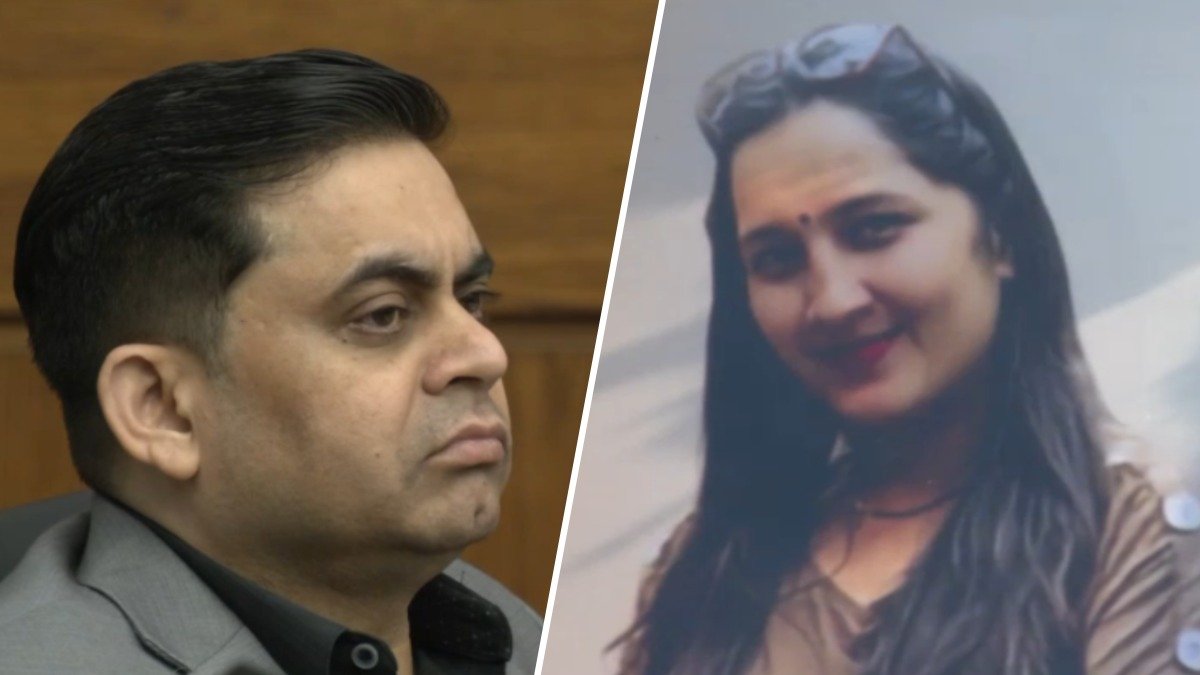
The defense rested its case Monday in the trial of Naresh Bhatt, the Northern Virginia man accused of killing and dismembering his wife, Mamta Kafle.
Bhatt claimed in bombshell testimony last week that he dismembered and disposed of his wife’s body in 2024 after discovered she died from an apparent suicide. Bhatt suggested on the witness stand that finding Kafle dead triggered his PTSD and he began dismembering her in a state of mind that he wasn’t fully in control of.
“My whole body was kind of shaking uncontrolled. Like extreme pain or trauma and that I was unable to think. I don’t know I was anything, I wasn’t thinking anything at all. Full body kind of moving … or automatically moving,” Bhatt said on Monday. “Uncontrolled extreme and sudden kind of heavy pain or trauma in my body. I don’t realize what I was thinking, what I was doing. Just kind of automatic movement. So intense. [My] body was so under pain like whole universe on the top of my head.”
After wrapping testimony from Bhatt, the defense called Dr. Barry Rosenfeld to the stand. Rosenfeld is a psychologist with clinic experience and professor at Fordham University who evaluated Bhatt in September and in early October.
Prosecutors decided how to move forward in Bhatt’s trial after his testimony in which he admitted to dismembering his wife’s body News4’s Drew Wilder reports.
“I’ve got a very, what I would consider, solid basis for thinking that he suffers from PTSD and that when I’m interviewing him, he’s not exaggerating the severity of that PTSD. I can’t know what he was doing or thinking in that moment beyond what he tells me,” Rosenfeld testified.
“When Mr. Bhatt is describing that thought process, is that consistent with the diagnosis of PTSD?” Bhatt’s attorney, Tracey Lennox, asked Rosenfeld.
“It’s certainly a plausible way of behaving. Not the cutting of a body. I mean the panicking and not knowing what to do. That is, not thinking clearly is not at all surprising for someone who’s got post traumatic stress disorder and has been triggered by something upsetting,” Rosenfeld said.
Outside the presence of the jury Monday, Bhatt’s attorneys wanted the court to allow his previous defense attorney to testify, saying that Bhatt told his original attorney his story just weeks after his arrest.
The judge refused the request, saying the attorney was never on the witness list and it’s too late to spring a new witness on prosecutors. Bhatt also had weeks to develop a motive to fabricate his story, the judge said.
Naresh Bhatt’s testimony about getting rid of his wife’s body in Northern Virginia was met with gasps. Watch News4’s special coverage deep dive.
Kafle disappeared more than two years ago in Manassas Park, Virginia. Her body has never been found.
Bhatt testified that on the night of July 29, 2024 he slept in a room with the couple’s baby down the hall from the primary bedroom.
He said he woke up a couple of times that night with the baby, including 4 a.m. the following morning on July 30. That’s when he said discovered Kafle lying on the floor as he walked into their primary bedroom to use the en suite bathroom.
Bhatt testified that Kafle was on her back with vomit on her and on the floor next to her. He said there were pills visible in the vomit as well as a bottle of pills nearby. He claimed there were also open cases of pesticides nearby and it appeared the chemical was in her vomit.
Bhatt said he tried reviving Kafle for 45 minutes to an hour before moving her body across the bedroom floor to the bathroom to try to give her water. She was unresponsive and not breathing the entire time, he said.
“Why didn’t you call 911?” Bhatt’s defense attorney asked.
“I really at that point scared. I don’t know why I did not. I tried to call. I really scared. I don’t know why. Something take over me. I was really, really panic. I don’t know … I don’t really even, like, it’s been, like, over two years. I have completed more than 3,500 hours of meditation. Still I don’t have that answer,” he said.
“Are you afraid that you’re going to be blamed for driving her to suicide?” his lawyer asked.
“Yes,” he said.
In stunning testimony as he stands trial for murder, Naresh Bhatt claimed he found his wife, Mamta Bhatt, dead and then tried to put her body in their outdoor trash can. He told police at the time that she disappeared and he had no idea where she was.
At some point, he texted their babysitter and brought his daughter to her home before going to Home Depot to try to find something to use to hide Kafle’s body, he said.
When his attorney asked him why he bought gloves at the Home Depot, he said, “I have no idea.”
Bhatt testified that he dismembered and disposed of his wife’s body over the next day to day-and-a-half inside the trash cans at their home.
“What did you do when you came back home?” his attorney asked.
“Put in the trash can,” he said. “Reduced the size and then put in the trash can. With a, in the bag.”
“How did you do that?”
“I had a saw. I used the saw,” Bhatt said.
“Did you use knives?”
“Little bit, but not a lot,” he said.
Multiple surveillance videos the prosecution presented to the jury earlier in the trial show Bhatt dumping numerous bags into different trash dumpsters while wearing gloves. Bhatt said on Thursday that none of those bags contained Kafle’s remains, but they had her personal belongings.
Some people sitting the courtroom Thursday gasped audibly during parts of Bhatt’s testimony, and Kafle’s mother left the courtroom at one point.
A few jurors didn’t appear to believe Bhatt’s story. Some rolled their eyes at times. One juror could be heard laughing at something Bhatt said.
Bhatt remained emotionless while describing how he allegedly found his wife and dismembered her body.
The prosecution challenged Naresh Bhatt after his claim that his wife, Mamta Kafle, killed herself. News4’s Drew Wilder reports.
His testimony is a direct about-face from his statements to police and reporters after Mamta’s disappearance. Bhatt said then that she left their home and was likely either in New York or Texas.
Prosecutor Matthew Sweet immediatly addressed the change to Bhatt’s story when he began cross examining him in the afternoon, telling him, “You’re a liar.”
“Yes,” Bhatt replied.
“You lied,” Sweet continued before applause erupted in the courtroom and the judge called for order.
Mamta’s friends expressed outrage while speaking to the media during the court’s lunch break on Thursday.
“He has no emotions. It’s all made up. It’s all, you know, he memorized all this last two years. ‘This is what I want to say,'” one woman told reporters.
Bhatt said he had signs mental health issues in military
Bhatt’s defense attorney first called him to the stand Wednesday, and began by asking him about his upbringing in Nepal and the experiences that shaped his early life.
He described living in a humble home built on a steep cliff with multiple families when he was a child. He said there was no heating or air conditioning in the home and they didn’t have enough to eat the majority of the time.
After detailing his life in Nepal, Bhatt spoke about coming to the United States and working a few odd jobs before enlisting in the Army.
Bhatt said he recognized he was experiencing some mental health issues during his time in the military.
Bhatt, who is accused of killing his wife Mamta Kafle, said he experienced mental health problems while in the Army.
“Did you start having symptoms having to do with your mental health?” his attorney asked him.
“Over there? Yes. I did not realize, but, like, you know, I did not know about these, all those dreams this and that,” Bhatt said.
“So you’re waking up screaming at night?” the attorney asked.
“Yeah and then [someone asked me] ‘What happened? What happened, soldier?’ And then I say, like, ‘nothing.’ And then he found me, like, a lot of sweating and then, you know, heartbeat is going. I say, ‘No, it’s a bad dream. Dream is gone. Some evil bother,'” Bhatt said.
After discussing Bhatt’s background, his attorney eventually asked him about his relationship with Kafle.
He admitted that in the months before her disappearance their relationship took a turn and that they weren’t being kind to each other. But he said on the stand multiple times that he never assaulted his wife.
A forensic expert also testified on the blood evidence, connecting some crucial dots for the prosecution. News4’s Drew Wilder reports.
Bhatt has maintained his innocence, pleading not guilty to first-degree murder, defiling a dead body and concealment of a dead body. He has changed attorneys over the past two years and tried to get his current public defender removed from his case as recently as September.
Forensic scientist says blood on carpet ‘beyond likely’ Mamta’s
The prosecution rested its case on Monday with testimony from forensic science experts, a family friend and Kafle’s brother.
A witness from the Department of Forensic Science testified it was “beyond likely” that the majority of the blood discovered on the stained primary bedroom carpet was Kafle’s.
Hired expert and professional forensic evidence analyst Iris Dalley Graff also connected some crucial dots for prosecutors.
Her testimony began with a diagram of Bhatt and Kafle’s primary bedroom, where prosecutors believe Bhatt murdered his wife.
The bed is positioned where detectives believe it was originally – then the yellow markings show where it was moved to, covering up an area of carpet where blood was found and, maybe more importantly, where blood was not found.
“There are patterns that are missing,” Graff testified.
Graff also explained what may seem obvious: If blood is found on the bottom side of carpet, at some point, the blood was on top of the carpet.
Missing stains on the top of the carpet “would generally indicate some type of cleaning,” she said.
Graff then testified to an illustration that showed the source of the blood on the carpet being dragged from the area near the bed to the primary bathroom, where investigators discovered more blood evidence.
A friend of the Bhatts testified that after Mamta disappeared, Naresh gave her all of Mamta’s jewelry and his wedding band. News4’s Drew Wilder reports.
Friend says Bhatt gave her wedding band after wife disappeared
A close friend of Bhatt and Mamta Kafle testified that a couple of weeks after Kafle disappeared, Bhatt gave her all of Mamta’s jewelry and his wedding band.
The friend said Bhatt spoke to her seven to eight months before about the possibility of divorcing Kafle.
Kafle’s brother Mahesh Kafle was the last witness to take the stand for the prosecution.
In emotional testimony, Mahesh said he told his sister not to marry Bhatt after the first time he met him.
He said that a couple of months before Mamta’s disappearance, she secretly texted him a picture that appeared to show her with a black eye, and she told him Naresh gave her the bruise.
Mahesh said Mamta told him to keep the photo because she might need it at a later time. She then told him she would delete it off of her phone so that Bhatt wouldn’t find it, Mahesh testified.
Last week, a forensic scientist testified that DNA and blood samples found in an electric saw are very likely to be Kafle’s blood.
Prosecutors said Bhatt bought the saw months before they say he killed Kafle. He gave it to a landscaper – who then gave it to police.
News4 sends breaking news stories by email. Go here to sign up to get breaking news alerts in your inbox.