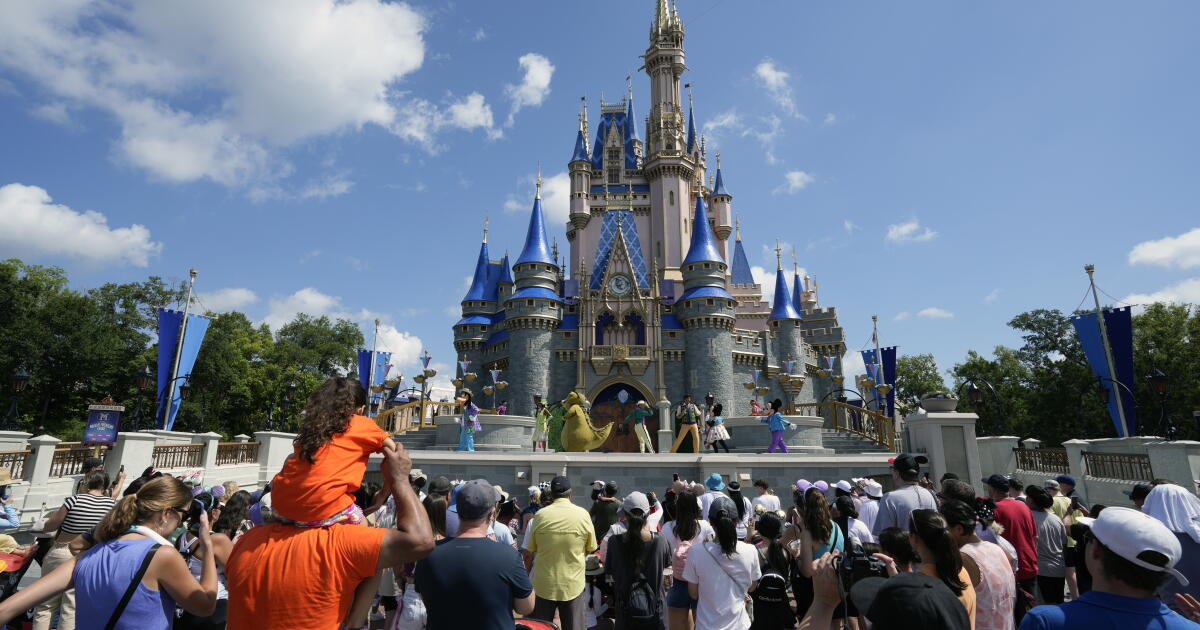
Despite tough economic conditions that have impeded competitors, Walt Disney Co.’s theme parks are still seeing growth in guest attendance and spending.
The Burbank entertainment giant has long relied on its experiences sector — which includes its theme parks, cruise lines and Aulani resort and spa in Hawaii — to drive finances, and that economic engine continues to hum.
Disney’s experiences division reported a 15% increase in revenue to $10.1 billion in the fourth fiscal quarter compared with the same period a year earlier. Operating income in the division rose 20% to $2.3 billion during the quarter, which ended Oct. 3.
The experiences sector generated nearly $39.6 billion in revenue for the full year, up 9%. Operating income increased 12% to $11.2 billion from a year earlier.
By contrast, rival Comcast reported in October a 4.4% drop in revenue for its Universal theme parks during the third quarter, citing “continued pressure” in Japan as well as Orlando, which has seen softer results since June.
Disney, too, continues to experience “headwinds” from lower international tourism to its domestic theme parks, as well as some softness at the company’s parks in Shanghai and Hong Kong. But the House of Mouse was boosted by local visitation to Walt Disney World in Florida, as well as strong attendance at Disneyland Paris, which opened a new “Frozen”-themed land earlier this year.
Global attendance across Disney’s experiences division jumped 4% for the full year, setting an all-time record, with guest spending rising both domestically and internationally during the fourth quarter.
“Fans just value the Disney experience, and there really isn’t anything out there that matches it,” Chief Executive Josh D’Amaro said Tuesday morning during an earnings call with analysts. “People today are spending so much of their lives on screens, they’re just looking for time to connect with each other in the real world. And I think a Disney park is one of the few places that you can actually do that.”
Beating Wall Street’s estimates
Overall, Disney brought in $25.9 billion in revenue for the fourth quarter, up 16% from the prior year. Net income totaled $2.6 billion, nearly double the $1.3 billion from a year ago. Operating income jumped 43% to more than $4.9 billion, and earnings per share, excluding certain items, improved 59% from a year earlier to $1.77.
For the full year, Disney produced revenue of $102.3 billion, up 8%. Operating income increased 12% to $19.7 billion.
The results beat analysts’ estimates, according to Factset.
Powered by streaming growth, heavy-hitter “Toy Story 5” and the success of television shows such as “Dancing With the Stars,” the entertainment division also saw gains for both the quarter and the full year.
Disney’s entertainment sector saw nearly $11.9 billion in revenue for the fourth quarter, a 17% increase from the year-earlier period. Operating income reached $1.3 billion, up 92% from a year earlier, which included the comparatively weaker box-office performances of Disney and Pixar’s animated original “Elio” and Disney and Marvel Studios’ “The Fantastic Four: First Steps.”
For the full year, Disney’s entertainment division produced $46.6 billion in revenue, a 10% bump from 2025. Operating income increased 16% to $5.4 billion.
Disney’s sports segment, which includes ESPN, had $4.6 billion in revenue for the fourth quarter, up 16%. Operation income rose 53% to nearly $1.4 billion. Disney credited high viewership to the start of the college football season, as well as the NFL.
In the coming months, employees are bracing for potentially massive job cuts that are expected as D’Amaro looks to sharpen Disney’s focus and make it more nimble. Already, Disney’s human resources and technology division have been hit with layoffs and Disney has separately offered early retirement packages to some older workers.
During the earnings call, Disney executives said cost-cutting plans, which include the impending layoffs as well as changes to procurement, sourcing, IT and real estate consolidation, will save about $3 billion by fiscal 2029. The company said it would put those savings toward future revenue growth, particularly in streaming.
“Changes like these are not easy, and they affect people who care deeply about Disney and have contributed so much to this company,” D’Amaro said during the call. “At the same time, these steps are important if we want to be a company that moves faster, adapts to a rapidly changing environment and keeps investing in the content and technology that will drive our growth.”
The company plans to invest in local content around the world, citing the recent success of South Korean breakout hit “The Remarried Empress.” That strategy is similar to Netflix’s international growth plans, said Mike Proulx, vice president and research director at market research firm Forrester.
“Across the streaming market, growth in North American markets is plateauing, forcing Disney and others to mine for expansion elsewhere,” he said in a statement. “Tripling its local originals in other regions over the next three years is a big investment that underscores why Disney is simultaneously looking for more aggressive cost cuts elsewhere in the business.”
Deploying AI
During Tuesday’s earnings call, executives also detailed how AI is being deployed throughout its divisions, including a vacation planning tool built with Google that’s currently in early-stage testing at Disney World, advanced analytics in the parks to help deploy employees to needed locations and more accurate recommendation technology on the Disney+ streaming platform.
New machine learning technology developed at Disney’s research studios and Lucasfilm visual effects studio ILM is sharpening the picture quality of films and TV shows, which has reduced the computing power needed for rendering by 30%, D’Amaro said.
Despite these advancements, he said the company would apply technology in a “very thoughtful way.”
“Our cast members, all of our creative teams, the people that are behind the magic, they’ll always stay at the center of the experience,” D’Amaro said.