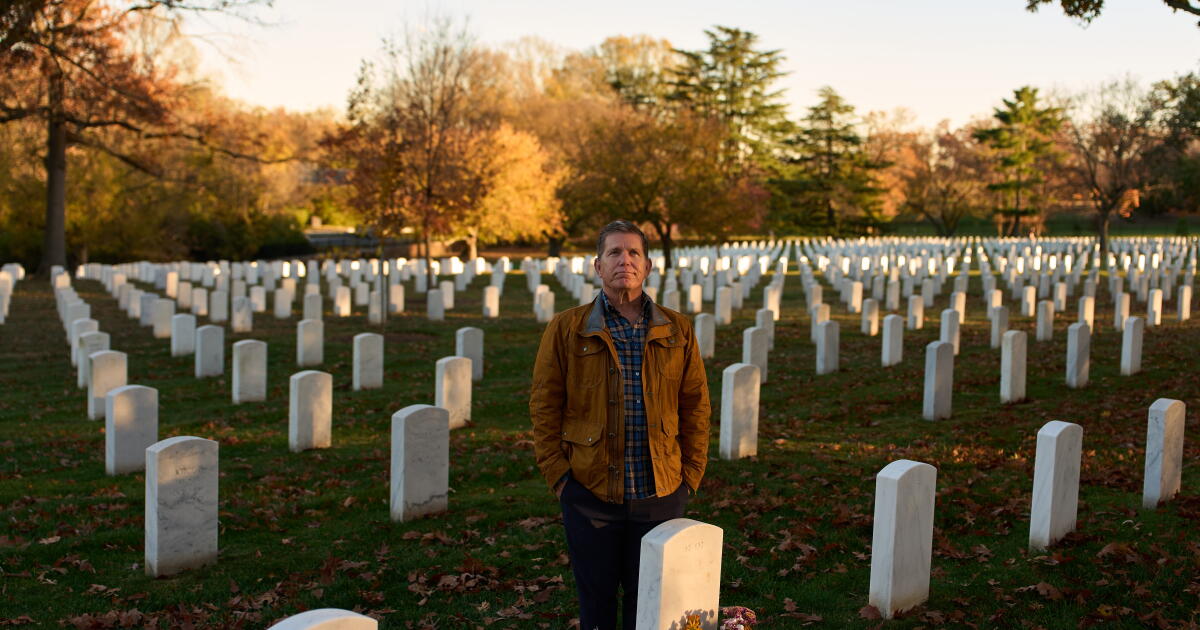
WASHINGTON — Cpl. Spencer Collart’s headstone faces the rising sun and the Lincoln Memorial to the east. The Marine Corps War Memorial is nearby. Soon, President Trump’s gilded, towering arch could be, too.
Collart’s silent stone speaks volumes in its simplicity of courage, sacrifice and loss. It stands among thousands of uniform headstones and other monuments, each telling the story of the person, or persons, beneath it.
But if Trump gets his way, a different story may be told. His proposed 250-foot-tall arch could cast a long shadow on Arlington National Cemetery, with the potential to literally shade gravesites, disrupt solemn visits with the noise of construction and alter the carefully designed historic landscape of the nation’s capital.
For many veterans and their families, and the loved ones of others buried at the cemetery, the arch has no place so close to the Arlington, Va., burial grounds. That opposition has sparked lawsuits by veterans groups and others, including nine family members of the Kennedy political dynasty, who argue the arch, which would be built on a traffic circle about half a mile from Arlington’s main entrance, will fundamentally change the experience of visiting the cemetery.
“It’s a billboard for an ego. It’s a loud, boastful, gaudy piece of marketing dropped onto sacred ground,” said Bart Collart, Spencer’s father. His son, a young Marine who died at 21 trying to save fellow crew members in a 2023 Osprey crash in Australia, would see it as “dirtying hallowed ground.”
A skyline-altering arch could impact the cemetery
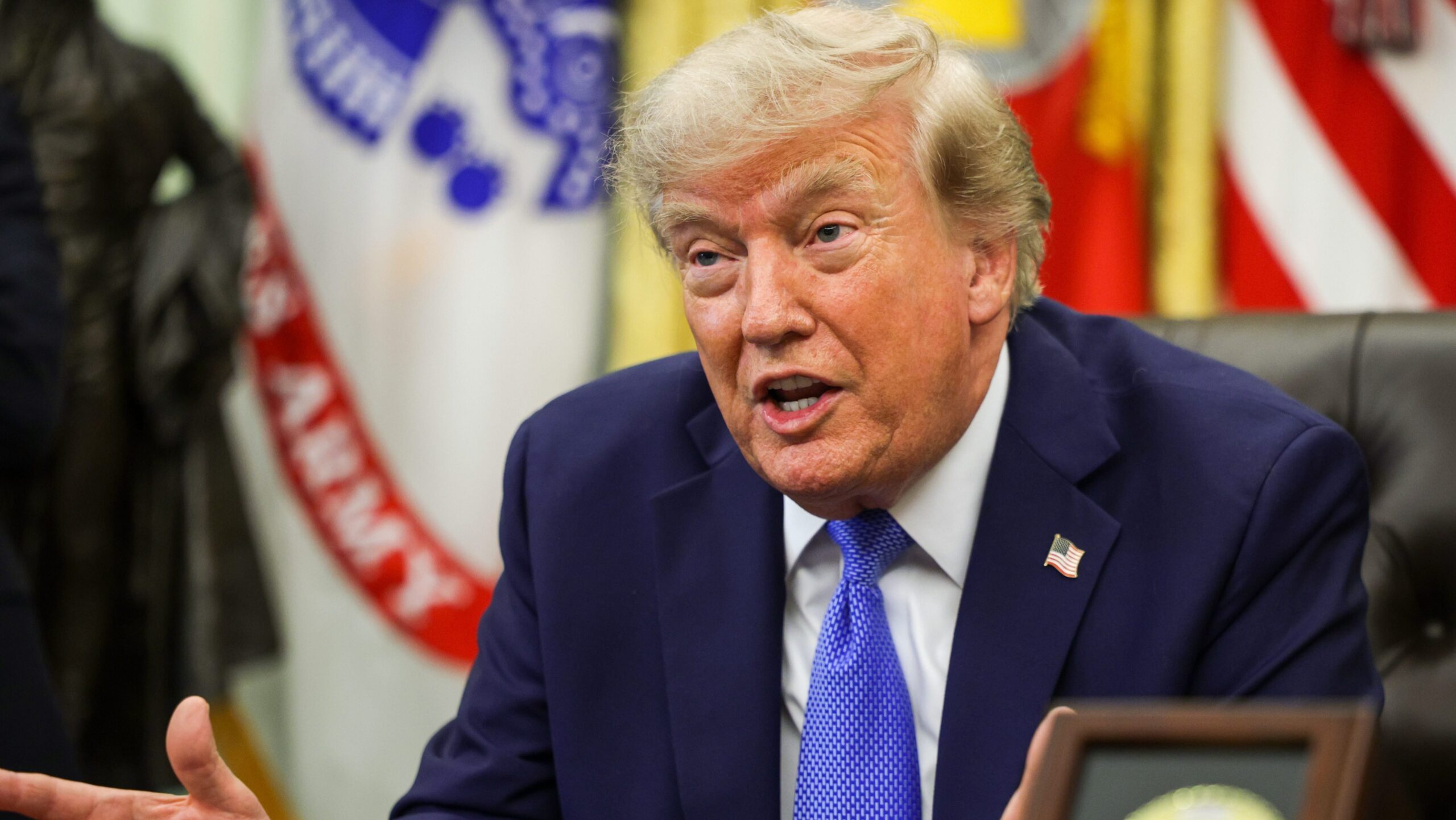
The arch project is part of a series of renovations to Washington that Trump, a Republican, has set in motion to reimagine the city. When complete, the gold and granite arch will stretch taller than the Lincoln Memorial.
Opponents say the arch would break the alignment between the Lincoln Memorial, the Memorial Bridge and Arlington House, which was formerly Confederate Gen. Robert E. Lee’s home, and the symbolism of a reunited North and South.
But behind the fences that line Memorial Drive is an active cemetery with more than 430,000 people interred there and dozens more added each week.
They include retirees and their spouses and some dependents and a few eligible dignitaries. There are two presidents, John F. Kennedy and William Howard Taft, there, along with more than a dozen Supreme Court justices. Among the dead are an untold number who died while on active duty and eligible spouses. There are more than 400 recipients of the Medal of Honor, the nation’s highest honor for valor in combat. The remains of military personnel from every war, dating back to the Revolutionary War, are there.
An estimated 3 million to 4 million people visit annually. Walking among the stones or taking the tour is a lesson in the nation’s military history. The Tomb of the Unknown Soldier is one prominent feature, as is the grave of boxing legend Joe Louis. Audie Murphy, an actor who was one of the most decorated U.S. soldiers in World War II, is also buried there.
On a recent visit, a small group of about 10 men came quietly from Section 60, an area where soldiers who died in Afghanistan and Iraq are buried.
Their young ages, “PH” for Purple Heart and the inscription Afghanistan or Operation Enduring Freedom mean premature loss. What comes through is silence and distant sound, except for the passenger planes flying over from nearby Ronald Reagan Washington National Airport.
“I think you could, by any definition, consider it the most hallowed ground in the United States, but I think we’re not even giving it credit for how hallowed, how representative, how much sacrifice and honor is there,” said Micki McElya, a historian at the University of Connecticut and author of “The Politics of Mourning: Death and Honor in Arlington National Cemetery.”
She said the country’s shifting values are represented there in all their complications, including slavery.
Court battles over the arch are ongoing
Supporters of the arch say it completes a plan mandated by Congress in 1925 to add a monument to the circle.
“It was always supposed to be a gateway to connect D.C. to Arlington,” said Jared Craig, general counsel and national vice president for Veterans for America First, which joined several veteran organizations in a brief in the lawsuit supporting the arch. Craig argued the arch honors veterans and fallen service members. He said that the project does not impact the cemetery itself and requires no changes there.
Jimi Shaughnessy, veterans program manager at the nonprofit National Parks Conservation Association, disagrees. A veteran, he visits his great-grandparents’ resting place regularly.
“The setting is open, it’s quiet, it’s peaceful, it is easy to navigate,” he said. And there is space to transition “so I can properly acknowledge my great-grandfolks that are buried there.”
The sounds of major construction will intrude on that and funerals, and creating a tourist attraction at the arch will bring noise and distraction, along with a “looming dark shadow above me,” he said.
The White House did not immediately respond to a request for comment.
A federal judge has temporarily blocked the project, and court challenges are ongoing.
A fallen Marine’s father pushes back
A recent day brought a steady stream of funerals. Planes took off from the nearby airport, but there were points when the quiet was encompassing. Section 52, where Cpl. Collart is buried, is in a corner of the cemetery and had just one visitor walking and reading the stones.
Collart was killed in August 2023. A crew chief on a V-22 Osprey that functions as a helicopter and an airplane, he had been deployed to Australia for several months when his aircraft went down. Collart and the pilots, Capt. Eleanor LeBeau and aircraft commander Maj. Tobin Lewis, died in the crash during a training mission. It was months later when the family learned that he survived the crash but went back into the burning aircraft to try to save the pilots, who were trapped.
Standing at his grave this week, the elder Collart spoke of his son’s love of flying and his pilots and he remembered how on the day of his burial a fleet of Ospreys had flown over his grave in a formation known as the missing man, meant to honor a fallen military aviator.
During a 10-hour hearing earlier this month when a key planning commission approved the arch, Collart spoke passionately of his son’s sacrifice. He asked commissioners to “do the right thing” and oppose Trump’s desires. Many of the more than 100,000 public comments that have come in about the project opposed it.
“Look across the road at those rows of clean, simple white headstones. Go take the time to walk amongst them,” Collart implored the commission during its hearing. “Show some real respect for the uniform my son died in.”
Fields writes for the Associated Press. AP journalist Nathan Ellgren contributed to this report.