A shark drone photographer captured extraordinary footage of a great white circling a swimmer off the coast of Santa Barbara.
Carlos Gauna, who has been documenting sharks for roughly a decade, regularly posts such videos to his YouTube channel, TheMalibuArtist. His work has helped people learn that the apex predators are around humans more often than once thought.
The vast majority of those encounters are uneventful, with both humans and sharks continuing on their way.
But a video Gauna shot on Sunday made him nervous.
“Normally when I film the white sharks around humans, they will come up to a human, figure out it’s a human and then leave,” he said.
In this case, the shark — which Gauna believes to be a roughly 9-foot juvenile — lingered within arm’s length of the swimmer, circling him several times.
“This one took a little longer to figure out that this was not food, or that it was a human, and that kind of made me a little uncomfortable,” Gauna said.
He theorized that was because the water was turbid and muddy due to big surf, which may make it harder for a shark to differentiate humans from prey.

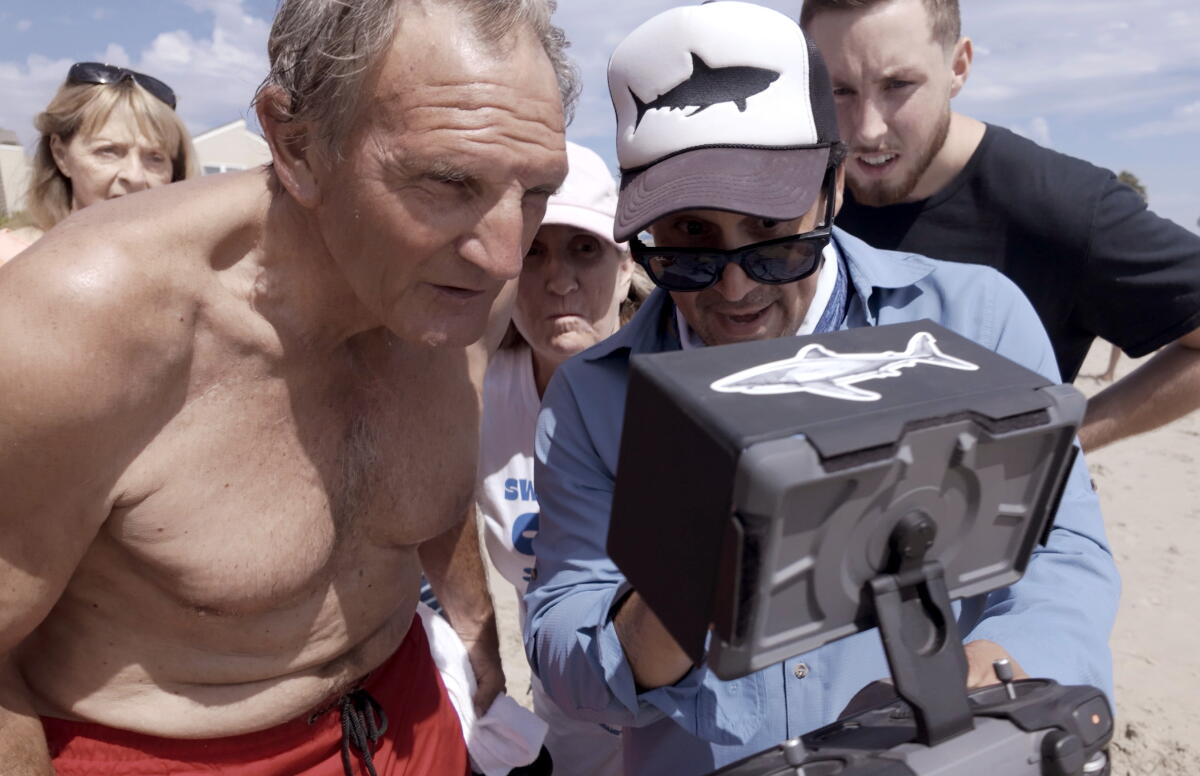
Drone operator Carlos Gauna, known as “TheMalibuArtist,” shares footage of a great white circling the swimmer after he got out of the water.
(@TheMalibuArtist)
Gauna found the swimmer on the beach and showed him the footage, filming his reaction. The swimmer said he had felt something moving through the water but hadn’t seen the shark. Still, the man told Gauna, “I think about the sharks, and I think if I do die this way, at least I’ll be in my happy place.”
The swimmer did not immediately respond to a message seeking comment.
Like humans, sharks use a melody of senses to interpret the world around them, said Chris Lowe, director of the Shark Lab at Cal State Long Beach. His team has recently been studying how hearing factors into this, and preliminary findings indicate that the sounds people make while swimming can make a shark more likely to approach from a distance.
At the same time, data compiled by researchers also suggest sharks are innately able to determine what is food, and humans simply don’t fit the bill. “Whether visibility is the key to how close they’ll get before they make that recognition, we just don’t know,” Lowe said.
Lowe reviewed the video and described the shark as inquisitive, saying it exhibited no behaviors that would indicate aggression or predation.
Experts had predicted a “sharky summer,” as a marine heat wave, El Niño and climate change combined to create record-high sea surface temperatures.
Ocean temperatures have exceeded 82 degrees off Baja, sending juvenile white sharks, who prefer waters between 67 and 73 degrees, north toward California, Lowe said. Researchers have tagged roughly 45 sharks so far this year, compared with about 40 in all of last year, and the peak of the season has probably not arrived, he said.
That doesn’t mean people should worry, as the vast majority of encounters don’t result in bites. “Sharks know we’re people,” he said. “People aren’t food.”
Gauna hopes his videos help educate people about the importance of coexisting with sharks.
“The one thing that I hope people learn from watching these encounters and watching my videos generally is that when we go in the water, we’re entering their domain,” he said, “and we should always have the utmost respect for their home.”