I met Los Feliz resident George Loomis as he was heading to catch a bus to Santa Monica. Just two weeks earlier, Loomis had decided he would drive his car only 30% of the time.
“When I drive at this percentage, I don’t have road rage,” Loomis said. “If everybody found their percentage, I think it would be a much happier city.”
L.A. has long been known as a city that runs on four wheels, but increasingly, its residents are challenging that identity. I talked to more than a dozen people who try to primarily get around via transit, walking and biking. Some have no choice: They cannot own a car right now, for financial and other reasons. Others are just fed up with driving and looking for alternatives.
L.A. Metro wants to encourage it. On Aug. 4, the agency announced the “One Car Challenge,” offering residents up to $600 to keep at least one car off the roads for five weeks.
Taking it in stride
Loomis isn’t just a transit user. For him, walking is also a lifestyle choice.
“I was born in Manhattan, so I think it’s really important to have some walkability in your life,” he said. “I think I’m happier than my neighbors, quite frankly.”
Marcela Mora, who has lived in West Adams “her whole life,” also finds herself using her car less and less.
“It’s not as dangerous as before,” Mora said. “I would never walk around here.” Now, she regularly finds herself walking to the local Whole Foods and cafes in the area.
Chloe Chen moved to Los Angeles from China to attend USC. While Chen regularly took the metro in China, she avoids the L.A. Metro system, telling me she finds it unclean and uncomfortable.
So she walks. But it comes with challenges.
“In the morning, it’s too hot, and I don’t dare walk at night, because it’s too dangerous,” Chen said.
On their own two wheels
Ryan Linares, a longtime Inglewood resident, owns a car but primarily bikes around the city.
“Gas prices are pretty bad right now,” he said. He also brings his bike on buses and trains when he needs to. Still, biking is not always easy. During the summer, Linares often defaults to driving, even if he’s going somewhere close by, because he “sweats a lot” and biking tires him out.
It’s not the only challenge: “I’ve had multiple bikes stolen from me in the past,” he said. “Some roads don’t even have bike lanes.”
The woes of public transportation
At a bus stop across the street from the Downtown Inglewood rail, Johnny Olvera was waiting for his ride. Olvera told me he was recently released from jail and doesn’t currently have access to a car.
“You gotta be patient,” he said. “Sometimes buses can be packed, so you gotta wait for the next one.”
Over in Koreatown, Adjoa Yeboah-Asuamah, a former musician and San Fernando Valley resident, was waiting for a bus. She also doesn’t have access to a car right now, but even when she was driving, she says she found herself using transit for work and longer distances.
“I prefer to take the bus anyway, to save on the gas. And with the long commute, I am more productive because I can multitask,” Yeboah-Asuamah told me. The commute via public transportation from Koreatown to the San Fernando Valley often takes more than an hour.
But just like walkers and bikers, transit users must contend with the heat.
Only 26% of bus stops in L.A. currently provide shade. Efforts to improve that number are slow going.
One rider I talked to, Rudolfo Battas, who was waiting for his ride in West Hollywood, says he is grateful for bus stops that have shade covering the benches.
“If you stand right in the sunlight, you will feel hot, but I don’t feel hot right here,” Battas told me.
Top stories

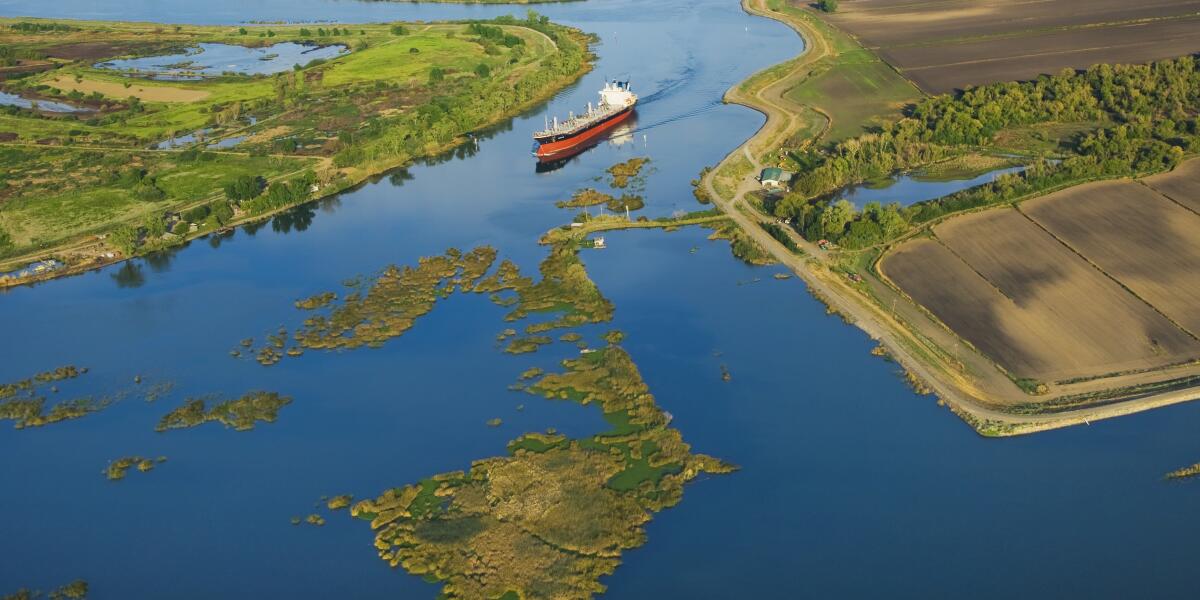
An ocean-going grain ship transits the deep water channel in the Sacramento-San Joaquin River Delta.
(Design Pics Editorial / Universal Images Group / Getty Images)
The long-awaited Delta water plan
- California regulators have released a water plan for the Sacramento-San Joaquin River Delta that would give water agencies more leeway in how they comply with the rules.
- The Delta is the central hub of California’s water system, providing water for nearly 30 million people and 4 million acres of farmland.
- Environmental advocates say this plan would starve the Delta of needed water and threaten fish that are already in severe decline.
Former acting U.S. attorney found dead
- Assistant U.S. Atty. Andrew Haden was found dead in an office inside the Edward J. Schwartz Federal Building in San Diego on Wednesday.
- Haden had worked for the U.S. attorney’s office since 2010 and twice served as acting U.S. attorney for the Southern District of California.
Swalwell investigation
More news
Commentary and opinion
- Michael Hiltzik: Baseball labor talks may look like a battle among millionaires, but it’s really about billionaires vs. peons
Editor’s pick
More picks
- Flying for El Chapo’s sons: The rise and fall of a mysterious cartel pilot.
- Why have private equity firms taken an interest in buying professional sports team?
- How the killing of Biggie Smalls brought a big break in the Tupac Shakur murder mystery.
Things to do

(Chiara Alexa/For The Times)
Today’s recipe

The H-Bomb burger with habanero Jack cheese.
(Kirk McKoy / Los Angeles Times)
If you don’t want to go out for a burger, you can make the H-Bomb at home instead. It is a hot chile fest. Habaneros are in the relish and the cheese. Jalapenos stud the patty, bacon and bun. Chipotle is in the mayo and fried serranos are draped on the patty.
Question for you
What is your favorite airport in California? Email us at [email protected], and your response might appear in the newsletter this week.
Photo of the day

People are splashed at the Orca Encounter live presentation at SeaWorld.
(Megan Morello/For The Times)
Games

Here’s today’s mini crossword, plus our other free, daily crossword puzzle, sudoku, word search and jigsaw games.
Have a great day, from the Essential California team
Jack Dolan, investigative reporter
Hugo Martín, assistant editor, Fast Break desk
Kevinisha Walker, multiplatform editor
Andrew J. Campa, weekend writer
Karim Doumar, head of newsletters
Shi Bradley, audience intern
How can we make this newsletter more useful? Send comments to [email protected].