Independent filmmaker Sylvia Ray always wanted to shoot her first feature film, “The Middle,” in California — as it’s set in Barstow, where she grew up.
Instead, she shot it in Mexico.
The math made the decision for her. Grants and incentives from the municipality of Torreón and the state of Coahuila covered 30%-40% of her production budget, which came in under a million dollars, Ray said, adding that she didn’t have to pay for film permits, on-site security or local hotel accommodations. Over 21 days in March and April, the production hired 75 local crew members and college students.
“All I needed was a desert landscape and American homes. I could have definitely shot it in L.A. comfortably. Had I gotten more support and made it make sense for us financially,” Ray said. “But it just didn’t.”
Her budget was too small to qualify for any California film incentive at the time, as the state’s program doesn’t reach projects costing under $1 million. Low-budget filmmakers and producers say that gap is a major problem. California’s incentives, even after the recent expansion, are built for productions several rungs above them.
Los Angeles County has plans to change that. Supervisors Lindsey Horvath and Kathryn Barger are developing an Entertainment Evergreen Fund, first introduced last July, which would channel money to productions the state’s tax credit doesn’t reach. The fund would distribute grants rather than tax credits.
No dollar amount has been attached and the county has not committed funding. The board intends to explore a public-private model, with funding sources, amounts and any cost sharing determined only after an outside consultant completes an analysis and presents recommendations to the board of supervisors.
“Like every County initiative, this work must be balanced with our current fiscal realities,” Barger said in a statement, adding that she hopes to build “a sustainable … partnership” that helps keep L.A. as “the global leader in entertainment production.”
“State tax credits have been the most instrumental tool to keep production local, and we want to amplify their success to make clear to the industry: LA County wants you here,” Horvath added.

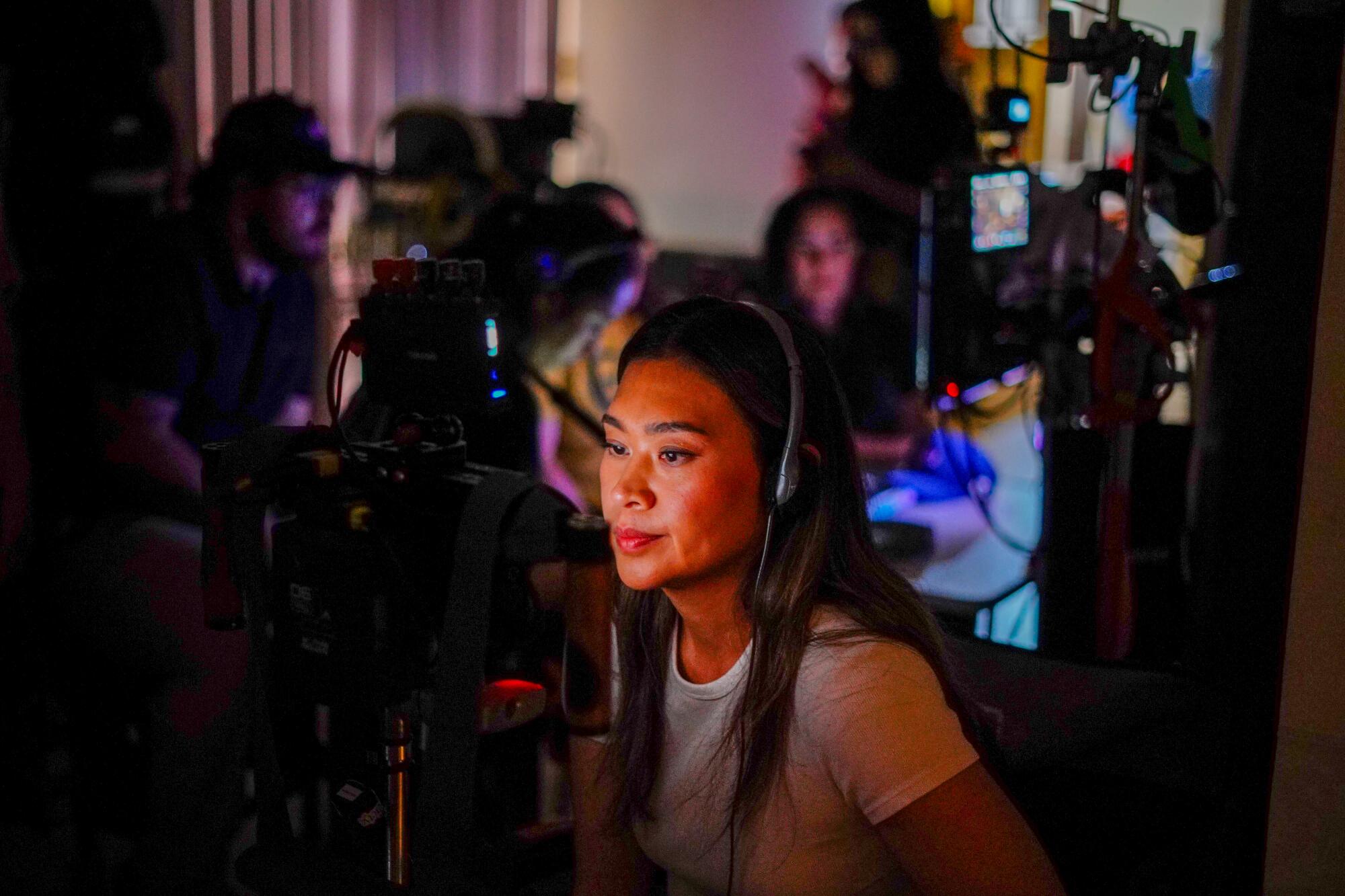
Director Sylvia Ray on set of “The Middle.”
(Alex Crunker)
Why L.A. got expensive for small films
Many small-budget filmmakers struggle with location and permitting costs in L.A., said Philip Sokoloski, vice president of communications at FilmLA, the nonprofit that coordinates permits and tracks local production.
“Many property owners inclined to rent out their homes or places of business for filming are used to an era where there was a lot of money to go around … It’s not true anymore,” Sokoloski said. “Until that message is widely understood, there’s a certain priced-out-of-the-market feeling that many indies are experiencing.”
A fund, he said, could help offset those costs.
The film grant proposal comes amid a bleak period for local film and TV production, which has struggled to rebound after the pandemic.

Director Vanna James on set for the film “The Seed” in a residential neighborhood in North Hollywood on Tuesday
Despite improvements attributed to an expansion of the state’s film tax credit program, feature film shoot days in the L.A. region dropped 20% in the second quarter compared to last year, while shoot days for TV productions plummeted 30%, according to a recent report from FilmLA.
Making an indie movie is harder than it has ever been, said Steven Wolfe, a producer whose credits include “(500) Days of Summer” and more than 45 other films. Companies are less willing to finance independent projects, buyers are spending less and the exhibition market is harder to navigate. Yet “there’s an audience that’s very hungry for them,” he said.
Wolfe is developing what he calls a passion project with a first-time feature director, set to shoot in Los Angeles. Whether it gets made, he said, depends on whether the fund materializes.
“All of us recognize the need to take extreme action and soon on trying to rebuild Los Angeles as the film capital of the world,” he said.
What’s being proposed
The fund is being shaped with input from the Indie Film Task Force, a group of industry voices led by the nonprofit NewFilmmakers Los Angeles. The task force pushed for grants rather than a tax credit, arguing that small budgets don’t generate enough tax liability for a credit to be worth much.
“We see this as a foundational level investment. It is a trickle-up incentive that’s going to feed into the studios,” said NFMLA Executive Director Larry Laboe. “This is a way to invest very little money in a lot of different productions and hope for some big wins from those productions that can trickle up.”
Laboe cites Curry Barker’s box office underdog “Obsession” as the latest example of a major low-budget indie success. The horror flick, which hit theaters in May, was made in Los Angeles for a budget of $750,000 and has since grossed nearly $475 million worldwide.
Laboe, one of the proposal’s leading advocates, has projected the fund’s ceiling could reach $100 million, depending on fundraising. NFMLA isn’t positioned to administer it, though he’s open to a role.

Actor Celestino Camille works on a scene for the film “The Seed” in a residential neighborhood in North Hollywood on Tuesday.
Barger said her conversations with filmmakers, labor representatives and production companies have surfaced “several promising ways an Evergreen Fund could strengthen our local industry,” including “grant incentives that encourage productions of all sizes — including independent filmmakers — to choose Los Angeles County.”
The case against film grants
Film and TV production incentives rarely deliver the economic benefit that justifies them and only occasionally change where a project shoots, said Patrick Button, an associate professor of economics at Tulane University who studies the programs. He sees a particular problem with targeting small productions: Indie filmmakers, already working on thin budgets, are the least likely to relocate in pursuit of a subsidy. Chasing incentives across jurisdictions is largely the province of major studios.
“Despite the goal with these incentives being to attract filmmaking and lead to economic stimulus, that’s not materialized in the data,” Button said. “In general, these incentives don’t have a good return on investment for the states and their counties.”
He also noted “a lot of stress on the L.A. County budget right now, and a lot of other things that the money could be spent on,” and expects the fund’s effect to be “very small.”
Laboe countered that covering even 10% of an indie production budget would help keep work local, adding that filmmakers may be able to layer a county grant with the state credit where it applies.
Who it would reach?
Independent productions are a meaningful share of SAG-AFTRA members’ income, particularly as major studios chase incentives abroad. More small films shot locally would mean more roles, said SAG-AFTRA L.A. Local President Joely Fisher.
“People are rolling up their sleeves, raising money and going to make a movie for under a million bucks,” Fisher said. “But also they’re able to take more chances. People are being discovered in these indie movies, and I think that that’s a great thing for our newer members, who can cut their teeth on something indie.”
Making the film is only half of it. The fund also should address marketing costs, or the films won’t get seen, said Jackie Brenneman, president of the Independent Film & Television Alliance. Those budgets traditionally come from distributors, but more independent films now go directly to theaters without one.
“You have to be able to exploit the thing you make,” Brenneman said. “If we want to be able to access theaters, the theater’s first question is going to be, what’s your marketing plan? What’s your marketing budget?” .
Ray is still editing “The Middle.” Whatever happens with the fund, it won’t reach her first feature. But she’s already thinking about her next one.
“After this film is done, I’ll have my next one to worry about,” she said. “As a filmmaker here, there are so many hurdles, and it would just be nicer to have a clear pipeline, a scaling budget for all of these things and [provide] access to people who want to support emerging talent and artists, not just the studio system.”