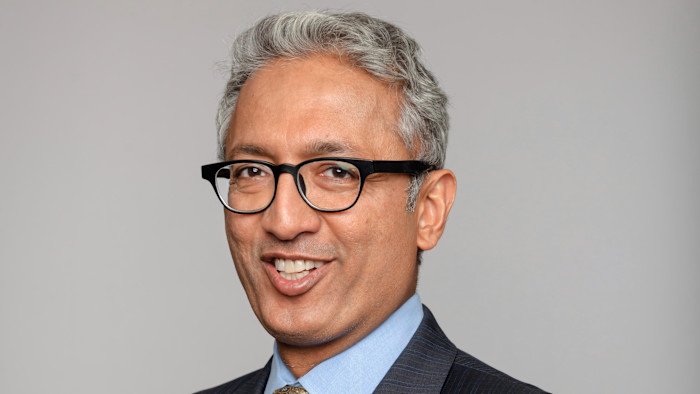
Good morning. Karthik Sankaran is a senior research fellow in geoeconomics in the global south program at the Quincy Institute for Responsible Statecraft. A former financial markets strategist and currency trader, he has spent much of his career working on foreign exchange and fixed income in emerging markets, and was previously director of global strategy at Eurasia Group. He spoke to Unhedged about the US and Japanese intervention to support the yen, the case for more frequent currency interventions, de-dollarisation and global imbalances. The interview has been edited for brevity and clarity.
Unhedged: We’re two weeks out from the joint US-Japanese intervention to support the yen. What did you make of the intervention and how it was conducted?
Sankaran: I’ve been calling for an intervention at least since dollar-yen was at 150. We crossed 150 more than three years ago.
The criteria you need to satisfy to do a multilateral currency intervention are: one, that a major central bank is becoming unable to run a cyclically appropriate monetary policy because of what’s happening with the exchange rate. Two, there is the risk of cross-border spillovers in major financial markets. And the third is when exchange rate developments threaten global trade.
I have argued for some time that the criteria were met, particularly because of what’s happening in global bond markets and because of the perception that what happens with Japanese government bonds can spill over to Treasuries. The spillover is happening in the bond markets rather than the currency. I think that’s why the US got involved.
There’s also a question of whether it will be effective or not. And the consensus of opinion seems to be that it will not be particularly effective unless and until the Bank of Japan raises interest rates.
Unhedged: You’ve argued in the past for more regular multilateral foreign exchange interventions. Do you think that this will become the new normal?
Sankaran: I would like to think that there are elements of a new heterodoxy appearing. I would welcome it because, as everyone in foreign exchange markets knows, currencies overshoot all the time.
Unhedged: Global imbalances are back in focus as a global macro risk. Some argue that the cause is the undervaluation of the renminbi. You’ve written for Alphaville that US healthcare is also a significant cause of the imbalances. What is your argument there?
Sankaran: I do think the dollar is too strong, and I do think that the yuan is too weak. Renminbi is a partial cause of global imbalances, and renminbi appreciation would be good for the world.
But I don’t agree that what’s happening in imbalances is caused entirely by a weak renminbi. I think there’s a US counterpart to this.
If you think one of the causes for global imbalances is that China is under-consuming, particularly in terms of public goods like healthcare, the obverse to that is that the world’s largest deficit economy is over-consuming and what it is over-consuming in spades is healthcare.
If the Chinese healthcare share of GDP is 7 per cent and France is 12 per cent and the US is 17 per cent — a massive outlier versus every other advanced industrial economy in the OECD — I would argue that tells us that the US is over-consuming healthcare in particular.
So, the renminbi should appreciate, and I would love it if China had a more ample safety net, but that’s not the only side of the equation that’s in play here. We have to do something about US non-tradeables, and the US non-tradeable that stands out like a giant sore thumb in cross-country comparisons is the healthcare industry and how it’s funded.
Unhedged: What do you think is the Trump administration’s dollar policy?
Sankaran: I think that the administration’s currency policy is confused in a sense. I think the desire is for a weak dollar to help re-industrialisation but that they want a strong dollar so that inflation is not passed through from the tariffs.
What the administration really cares about is not so much dollar strength per se but dollar centrality for two different reasons. One is the capacity for surveillance and sanctions. And the other is the idea that dollar centrality allows the US cheaper external financing, particularly in its bond markets.
To some extent the contradiction here is that the tariffs are supposed to bring in revenue. Look at my shiny new tariff revenue. Some of that revenue gets eaten up in terms of higher interest costs because of the way bond markets react to tariffs. The retreat of the US defence umbrella means other countries have to build up their own defences, so they have less excess savings to channel into the US.
I think that’s where this confusion plays out. And then they’ve ended up with dollar stablecoin as the expedient that is supposedly going to draw fresh savings into the US market. But that’s on a scale that’s just much, much smaller than the surpluses that were getting reinvested in the US.
Unhedged: You’ve also argued that people conflate dollar strength with dollar centrality. Could you explain that?
Sankaran: I mean dollar strength is the idea that the dollar is strong or weak. It’s a market thing. Dollar centrality is the role that the dollar plays in the international financial system. Some argue that dollar centrality has led to persistent dollar strength, which then has disfigured the US economy because it has led to deindustrialisation and so on. I believe that is wrong because the dollar has been central in the global financial system since 1971 but the dollar had not been persistently strong. In fact, the dollar was extremely weak in a couple of those periods. What turns the dollar around is the shale revolution, which gives the dollar this aspect of a commodity currency. So that’s why I think strength and centrality are two different things.
Unhedged: What worries you about using access to the dollar system as a tool of US power?
Sankaran: As someone who’s argued for a bit more policy heterodoxy in the currency space for years now, I am happy to see it. I would like to see it applied much less selectively and much less as a tool to influence domestic politics in certain countries, though that may be inescapable.
But giving an Exchange Stabilisation Fund line to Argentina just before a critical legislative election at the same time that you’re putting tariffs on Brazil because of the legal travails of Mr Bolsonaro . . . That’s the part that bothers me.
If you’re willing to use these kinds of tools, which is good, they should be used in a way that is conducive for global financial stability overall. And global financial instability is an especially critical concern in global south countries because they tend to get the extremely short end of the stick when it comes to financial instability for various reasons.
Unhedged: If countries want to reduce their dependence on the dollar, how far can the renminbi realistically go as an alternative?
Sankaran: The renminbi is very well positioned to be a global trade currency because China’s the world’s largest trader, and they’re trying to make it more and more attractive as an invoice currency, which makes sense, and that should gather steam.
The problem is that the renminbi is nowhere near ready to replace the dollar as a liability currency in global capital markets at scale.
You have the renminbi-isation of some debt, particularly in BRI [belt and road initiative] countries, which is helpful. I think it’s conducive to financial stability in these countries, because if your largest market is China, and they’re going to pay you in renminbi, it makes sense for you to borrow in renminbi as well.
The problem is that while the Chinese banking system can do this selectively, and it probably should be doing more, Chinese capital markets are really nowhere near the scale to allow a large issuer to drop the bulk of their debt in renminbi.
Unhedged: Could a stronger yen make it easier for China to allow the renminbi to appreciate?
Sankaran: I think it’s important that Asian currencies tend to move together and this may not have been the explicit motive, but I do think it’s hard to convince the Chinese to appreciate the renminbi when the Asian currency complex, in particular the yen, is as weak as it is.
If you see dollar-yen back off from here and the yen appreciates, I think that would probably give China some incentives to allow for the renminbi appreciation instead of doing shadow intervention to prevent renminbi appreciation. That would be good for global south countries.
Obviously, not every country will benefit from a stronger renminbi because of scale, logistics and governance and labour costs. But a stronger renminbi would help allow substitution in certain global manufacturing supply chains.
There is something extremely disingenuous about pointing fingers at China for not appreciating the renminbi, and consequently not industrialising poorer developing countries, and also being opposed to Chinese foreign direct investment in those countries because it allegedly creates more compromised supply chains.
Unhedged: Why have emerging markets weathered the Iran shock relatively well?
Sankaran: At least part of the story is that this was a major shock for east Asia and for portions of Africa, south-east Asia and south Asia. But the Asian regions have actually done the most resiliency testing through reserve building.
The other thread here is the role of Chinese oil imports dropping, which acted as an immense shock absorber.
And in many cases, countries did the orthodox policy response, which meant that they allowed oil price increases to pass through, went to four-day weeks and so on. Those are instances in which financial stability was purchased at the expense of local populations. They kept the balance of payments in control, but they did that by forcing demand destruction.