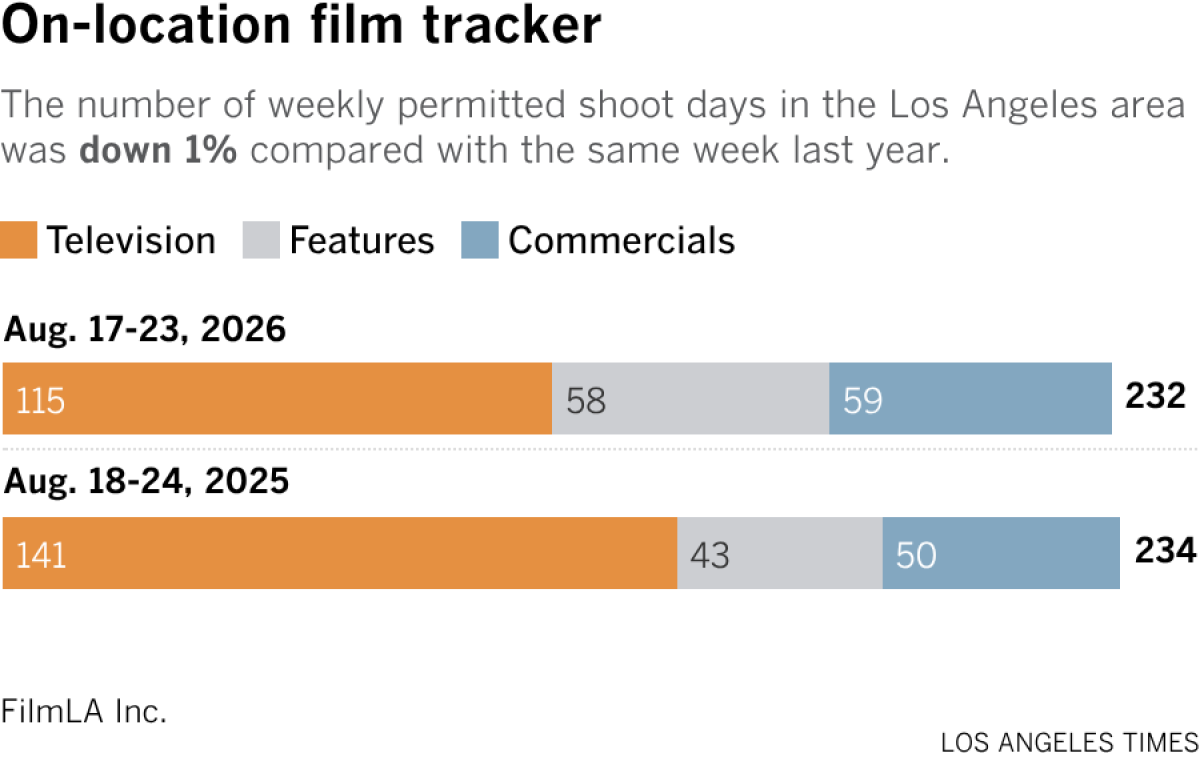
When I sit down on Mondays to write this newsletter, I check the weekly data on film and TV shoots around the Greater Los Angeles area.
Nearly every week, it’s grim.
There’s almost always a decline in production compared with 2025. And those weeks add up.
In late July, the nonprofit FilmLA reported that feature film shoots were down 20% in the second quarter versus last year. Even worse, TV production — once the lifeblood of L.A.’s entertainment industry — decreased by 30%.
L.A.’s flagging production levels are an existential crisis for Hollywood, and my colleague Stacy Perman recently wrote a definitive account about how we got here. As she noted, it’s a tale of increasing costs, political inaction, stiff competition from other locales and, importantly, an overconfidence from Californians that Hollywood couldn’t and wouldn’t ever leave.
The problem goes back to the early 1990s, when “The X-Files” first began shooting in Vancouver. Turns out the truth was out there — Canada was becoming a more film-friendly destination than L.A. with “Hollywood North’s” cheaper production costs, growing expertise for film crews and, eventually, tax credits that wooed even more projects to the region.
Over time, more states and countries ate California’s lunch until last year, when the state finally took steps to revamp its film and TV tax credit program to increase the annual cap to $750 million and expand the types of productions that could qualify for an incentive. That progress was cheered by industry groups, including studio executives and rank-and-file union crew members.
But while the tax credits have brought some production back to California, it hasn’t been enough to fully halt the exodus.
For one, California’s program has that annual cap on the total amount of money that can be awarded as production incentives, a limit that does not exist in other states and countries.
It also does not allow for reimbursement of expenses such as actors’ salaries and other so-called above-the-line costs. That’s a crucial difference many in Hollywood say will keep California less competitive than other locations, though such a provision is likely unpalatable in the broader state Legislature.
(More recently, film industry advocates have banded together once again to lobby against a broader corporate tax cap passed this year that they say could jeopardize the job gains made by the state’s production incentive program.)
In the meantime, many are still struggling. I’ve seen this firsthand in my reporting on the production woes in L.A. I’ve spoken with vendors who navigated the COVID-19 pandemic and the 2023 writers’ and actors’ strikes only to be crushed by runaway production, forced to downsize their homes and accrue millions of dollars in debt. And that’s not counting the thousands who have been laid off, retired early, moved out of state or changed careers, just to survive.
Adding to the industry’s angst is Paramount Skydance’s impending acquisition of Warner Bros. Discovery, a deal that could eliminate 4,500 L.A. jobs over three years, according to a recent L.A. County report completed by CVL Economics. (Paramount has said that its merger would ultimately strengthen the industry and that the company plans to invest $30 billion a year in production.)
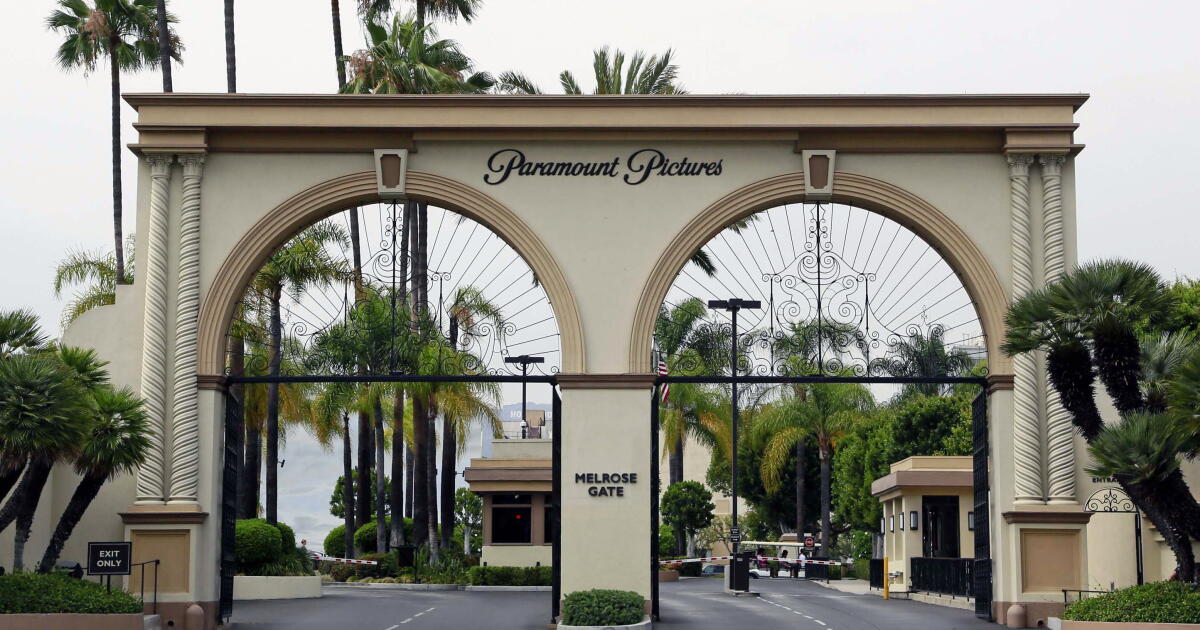
After California Atty. Gen. Rob Bonta and 11 other Democratic state attorneys general filed an antitrust suit to block the deal, Paramount threatened to move its Melrose Avenue studio to Tennessee or Texas.
Is it too late for things to turn around in Hollywood?
Given the changes in the industry — the slimmer film and TV lineups, the established and experienced film hubs outside the Golden State and cheaper costs elsewhere — it may not be possible for production in L.A. to reach the heights it once did.
But that doesn’t mean the industry here is a lost cause.
Hollywood production has become a hot-button issue in the L.A. mayoral race, with Mayor Karen Bass and Councilmember Nithya Raman both vowing to make it easier for filming to happen in L.A.
Although the mayor’s office can’t affect the state’s production incentive program, it can help reduce the local bureaucracy film crews say they face in the city. Keeping the issue in the spotlight can only give the industry more leverage to push for change.
There’s also now a lobbying effort to back a state bill that would give tax breaks to postproduction firms, similar to a policy in New York.
And on the national level, there’s discussion of a possible federal film and TV tax credit, an incentive that wouldn’t just target California, but could help claw back some overseas production and give L.A. a second look.
These are all signs that everyone is now well aware of the extent of the problem. Combined with L.A.’s wealth of experience in this industry, there’s at least a glimmer of hope.
Stuff We Wrote
Film shoots

Number of the week

Charter Communications’ $34.5-billion acquisition of Cox Communications wrapped up Thursday, meaning millions more Southern Californians will become Spectrum customers.
As my colleague Meg James has reported, the marriage of two of the Southland’s major cable TV and internet providers comes as the industry battles the effects of cord-cutting amid the rise of streaming.
Current Cox subscribers will shift over to Spectrum service by mid-September.
What I’m watching
I love a good sports documentary, so over the weekend, I sat down to watch “The Dynasty: UConn Huskies” on AppleTV. The three-part docuseries chronicles how UConn came to dominate college women’s basketball and why head coach Geno Auriemma became such a polarizing figure. I’m no fan of Auriemma’s behavior, particularly toward South Carolina coach Dawn Staley at this year’s Final Four, but after watching this, you can’t deny his lasting influence on the sport.