Have you ever searched for flights online, gotten interrupted, and then come back to find the prices had jumped? Or, once you committed yourself by booking the flight, watched the price for hotels and rental cars skyrocket?
That’s called “surveillance pricing.” Companies use your search history and other personal data to guess what you really want, or need, and then raise the price to find what digital marketers call your personal “pain point” — the price that is too high for you.
Sure, it might annoy you, but if you need the flight, you need the flight, right?
You can clear your browser history or start over on another site, but your time is worth something, too. Marketers call that “friction” and they’re betting you’ll pay a premium to avoid it.
These digital surveillance practices have become so ubiquitous — and so wildly unpopular — that the Federal Trade Commission last week proposed a new enforcement policy that would require companies to disclose when they use highly detailed personal information to set individual prices, and share the type of information they use. A 30-day public comment period on the policy ends Sept. 18.
A “devious” practice
Several dozen comments have already been submitted and the general consensus seems to be against personalized pricing.
One commenter complained that Amazon had swung the price of his favorite muesli from $34 to $54 in the space of a couple of days, seemingly based on the time of day he searched.
Others called surveillance pricing “obviously predatory” and “devious.”
“Many Americans do not understand just how much data they generate every second of their lives,” the commission’s staffers wrote. We also don’t understand how that data can be used by marketers.
All of the little crumbs of information we leave scattered across the internet can be pieced together into an incredibly intimate portrait of our “interests, locations, credit histories, medical conditions, sexual interests and religious and political views,” the commission staff noted.
Targeting new parents, home-bound people
After poring over mountains of disclosures gathered from industry about marketing practices in recent years, the staff offered a few “hypothetical” examples of the pricing they would like to target for enforcement.
- Raising the cost of baby products such as thermometers or formula for brand-new parents.
- Food delivery companies raising prices for people they know are home-bound.
- Rideshare companies charging someone with a life-threatening emergency more for a trip to the hospital.
- Raising the price of home security cameras for someone who has recently been the victim of a crime.
The commission can’t prohibit these practices outright — that would require new legislation. But it can act against companies that don’t disclose how they set their prices, issuing cease-and-desist orders, suing in federal court and demanding refunds worth millions for consumers who have been harmed.
As that proposal winds through the FTC’s public comments process, several states are taking matters into their own hands.
Other efforts to battle the practice
Maryland was the first in the country to prohibit large grocery stores and delivery services from using personal data to set prices for specific customers. Its law goes into effect Oct. 1.
New Jersey passed a similar law that goes a step further, placing a moratorium on stores installing electronic shelf labels — essentially digital price tags — that critics worry can use your phone data to display a new price just for you.
A similar bill from Assemblymember Christopher M. Ward (D-San Diego) is working its way through the California Legislature now.
The measure “seems like a no-brainer if you actually care about affordability and your constituents,” my colleague Anita Chabria, a veteran political columnist, wrote earlier this month. But the clock is ticking, she added, and lobbyists for big retailers and data brokers are trying to kill it.
Ward sponsored a similar bill last year that died a quiet death.
Business groups argue that Orwellian fears about surveillance pricing are overblown and that they mostly use data to send you ads for stuff you might really like or offer discounts, not to boost profits.
If you buy that, I have a bridge in Brooklyn I’d like to sell you. How much? Gimme a sec, and your Instagram handle, and I’ll let you know.
Top stories

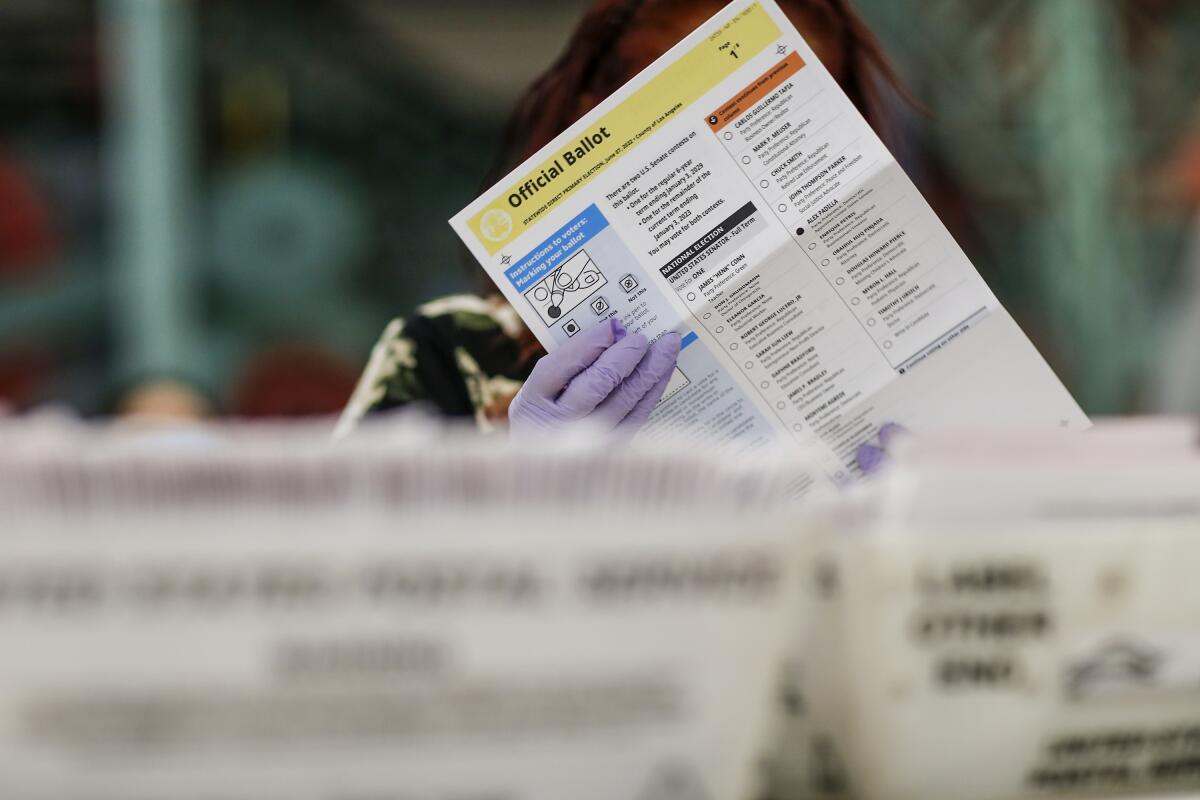
Mail ballots are processed at a Los Angeles County facility in Downey in June.
(Robert Gauthier / Los Angeles Times)
California sues again to block new USPS rules for mail ballots
- California and other Democratic-led states sued to block the U.S. Postal Service from implementing new nationwide rules for mail ballots, arguing they usurp state authority over elections at President Trump’s behest, expose voter information unnecessarily and threaten chaos in the rapidly approaching November election.
- “Donald Trump does not run elections. States do. And his latest attack on democracy is proof of how weak he has become,” said Gov. Gavin Newsom.
The worst of record-smashing SoCal heat wave is over
Orange County is now treating e-bikes like guns
- In September, the Orange County district attorney’s office will host an e-bike buyback program — offering anywhere from $200 to $1,000 for each — patterned after police departments’ gun buyback programs.
- The efforts speak to the increasingly stringent measures public agencies and lawmakers in California are attempting in order to stem a troubling rise in e-bike incidents.
California universities bet big on AI
- USC, UCLA and other universities are launching new undergraduate majors and programs in AI and digital humanities to prepare students for high-demand tech careers.
- These powerhouse Los Angeles institutions join a growing cohort of universities in California and nationwide responding quickly to a technology most undergraduates first encountered in chat bots or social media feeds in middle and high school.
More news
Commentary and opinion
Editor’s pick
More picks
Things to do

A “blood moon” lunar eclipse, as seen from Huntington Beach in March 2025. There will be a partial lunar eclipse Thursday night.
(Allen J. Schaben / Los Angeles Times)
Today’s recipe

The refreshing Mexican drink suero with lime and sparkling water.
(Stephanie Breijo / Los Angeles Times)
Cool yourself down with a suero aka “water cocktail,” which consists of lime juice, ice and sparkling mineral water, all served in a tall glass with a salted rim. The same word is used for an IV of fluids in Mexico, and the two serve the same purpose: to keep you healthy and hydrated.
Question for you
What is a Dolly Parton song you love and why? Email us at [email protected], and your response might appear in the newsletter this week.
Emily N. writes, “I have always loved ‘I Will Always Love You.’ I am a 79-year-old trans woman. I have been married twice (as a man) and divorced twice. Although I suppose I now know why, I also know I loved my partners very much. Dolly’s recording of ‘I Will Always Love You’ brings me to tears each time I hear it. Having become a woman through surgery at age 60, I am too late to find love again, but longing for it always makes me cry when I hear Dolly’s song. I will miss you Dolly … I love you … but, at least, I can listen to your beautiful, awfully true ‘I Will Always Love You.’”
Photo of the day

(Myung J. Chun / Los Angeles Times)
Games

Here’s today’s mini crossword, plus our other free, daily crossword puzzle, sudoku, word search and jigsaw games.
Have a great day, from the Essential California team
Jack Dolan, investigative reporter
Hugo Martín, assistant editor, fast break desk
Kevinisha Walker, multiplatform editor
Andrew Campa, weekend writer
Karim Doumar, head of newsletters
How can we make this newsletter more useful? Send comments to [email protected]. Check our top stories, topics and the latest articles on latimes.com.