Sometimes the joints get rusty.
Sometimes rising pressure stresses arteries.
Sometimes there’s a bit of leakage.
It’s tough getting old.
But that’s the reality for much of the underground network of pipes that deliver more than 400 million gallons of water daily to customers of the Los Angeles Department of Water and Power.
We don’t give it much thought until there’s a major water line break, as there was early on the morning of July 17 under Sunset Boulevard in West Hollywood. A 36-inch artery blew like a ruptured aorta, creating a sinkhole and sending 17 million gallons of water rushing through the streets.

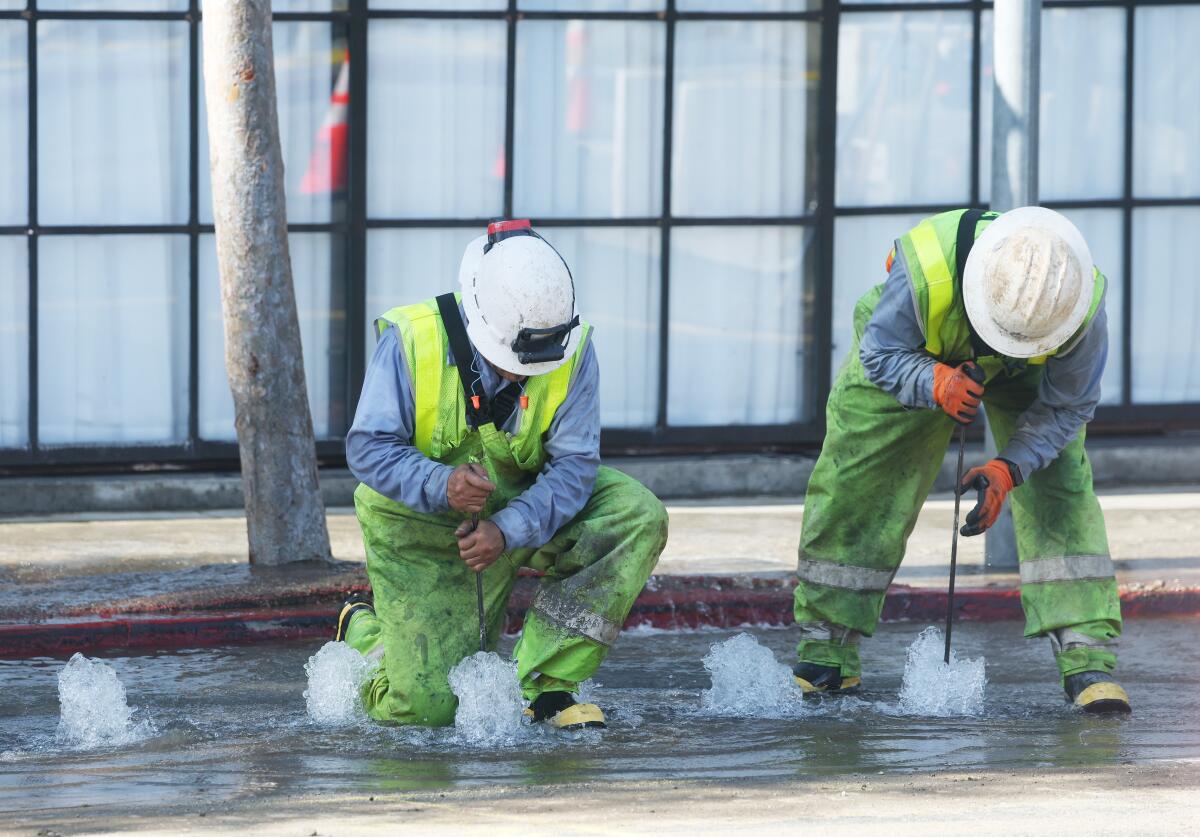
With repairs nearly completed on a massive water main break that flooded a swath of West Hollywood a week ago, another leak occurred on July 23 nearby at Santa Monica Boulevard and Laurel Avenue.
(Myung J. Chun/Los Angeles Times)
We learned from DWP in the early post-mortem that the pipe in question had been on duty for more than a century — 110 years, to be exact.
As someone who writes now and again about aging, I’ve been giving this some thought. We think of Los Angeles as a relatively young city, but out of sight and under our feet there lies a massive community of unsung senior citizens whose work is essential to our survival.
Through drought and earthquake, and from horse-drawn wagons to driverless cars, they have delivered.
President Woodrow Wilson was re-elected the year that pipe was laid, and the Germans attacked the French in the World War I Battle of Verdun, with the death toll topping 700,000.
In all the time since, the water flowed through that line under the many incarnations of the Sunset Strip, feeding smaller pipes that quenched a growing metropolis that expanded from about 500,000 people to 4 million.
Last month, I walked with friends from Book Soup one evening to get a drink at Dialog. If we’d done that on July 17, we might have been swept out to sea.
Tadeh Ghazalian, owner of Dialog, was still sizing up the damage to his restaurant the other day. He poked at the steps on a back stairway and the water-damaged tiles disintegrated like soggy saltines.
Water, essential to life, can destroy everything in its path.
“This is catastrophic,” Ghazalian said, telling me he had no idea when he’ll be able to put employees back to work and serve customers again.

An aerial view of the flooded Metro bus yard, where water was gushing down after a more than 100-year-old trunk line failed on Sunset Blvd. in West Hollywood.
(Allen J. Schaben/Los Angeles Times)
LADWP has roughly 6,800 miles of pipes between 4 inches and 20 inches in diameter, and an additional 570 miles of larger trunk pipes. Many of them work until the day they die, and the funeral is the opposite of what we do with people. We pull the dead soldiers out of the ground and cart them away.
The DWP tells us that 30% of its underground mainlines are 80 years old or older. By comparison, roughly 3.7% of L.A. County’s humans are 80 or older.
You may recall that back in 2014, when UCLA was temporarily an underwater university, it was another geezer that blew a gasket. That pipe was 90, and it died spectacularly, sending up a 30-foot geyser and causing damage in the millions.
But just as humans do, old pipes can defy the odds and perform better than younger ones.
“Age is not the only factor,” Anselmo Collins, DWP’s water systems chief, told me.
USC engineering professor Lucio Soibelman picked up on that thought.
“You can look at a 100-year-old pipe,” he said, “and the pipe is in perfect condition.”
The factors that wear down a pipe’s structural integrity include soil compaction and water table variables, Soibelman said.
As someone who has weighed in now and again on DWP operations, my occupational instinct in sizing up the spate of water line breaks (a few more leaks have sprouted since the most recent big one) is to consider the possibility of failed leadership.
This is an agency with a history of billing scandals, of union bosses bullying pushover pols, of robust pensions and sweetheart health and dental plans that require little or no payment by employees. And then there’s the annual plowing of millions in DWP surplus dollars into the City Hall piggy bank, which convinces ratepayers they’re being fleeced.
So has the agency neglected the geriatric underground foundation on which it stands?
To be fair, DWP is replacing about 45 miles annually of deteriorating water lines, with the new pipes built to last as long as 150 years.
“They should have started this about 40 or 50 years ago,” said Loyola Marymount University engineering professor Joseph Reichenberger.
Soibelman pushed back on that a bit.
“They do pretty well,” said the professor, who spoke to me by phone from an infrastructure conference at Cambridge in the United Kingdom.
Philadelphia and Boston, much older cities, have more water main breakdowns than L.A., Soibelman said. And DWP is well below the national average in leaky pipes, he said, thanks to sophisticated monitoring and management techniques.
Just out of curiosity, I did a bit of research on Cambridge and found that Franciscan friars laid the first water pipes in 1325, and the modern water system went into the ground in 1855. The local utility is in the midst of a five-year project to replace about 150 miles of pipes, the oldest of which are about 170.
The Cambridge water utility’s “incident” website says there have been four water main breaks since early June, including one Thursday afternoon at Boxworth Road and Cotterells Lane. The use of garden hoses has been temporarily banned because of drought.
So it could be worse here in L.A.
Collins told me the 45 miles of new pipe being installed each year is about triple the number from two decades ago. Picking up the pace is a worthy goal, he said, but that would mean beefing up the workforce, disrupting traffic and commerce with more street closures, and asking customers to write bigger checks.
“There’s a rate impact if you do more,” Collins said.
This is a familiar theme in Los Angeles.
Pipes. Sidewalks. Trees.
Aging is expensive. And if you let things go, the price rises to where you can’t cover the cost of surgery.
It would take years and millions to fix all the ruptured sidewalks in Los Angeles. European cities have done a better job, Soibelman said, but that’s partly because they were designed for walking, while L.A. is built for four-wheeled comfort.
In 1916, when the 36-inch pipeline was dropped into the ground along Sunset Boulevard, cars were just beginning to compete with trolleys and horse-drawn wagons in Los Angeles.
There were no Dodgers. The team, known as the Brooklyn Robins, was 3,000 miles and 42 years away from Los Angeles.
Philippe the Original was in business, but Musso & Frank Grill was three years away from mixing its first martini.
Born in 1916, and now long gone, were Walter Cronkite, Gregory Peck, Dinah Shore, Jackie Gleason and Kirk Douglas.
It’s tough getting old.
I know a couple of senior citizens, though, who are doing remarkably well.
At the epicenter of the break, Bullwinkle managed to pull a rabbit out of his hat and save himself and Rocky while everything around them was swept away July 17 in West Hollywood.
The statue of the cartoon characters, now 67 (look it up, first episode was in 1959), stood firmly at Sunset and Holloway, with Rocky the squirrel and Bullwinkle the moose monitoring the Big Fix as if they were foremen on the DWP payroll.
It’s good to see them working again, and nice to know they’ve got great healthcare plans.