Journalist Sonali Kolhatkar has chronicled the world through her progressive lens from Los Angeles since 2002, most famously as a longtime host on KPFK 90.7 FM but also via essays, stories, speeches and books.
Her latest effort, “Breaking ICE: Community Defense against State Terror and MAGA Fascism,” is one of the first book-length accounts of President Trump’s second-term campaign to deport as many undocumented immigrants as possible. Kolhatkar places a special focus on what Los Angeles went through and is undergoing — and how it’s fighting back.
She’ll debut “Breaking ICE” on Sept. 3 with a book signing and talk at Vroman’s Bookstore in Pasadena at 7 p.m. Kolhatkar answered a few questions from yours truly. Our conversation has been lightly edited for length and clarity.
Why do you think people should read a book of interviews with people fighting against Trump’s deportation deluge when folks can just tune into social media and get bite-sized, instantaneous outrage?
I don’t want to dismiss social media, since many of the people I interview belong to organizations that use it effectively. That said, my book is designed to go deeper and requires a longer attention span. But because it’s a collection of conversations, it’s readable.
There are so many important voices you included in your book, and so many others you and I know should be included. How did you decide who to highlight?
I wanted to balance frontline activists, like Pablo Alvarado, Ron Gochez, and the late Kent Wong, with academics such as Yohuru Williams and Ibram X. Kendi and storytellers like Josefina López, Viet Thanh Nguyen and Favianna Rodriguez.
I also knew it was crucial to draw the links between U.S. wars in Latin America and migration, so folks like Roberto Lovato, who wrote the book’s foreword, and Luis Rodriguez, are included.
And I felt it was critical to center Black thinkers and activists like Robin D. G. Kelley and Richard Wallace, who are applying abolitionist frameworks to ICE. ICE agents are police. Abolish ICE is in the same vein as Defund the Police.
What’s the common thread you want readers to connect with each person you interviewed?
That victory is possible and that people’s courageous pushback against ICE is working. It’s too easy to feel discouraged these days. Social media, and frankly, corporate news media are designed to deluge us with bad news.
But the reason ICE changed its tactics earlier this year is because people fought back successfully in cities like L.A. and Minneapolis. It doesn’t mean ICE is less dangerous now. On the contrary. But it means that activism works and that it must continue.
You’ve been a chronicler of the fight for amnesty for undocumented immigrants and against mass deportations since 2002. What terrifies you about this moment and inspires you about this moment?
I’m terrified at how the dehumanization of immigrants has become so normalized, and of the rise of inequality and billionaires — all of which fuels scapegoating and authoritarianism.
At the same time, the demographic shift in the U.S. is here to stay, and people of color are using everything at our disposal — including the tools of elites — to beat them. Plus, at the risk of sounding cliche, our culture is our weapon. The lessons of the civil rights movement, the language and songs of homelands, our stories, music and cuisines, have so much power.
You dedicated your book to your late sister Sameera. How did her untimely passing push you into writing this book?
My sister and I were separated by borders for reasons all immigrants are familiar with. I would have had more time with her while she was alive if we lived in the same country. I know what family separation feels like, what it means to navigate the labyrinths of immigration, to live with the knowledge that we may never again see our loved ones because of institutional hurdles designed to separate us.
Start pre-ordering your copy now, folks.
Today’s top stories

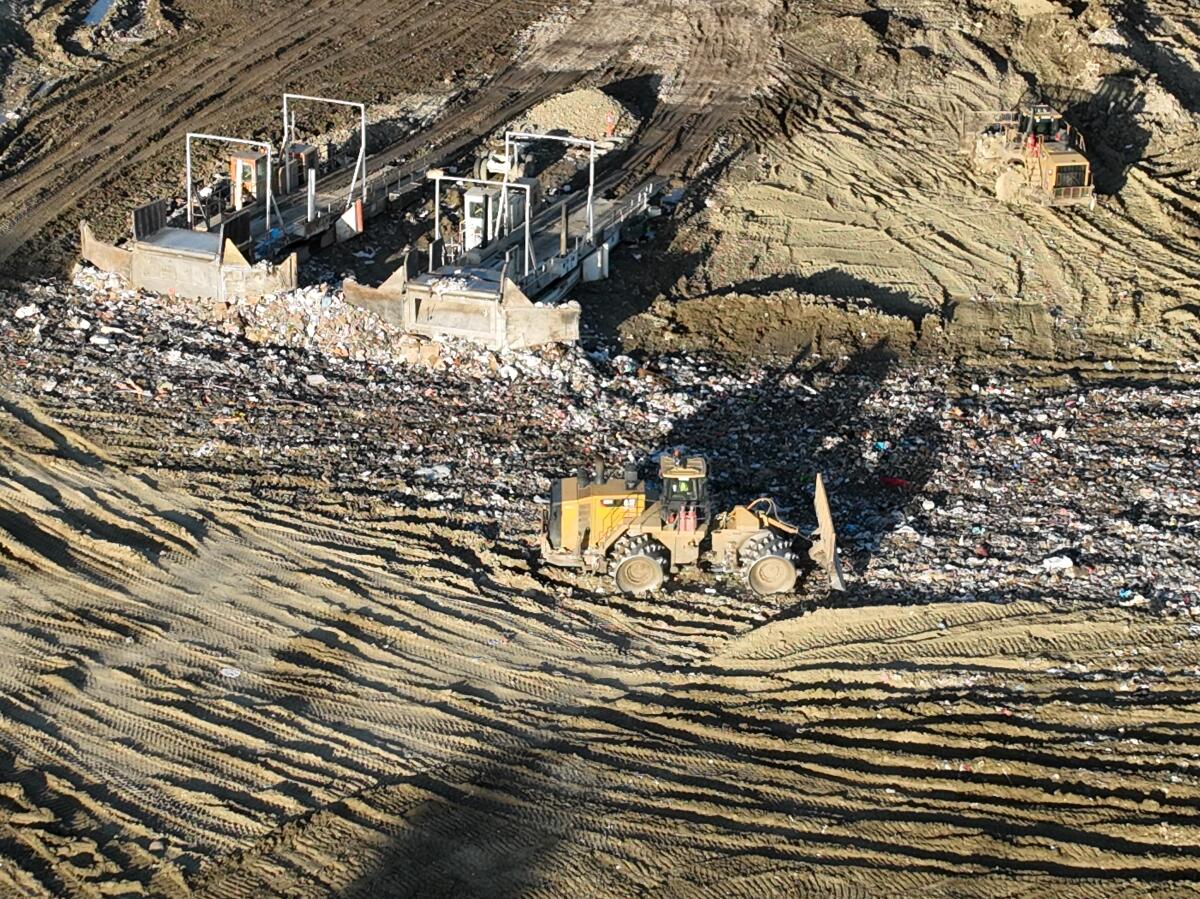
Feb. 2024 aerial view of heavy equipment spreading trash over a hill at Chiquita Canyon Landfill in Castaic.
(Allen J. Schaben / Los Angeles Times)
Toxic underground fires are spreading at California landfills
- A rapid burn has caused one slope of a major L.A. area landfill to warp, threatening a collapse and spill of toxic liquid.
- If you live near a landfill and have experienced an abnormal spike in odors or other issues, we want to hear about your experience.
Mystery surrounds ex-Marine’s possible motives at Trump golf course
- Authorities are trying to solve the mystery of a security guard accused of weapons violations after he visited Trump’s golf course twice in advance of the president’s visit.
- The man is not being charged for any crimes in relation to Trump, and authorities have not determined a motive.
Researchers sound the alarm on unregulated use of peptides
- Social media and a growing distrust of public health guidance has caused consumer demand for experimental peptides to skyrocket over the last decade.
- Now, the clamor over unregulated peptides has become a high-stakes policy battle within the federal government.
What else is going on
- ICE’s healthcare payment system collapsed. Are detainees still getting off-site care?
- Rising temperatures could keep more flights from taking off on time.
- Utilities threaten action if lawmakers fail to cut their wildfire liability risk.
- The Trump administration overhauls Head Start, largely giving up federal control.
Commentary and opinions
This morning’s must-read
Another must-read
For your downtime

Guests in the dining room at A Tí in Los Angeles.
(Ron De Angelis/For The Times)
Going out
- Food: An Echo Park charmer started as a bar. Now it’s one of L.A.’s defining modern Mexican restaurants.
- Movies: Dystopian rom-com “One Night Only” bans sex and general plot coherence.
- Travel: Take a look at this Charming Victorian inn with a cocktail parlor, organs and no screens that opened just outside L.A.
Staying in
A question for you: What’s the best spot for people watching?
William B. writes: I find a big easy chair to sit in at the Last Bookstore in downtown L.A. The best spot to people watch.
Email us at [email protected], and your response might appear in the newsletter this week.
And finally … your photo of the day

Marc Papas, who is currently 79.74% done with biking the entirety of the Los Angeles area, wants to prove that L.A. has the potential to be the best biking city in the world.
(Kayla Bartkowski / Los Angeles Times)
Today’s great photo is from Times photographer Kayla Bartkowski of cyclist Marc Papas, who biked 5,840-plus miles in one year to find out whether L.A. is the world’s best biking city.
Have a great day, from the Essential California team
Hugo Martín, assistant editor, fast break desk
Kevinisha Walker, multiplatform editor
Andrew Campa, weekend writer
Karim Doumar, head of newsletters
Shi Bradley, audience intern
How can we make this newsletter more useful? Send comments to [email protected]. Check our top stories, topics and the latest articles on latimes.com.