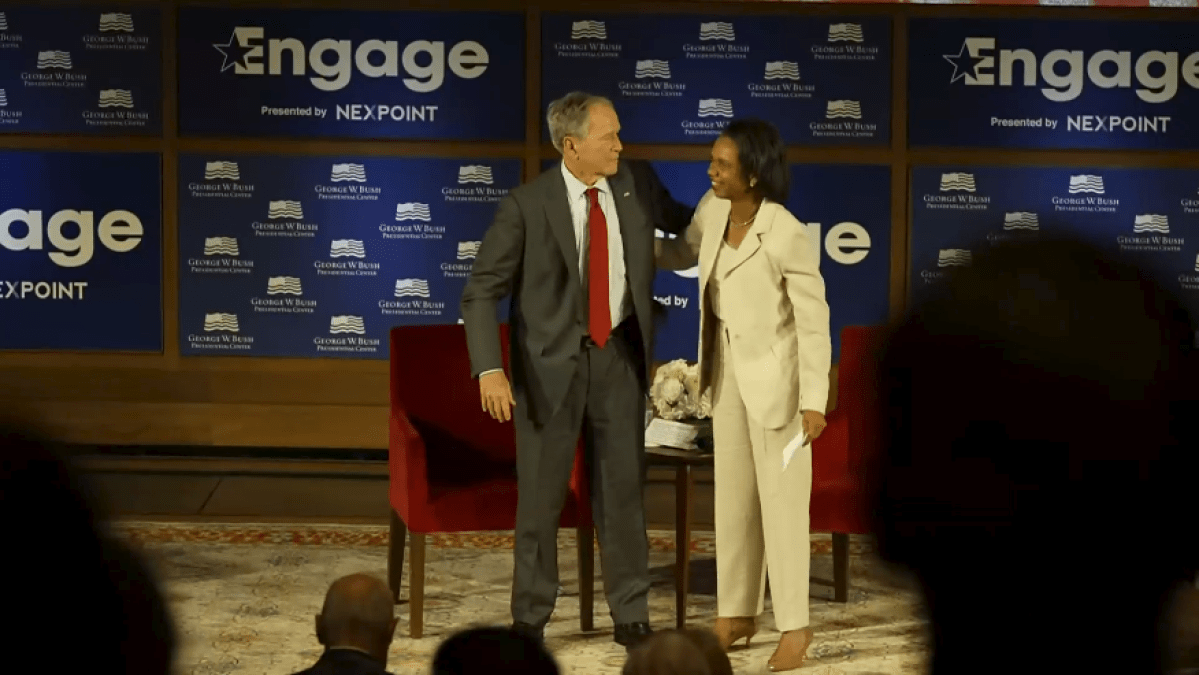
Ahead of the 25th anniversary of the Sept. 11 terrorist attacks on America, former President George W. Bush sat down with former Secretary of State Condoleezza Rice on Wednesday evening for an event at the George W. Bush Presidential Center at SMU in Dallas.
At the start of the conversation, Bush remembered the moment he learned the second World Trade Center tower had been hit, the information whispered to him by a presidential aide as a young student read aloud to a classroom full of children in Florida.
“America is now under attack. I didn’t have much time to process that, but it was pretty clear to me that if we were under attack, then my job was to defend the child that was reading to me, and her family, and her country,” Bush said. “And so it was a moment of clarity.”
Rice, who served as the president’s National Security Advisor at the time, recalled raising her voice at the president when they spoke over the phone.
“I did something I would never do again,” Rice shared. “I raised my voice to you because you said, ‘I’m coming back.’ And I said, ‘Stay where you are. The United States of America is under attack. It’s not safe here.'”
Bush left the school, flying on Air Force One to a military base in Louisiana, then on to another in Omaha, where someone on the national security team told him he needed to address the nation.
“I said, ‘You’re right, I do, but I’m damn sure not going to give it from a bunker in Omaha, Nebraska,” Bush said. “I thought that would be a psychological victory for those who attacked us. And so I flew back.”
Bush remembered spending the night in a bunker under the White House and taking calls the next morning from world leaders, adding that his main concern was being “comforter in chief.”
“How does one help America have the confidence to go forward, have the confidence we can go forward as a nation?” Bush asked.
He spoke with Rice about trying to bring a sense of normalcy back for Americans in the days and weeks that followed.
“Why was that so important?” she asked.
“I didn’t want us to lose our soul,” Bush responded. “I wanted to, as we defended our freedoms, I wanted people to remember how precious they are.”
The conversation, part of an event titled “A Legacy of Service: America at the 25th Anniversary of 9/11,” will be the former president’s only public remarks on the attacks this year, according to the Bush Center. In addition to memories of the day, the program revolved around the impact of the attacks and the service that grew as the country recovered.
The discussion between Bush and Rice also touched on what the former president hopes the younger generation who were not alive at the time understands about what happened, along with concerns about time erasing some of the impact of the attacks.
“The danger, of course, the farther it gets away from Sept. 11, 2001, the more likely it is people will not remember A: the importance, B: the service, C: the sacrifice, and what it meant,” Bush said.
Chairman of the Joint Chiefs of Staff, Gen. Dan Caine, spoke near the start of the event, sharing his recollections of the day.
25 years ago, Caine was an Air Force F-16 pilot stationed at Andrews Air Force Base just outside of Washington, D.C. He recalled it was a crystal clear morning, and as he met with other members of the squadron about the flying schedule for the week ahead, the group learned something was wrong.
“A young enlisted intelligence professional came in and said to me an airplane has just hit the World Trade Center,” remembered Caine, adding, “Something didn’t feel right.”
Like many other Americans, Caine watched live TV news footage from New York showing smoke pouring from the first tower.
“Out of the corner of the camera shot came the second airplane, and in our squadron, you could have heard a pin drop,” he said. “And what seemed like an eternity, and I think it was probably just a few seconds, we instantly knew that the United States of America was under attack.”
Caine went over to the phone, calling a weapons storage center on the other side of the base that housed emergency weapons only meant to be brought out during war, telling them to bring the live missiles over.
Caine vividly described the moments after when he and other pilots began donning their flight suits and harnesses. While others headed to their jets, he waited for the live missiles, and saw the fax with the rules of engagement from the White House.
“I could hear the vice president talking to his military aide as we got ready to go fly, and in one of the moments that stuck with me over these last 25 years, General Wherley read us the rules of engagement that had been issued by the president,” said Caine. “That put the decision on whether to ram or shoot an airliner on us.”
“General Wherley, in a moment I will never forget – a leadership moment I will never forget, looked me straight in the eye and he said, ‘Dan, I don’t know what you’re going to face out there. I think you’re going to have to do some incredibly difficult things. No matter what, I trust you,’” he remembered.
Moments later, Caine saw smoke rising from the Pentagon, and ran to his jet to take off.
In a conversation with former Deputy National Security Advisor J.D. Crouch, Caine discussed the decision some young Americans made to enlist after the attacks.
“[They] saw the chance to serve something greater than themselves, knowing full well that they were signing up to go into combat,” said Caine.
This story originally appeared on NBCDFW.com.