It’s a story News4 has covered countless times: Black women and girls have gone missing and, in some cases, are never found. It’s a sad reality nationally.
In D.C., perhaps no case is more famous than when 8-year-old Relisha Rudd went missing in 2014. She was last seen on surveillance video at a hotel in Northeast with a custodian from the former D.C. General homeless shelter. He later took his life. Relisha’s whereabouts are still a mystery.
More recently, 19-year-old DaCara Thompson disappeared last August. She left her father’s house and said she was going to put gas in her car. Her family reported her missing the next day. A day later, police found her car with her purse inside. Her phone was gone and disabled. A few days later, her body was found on a riverbank off Route 50 in Anne Arundel County.
A law named after Thompson was introduced in Prince George’s County to bring attention to missing persons cases and to eliminate waiting periods for families to report someone missing. It’s one of the many efforts around the region to protect Black women and girls.
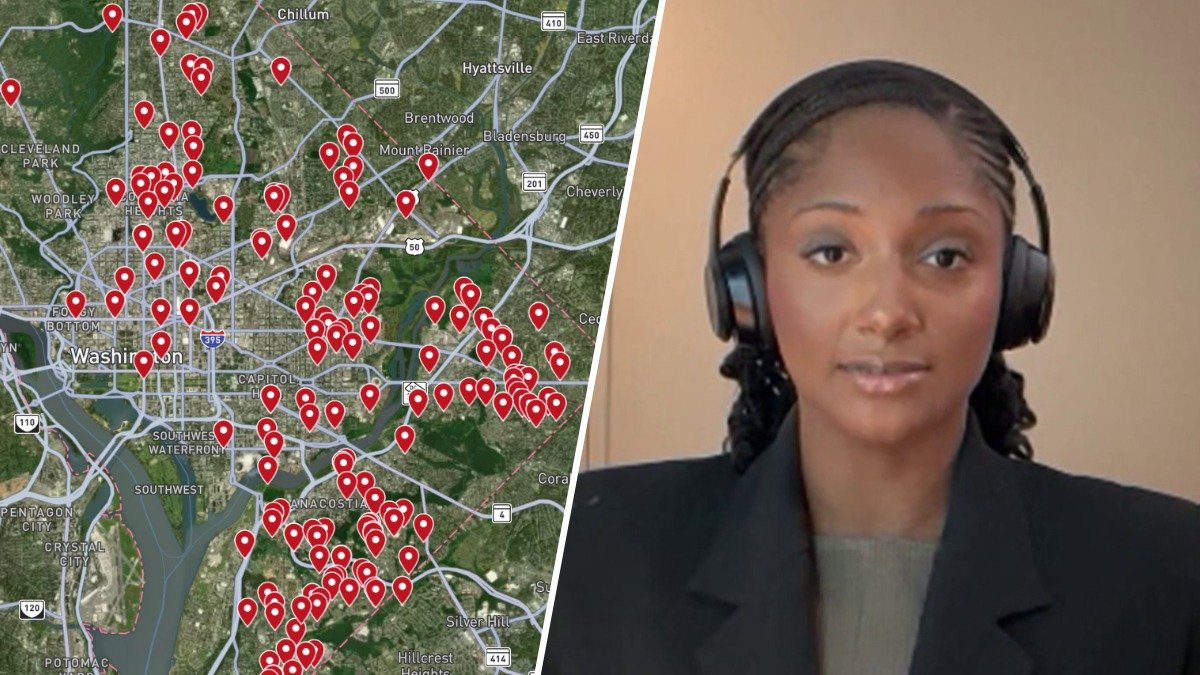
Avery Bernard Johns, a Howard University junior, has made it her mission to investigate the disappearances and murders of women and girls who sometimes go under the radar.
She created Deadlining: The Washington D.C. Database for Missing and Murdered Black Women. The website documents nearly 200 cases of missing and murdered Black women and girls in D.C.
Here’s what she told News4 about the project.
What sparked your interest in this project, and what does the name Deadlining mean?
“What sparked my interest in missing and murdered Black women was a research project I had in my history class. Freshman year, we were just supposed to research Black history in D.C. And I got very, I guess, infatuated with a case of this little girl named Hattie Yvonne Jackson. She was 6 years old when she went missing [from D.C. in 1961].
“And my university, an HBCU, had most of the information stored regarding her. I was initially attempting to find more of what happened to Hattie Yvonne Jackson, and in the wake of the absence of evidence, I just saw so many cases and bodies of Black women and girls building up and it not being fully connected to the federal database system. So I wanted to create one of my own.
“Deadlining refers to the historical practice of redlining, which has occurred across D.C. And there’s been some heavy gentrification, and my research is primarily rooted in the hypothesis that as Black women are over-criminalized and pushed into more white spaces as a result of gentrification, we’re more hyper-policed and seen as criminals rather than victims, and we’re not put into databases and we are not seen as innocent, so they don’t look for us.”
What did you find most surprising as you did your research?
“I’d say what I found was most surprising was how much more, like, digital communities and people online had information about missing people rather than government or publicly listed information from the police department.”
We’ve been showing a video of you testifying before the Baltimore City Council. Tell us what’s next, and does this mean that you plan to expand your research outside of D.C.?
“I definitely plan to expand my research outside of D.C. That was my initial goal. I wanted to just start with the entire DMV, but it was a lot of coding. I want to be able to replicate my system for other governments, and I think it’d be very important to have someone who understands the perspectives of these Black girls and Black women to report them fairly and bring together the fragments of data. So, I do want to create my database across Washington, D.C., and Baltimore and Virginia.”
Why did it take so long for Dacara Thompson’s case to get attention? 4 More Context explores the disparities in missing person coverage.
What are you hoping that others who are watching right now will gain from your research?
“I just initially, like, I knew that there was nothing I could do as an undergraduate fully to the, I didn’t think I could find the girls to the extent that I wanted to. And I realized just having them existing and within the public memory is enough for right now until I can make a substantial change. So right now the existence of the database is supposed to be utility for the police and the people who are looking. But I couldn’t go to sleep at night knowing that no one else has to bear the weight of the knowledge of their death and no one is thinking about these women and girls.”
“We know that someone knows something about Relisha’s disappearance.” The Black and Missing Foundation launched a TikTok series to tell her story to a new audience, after she went missing at age 8 in 2014. Derrica Wilson and Natalie Wilson spoke with News4’s Tony Perkins and Juliana Valencia.