Think of your unlikeliest friend. The one you unexpectedly crossed paths with, despite being as different as chalk and cheese. How did you meet? And what have you learnt from them?
An economic literature on the power of unlikely friendships is taking shape. Researchers have long known that one’s social network is important for a range of economic outcomes, from the job search to the marriage market. But recent research suggests it might also be central to social mobility. In fact, having pals across class boundaries appears to be one of the strongest predictors of upward mobility for people in low socio-economic groups.
Raj Chetty, economics professor at Harvard University, pioneered this area of study with a 2022 paper using data on 72mn active US Facebook users and their 21bn friendships on the platform. Combining that data with US census and tax records, he and his colleagues mapped American counties based on their “economic connectedness”. That is, a measure of the prevalence of friendships between high- and low-income residents, relative to a baseline where people chum up randomly.
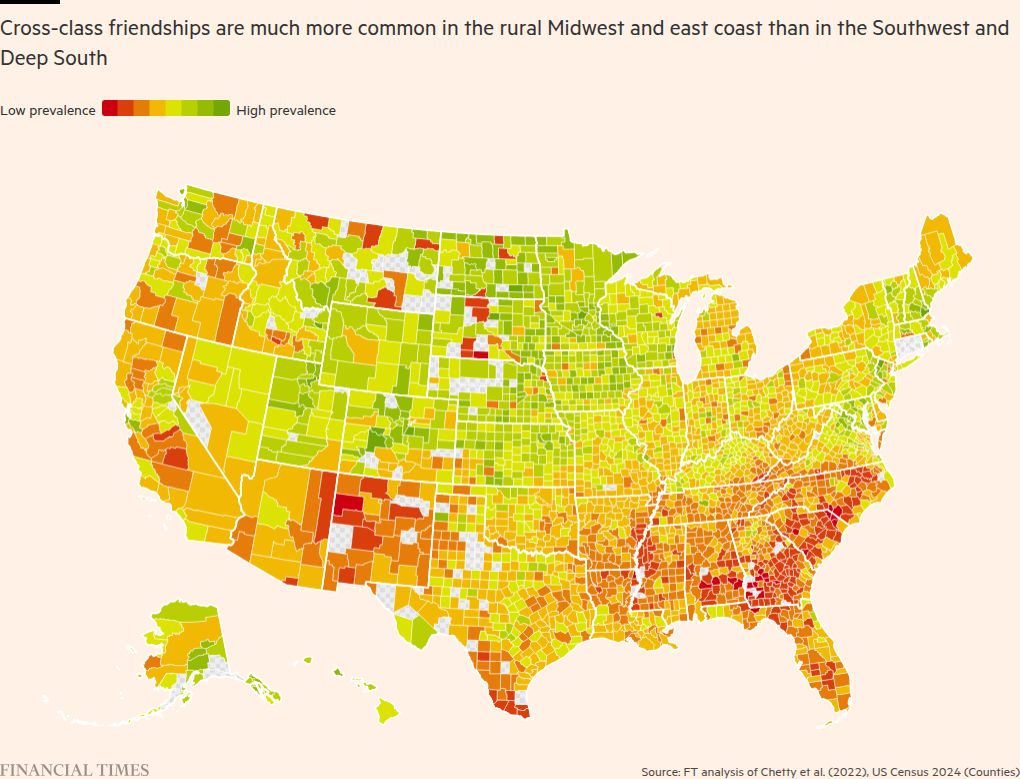
Cross-class friendships, they found, are much more likely to feature in Midwest and east coast social worlds than in those of the Southwest and Deep South. (Note: throughout, I’ve converted the economic connectedness variable into a percentage of low-income residents’ friends who are high-income. Low- and high-socio-economic individuals refer to those with below- and above-median incomes, respectively.)
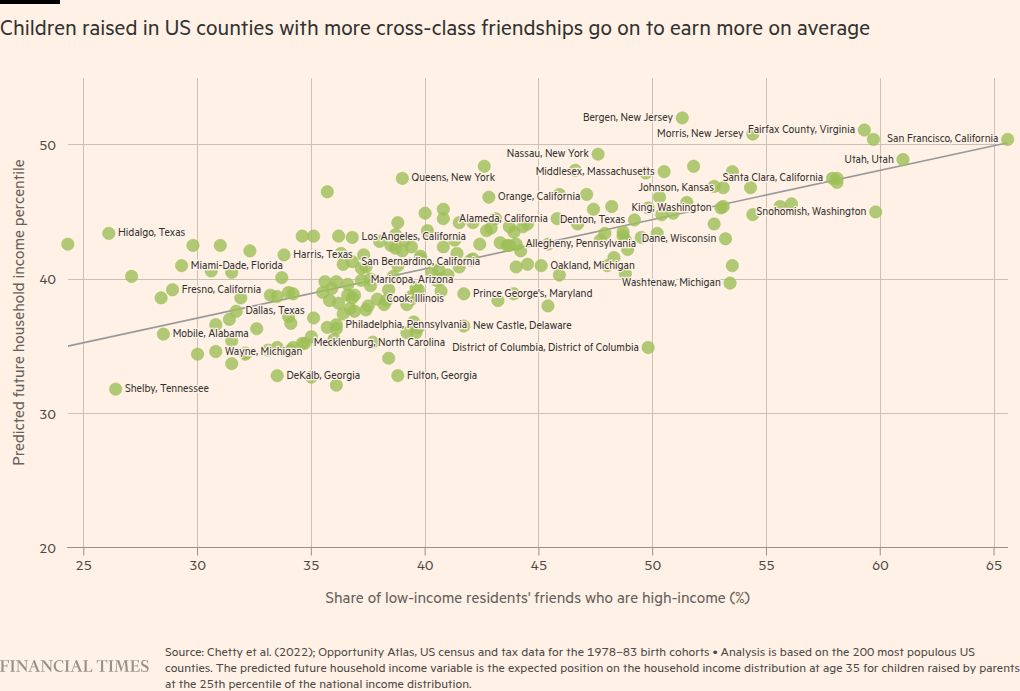
What’s more, children who grow up in areas with more cross-class mixing go on to earn more on average, controlling for parents’ income. To isolate the effect of the county itself, the researchers tracked families who moved. Assuming those moves were not related to their children’s future prospects — a reasonable assumption — the analysis found that people who spent a larger portion of their childhood in a better-connected county went on to earn more.
David Forte, director of research translation and strategic initiatives at Opportunity Insights, a Harvard-based think-tank led by Chetty, told me that a county’s economic connectedness is shaped by two key factors: “the extent to which people from different income backgrounds interact in shared settings” and “the extent to which those interactions become friendships”.
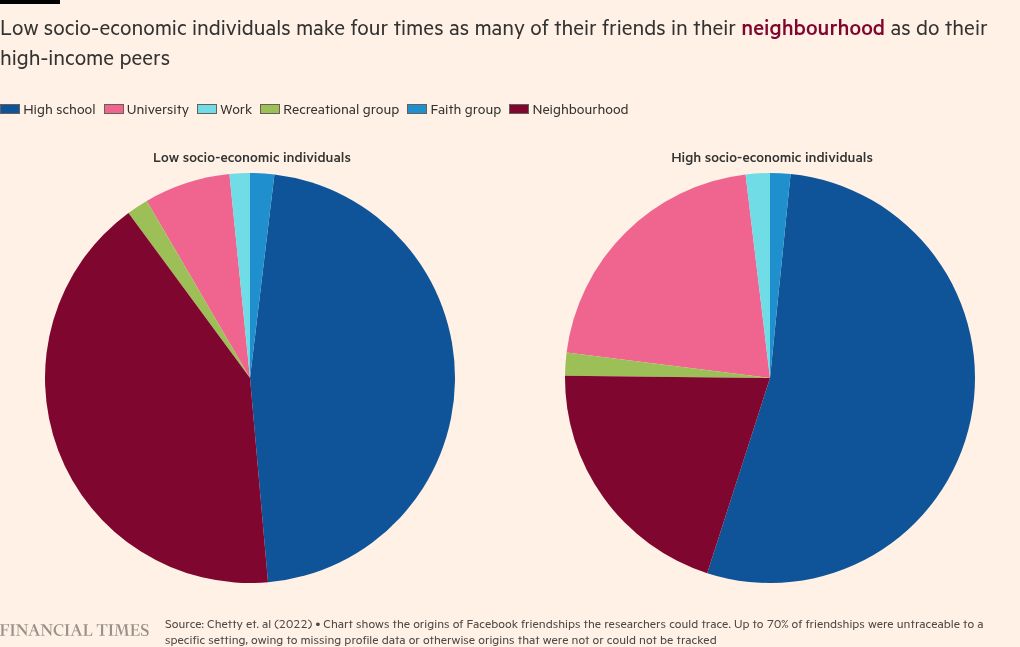
Proximity is a key driver of friendship formation. For most of us, a large section of our social world is formed at school, university and work, though there are differences in the settings in which low- and high-income people pick up friends. Based on the connections the researchers could trace, low socio-economic groups make four times as many of their friends in their neighbourhoods as their richer peers, for example.
Moreover, environments such as churches and sports clubs are particularly effective for integrating people beyond class lines. That said, even in mixed-class settings a “friending bias” pervades, which describes people within socio-economic groups flocking to each other at a higher-than-random rate. In other words, if you put a rich and poor person in the same room, other factors can keep them apart.
Universities, especially elite ones, can transform low socio-economic individuals’ social worlds (of course, conditional on getting in). They are a setting at which people mix much closer to randomly, whether in halls of residence, seminars or extracurricular groups. And though barriers still exist on income lines — such as in fraternities and sororities, whose high-cost barrier to entry can shut out some students — rarely will someone from a low-income background ever again be surrounded by such a concentration of high-income peers.
While college benefits student outcomes through multiple channels — such as upskilling and knowledge formation — “the relationships formed there are likely part of the reason it has such lasting effects”, says Forte. Admission creates “opportunities to build relationships that can provide information, mentorship, shape aspirations and open doors to future educational and career opportunities”, he adds.
This is certainly true of my experience. On my first day in undergrad, a Finn and a Singaporean, now among my closest friends, had asked me which spring internships I was applying for. I did not know what a “spring” was, nor that I should have already started applying. Amid a feeble graduate jobs market and sinking degree wage premium, this “peer learning” may very well be among the strongest arguments for going to university today.
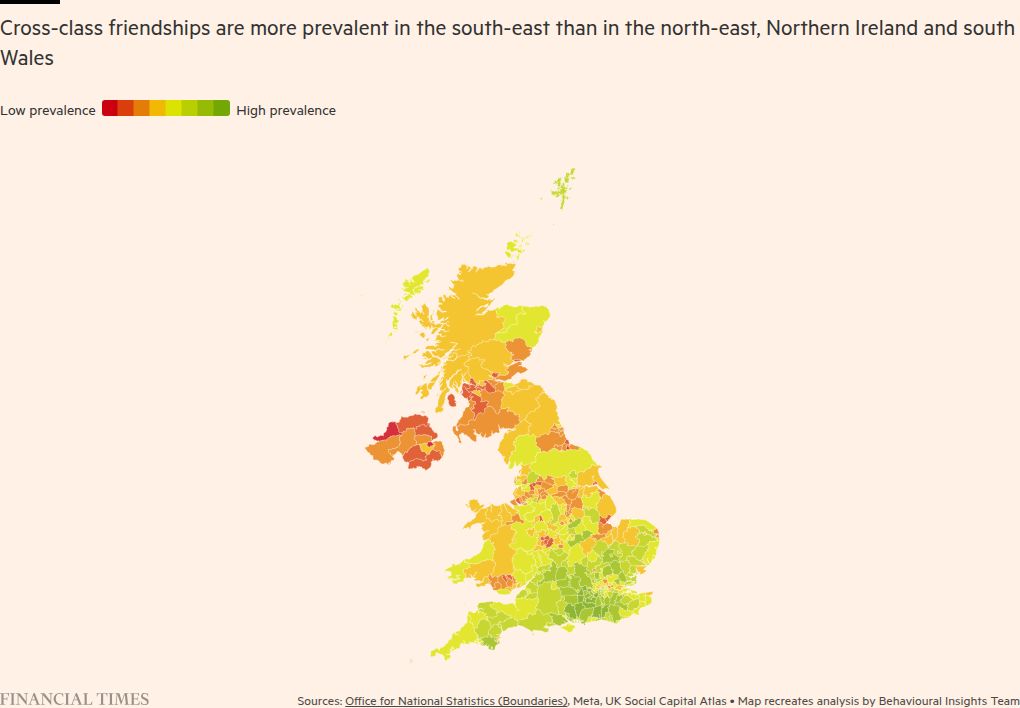
The UK’s Behavioural Insights Team (BIT), Meta and the Royal Society of Arts (RSA) deployed a similar methodology to Chetty to map economic connectedness across Britain. Again, they found that low-income children from the most economically connected areas go on to outearn their peers in the least connected regions.
Nonetheless, there is a geographic divide. “Deprived areas across the country tend to have fewer connections across economic lines,” said Martin Wessel, senior adviser at BIT’s home affairs and social cohesion team. The south-east stands out for its cross-class connections, while communities such as the north-east and south Wales are “rich in bonding social capital, but thin in bridging”, he added.
There are some signs that mixing is getting more rigid. For instance, UK schools are becoming “increasingly income-segregated”, Wessel tells me, with “shrinking catchment areas and rising house prices [creating] wealth barriers to entry”. Most people establish the elemental contours of their social networks in school, which means that whatever inequalities exist there can trail us throughout our lives.
But policymaker efforts to better distribute children between schools could reverse this. One example comes from Brighton and Hove, whose council prioritises free school meal-eligible children across the city over other children in a school catchment area to get a more even distribution of incomes across the region’s secondary education institutions.
Beyond school, “small, practical changes could turn routine encounters into opportunities for cross-class connection,” continues Wessel. This might look like a “family hub class that brings new parents together regardless of income, a youth programme that mixes teenagers from different schools, or a leisure centre that prices activities to reward mixed sign-ups,” he says. In that vein, the American Academy of Arts & Sciences chronicles a list of programmes boosting economic connectedness in the US.
So who knows? Maybe your next unlikely friendship could be engineered by a policymaker.
Send your thoughts to [email protected].
Food for thought
A new working paper provides another puzzle piece to the great mystery of fertility collapse. Fewer people believe that women or men need children to lead a fulfilled life, say researchers.